The Life of Forms: An Interview on Rosa de Areia
António Reis & Margarida Cordeiro, 1989
Interviewed by João Pedro Rodrigues & Amândio Coroado
A special thanks to João Pedro Rodrigues for allowing us to publish this conversation. It was conducted at the time of Rosa de Areia—the final, mighty, and much-misunderstood work of António Reis & Margarida Cordeiro—and until now it has never seen the light of day.
The text was transcribed and translated by Rodrigues himself, with editing and revisions by Bingham Bryant.
António Reis & Margarida Cordeiro, Restored, a comprehensive retrospective programmed by Andréa Picard, runs from May 8-17 at TIFF Cinematheque in Toronto. This is the first stop on a planned theatrical tour of Reis and Cordeiro’s restored films across North America, organized by Cinema Guild and Cinemateca Portuguesa.
Before the preview screening of Rosa de Areia at the Cinemateca Portuguesa in Lisbon, on October 10, 1989, I interviewed António Reis and Margarida Cordeiro with my friend and future producer of O Fantasma, Amândio Coroado, for a planned film magazine that a few schoolmates from the Lisbon Film School were putting together. This interview remained unpublished. Rosa de Areia was only commercially released in theatres recently.
- João Pedro Rodrigues
The great difficulty is always the same: how to speak concretely without the film in front of you; how, with words, to try to approach a film that is an extremely complex form… It is like entering a dark room.
How did you write the screenplay for “Rosa de Areia”?
Margarida Cordeiro: We know the locations quite well. When you have a single idea, you can’t graft a second idea onto it without it feeling artificial. When you have lots of ideas, they start to come together on their own. There’s an internal movement of ideas, neither conscious nor logical… ideas grow and attract or repel one another… that’s how they exist inside the head. One fine day they emerge fully formed, then it’s just a matter of writing them down.
It all happens in a certain way… I wouldn’t say unconscious, perhaps preconscious. Now, it’s not a mechanical process: we don’t write a scene, then add ‘such-and-such’ a scene because it is convenient for someone to come along and say ‘this’ or ‘that’… No, never! Things emerge in an almost mysterious way.
UNIQUE LOCATIONS
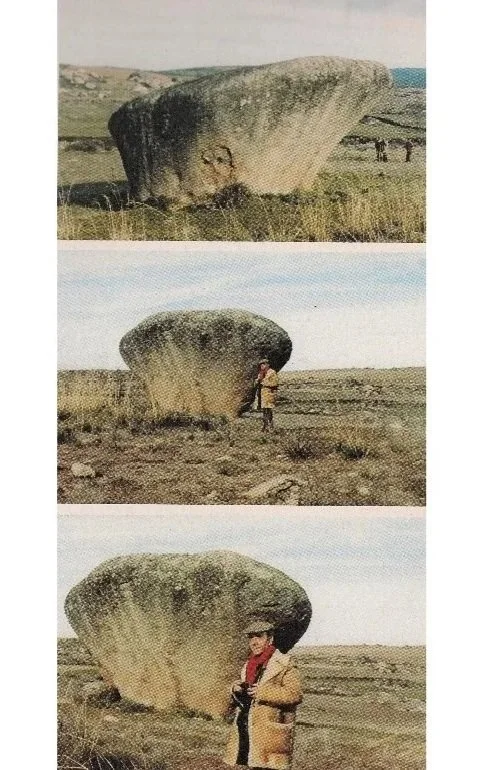
M.C.: The location scouting took a very long time, many trips…
António Reis: We chose everything very carefully. Even during breaks in filming, we’d go out looking for better locations.
M.C.: Most of the locations we chose are unique—you have to film there and only there.
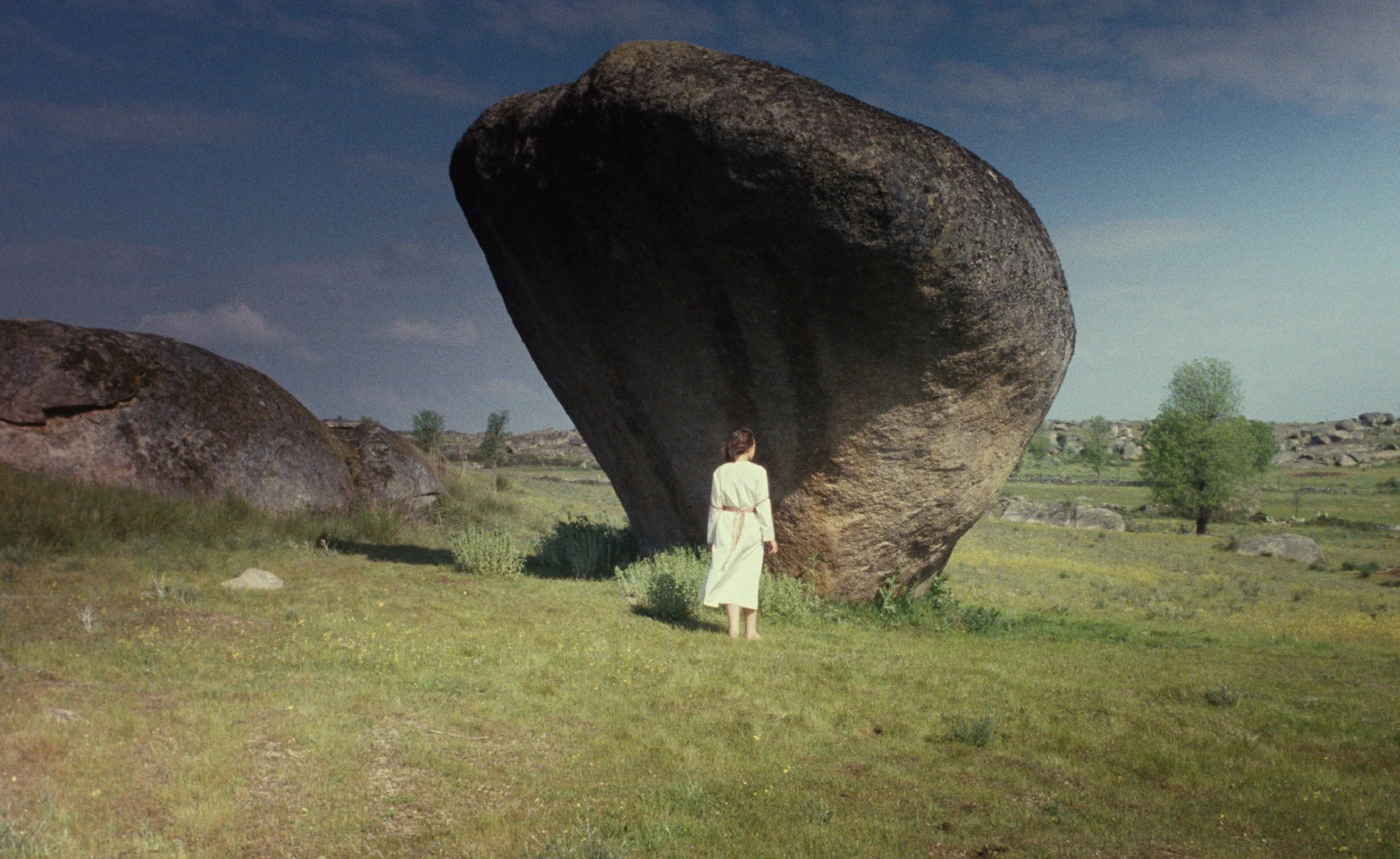
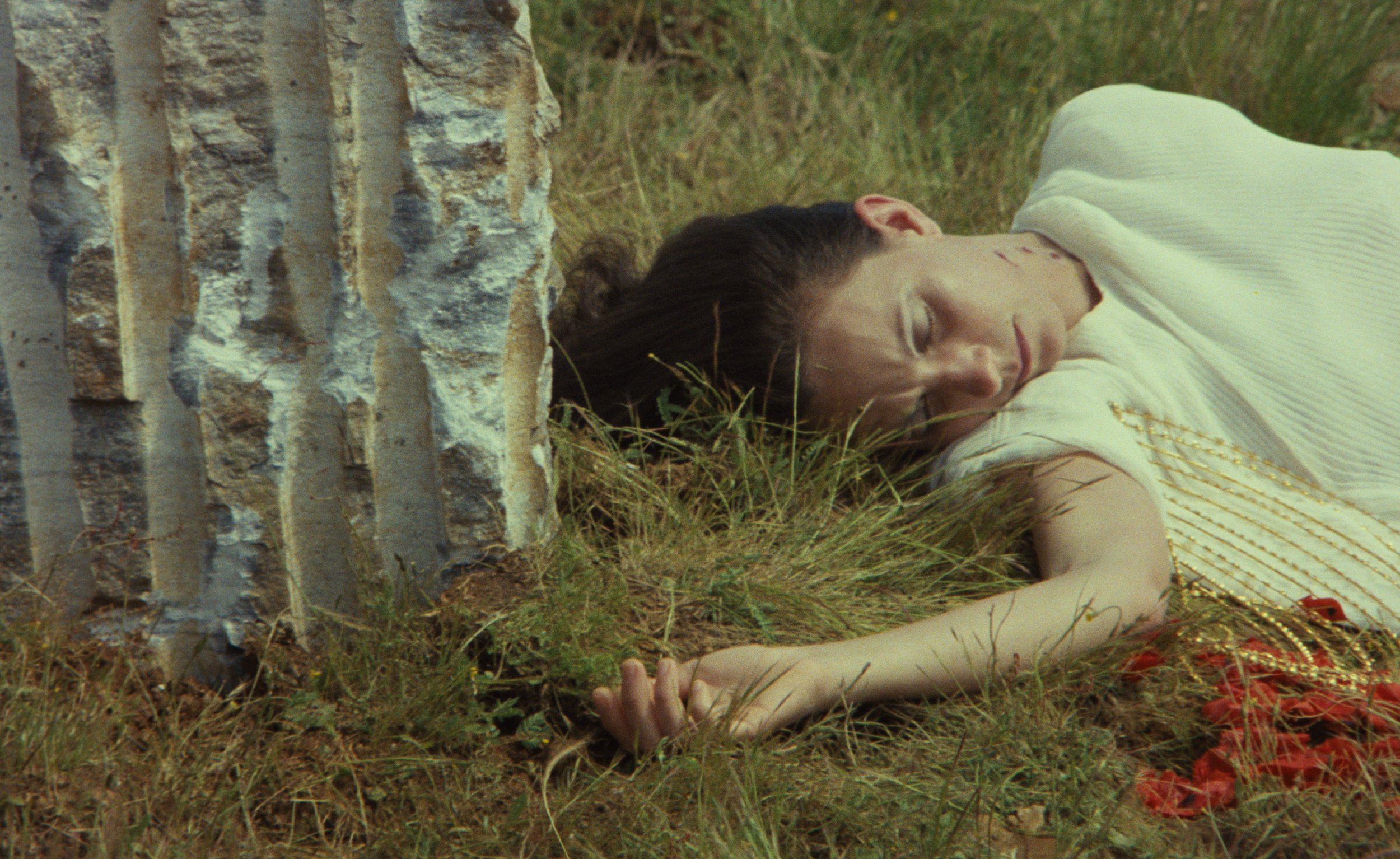
A.R.: As we were already familiar with several places, we compared them and chose the ones that were best from both an aesthetic and a cost-effective point of view. Imagine what it was like to transport the enormous elm trunks standing by the waterfall or the 10-tonne block of marble (it weighed more than our generator truck)—it came from a quarry and getting it into position was almost a military operation.
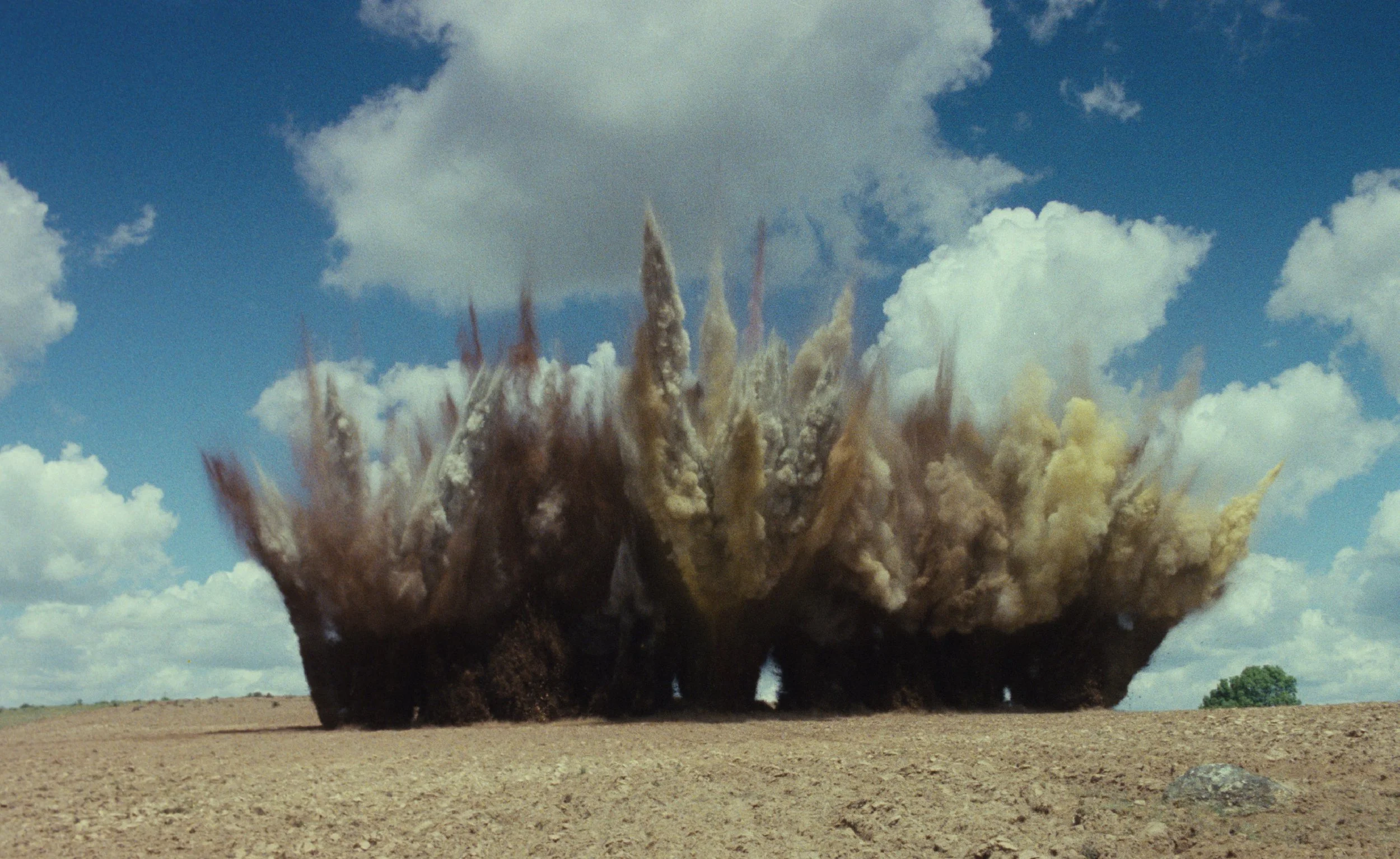
People love the explosion but have no idea what it was to prepare an ‘actress’ like that explosion. The expansion cones, the color of the pigments, the plume, etc. These were seriously studied with specialist technicians to achieve that color palette and pattern in the sky. It was like choosing a costume for a person. The explosion had to ‘perform’ like that; otherwise, we would have had to set a second charge of 50 kg of dynamite, or the shot would have had to be eliminated. Don’t think that it was a fortuitous, natural spectacle. In fact, since Jaime, nothing is left to chance in our films. Everything is rigorously and mathematically studied; what is fascinating is to give the impression that things were found that way.
You had never transformed Nature so much. In the shot of the waterfall, amongst the elm trunks, that stain of ochre pigment on the sand…
M.C.: I don’t know if you noticed that this round stain of ochre is in play with many other elements: in the same sequence shot, with a large clump of yellow flowers by the waterfall. The shot begins and ends with two circles of yellow. There are more circles in the film, drawn or sketched…
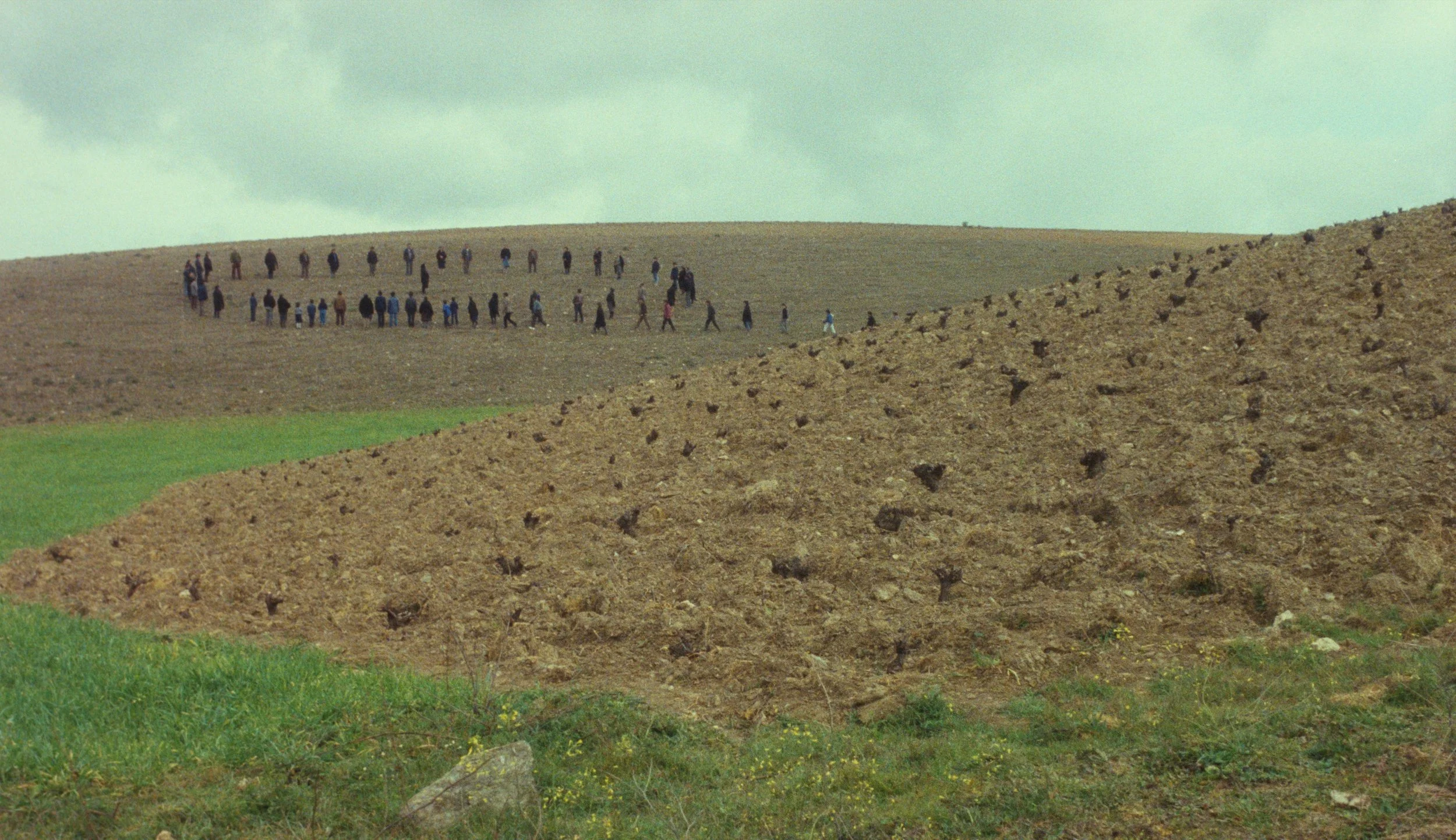
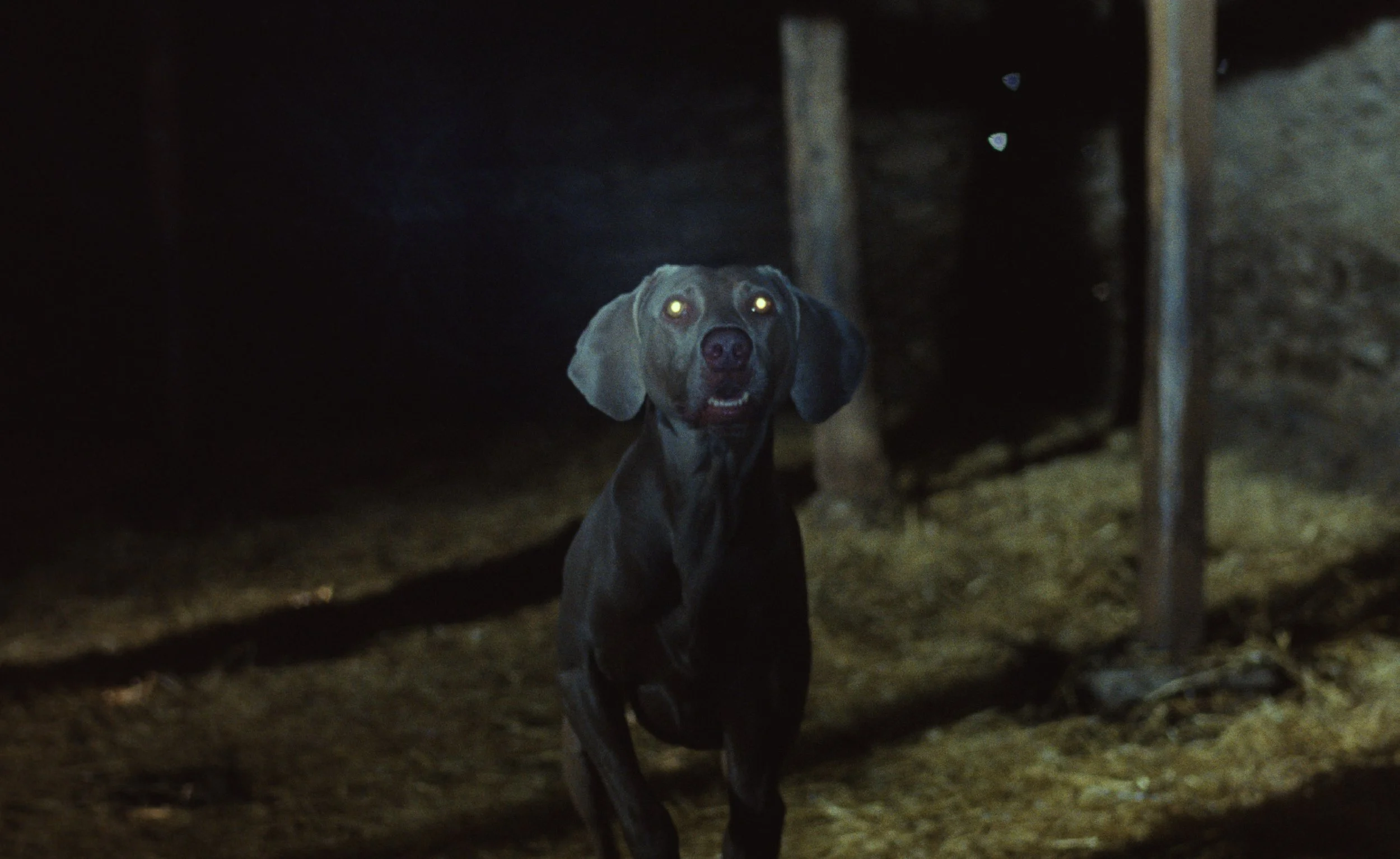
The well of yellow water, the dog’s eyes, the lake…
M.C.: Exactly!
A.R.: That ochre mark emerges as a fundamental chromatic harmony with that black and that red of the young woman’s dress.
Every shot in every film is constructed; none is spontaneous, not even in ‘cinéma vérité’. We tried to take that fact to its logical conclusion without falling into artificiality; at least, that wasn’t our intention.
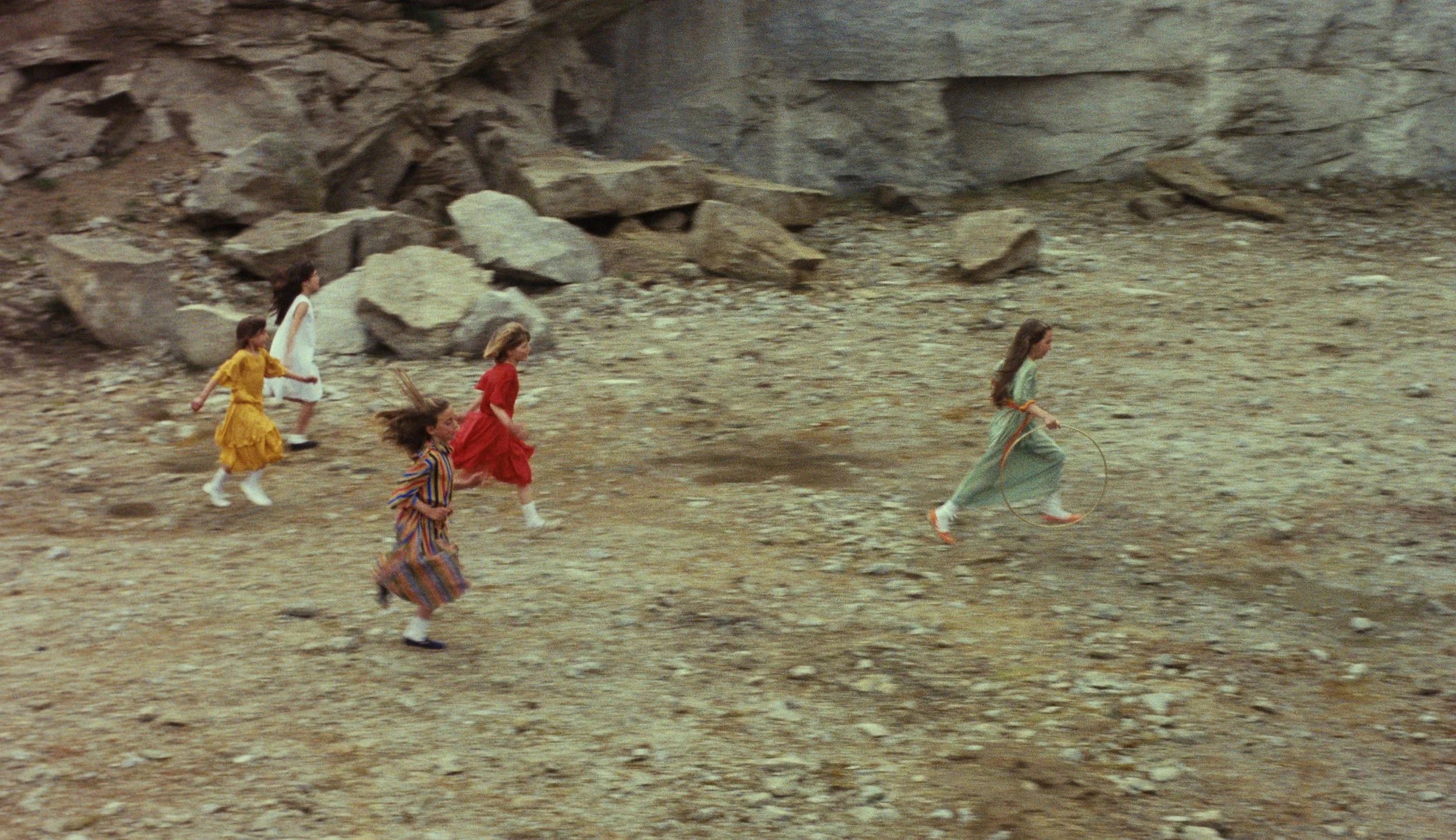
M.C.: In the other films there was already a distancing from ‘realism’. The costumes were already carefully chosen, but in this one there was a conscious concern for timelessness in characterizing the roles—it could be set in this era or any other, it’s a bit random…
Both in terms of time and the place where it is set.
M.C.: The other films were set in the countryside; that was clear. This one is set in the countryside, but a doubt remains—what sort of countryside is this where people dress like this? But I think people accept that quite readily.
You continue to work with non-professional actors.
A.R.: For us, actors are forms amongst other forms, without any particular priority.
M.C.: Just like the texts, which function exactly like the strokes of colour; they are other forms.
A.R.: That is why the use of voices ruled out, from the outset, the possibility of introducing music; the voices are the musical expression of the film. We utilized the actresses’ own vocal potential, creating beautiful dissonances between wan voices—such as the blind character’s—voices with an urban quality, and voices with an almost local tone, like Cristina’s (Cristina de Jesus, one of the actresses). This creates a sort of ‘a cappella’ construction. It is not a mixture of voices, but a use of the specific timbre of each actress’s voice and their relative speaking rates. Even so, they are by no means their real-life voices.
The blind woman’s voice is a sort of beautiful saxophone. We used it for both the ‘on-screen’ and ‘off-screen’ voices. It was the form that interested us. We didn’t mind breaking the rules by using the same voice.
M.C.: There’s no transgression, because there are no rules…
A.R.: Transgression in relation to more or less accepted codes.
M.C.: As we don’t use them, we don’t transgress.
Specifically, how did you work with the actresses?
M.C.: The text was given to the actresses. That’s where we differed: António would have liked to have given it to them a month or two before shooting, I objected. We opted for a middle ground and the scripts were learnt by heart whilst still in Lisbon. Personally, I prefer the actors not to have the text fully internalised. As these aren’t everyday situations, they can’t be explained properly. That would only lead to confusion and even inhibitions.
A.R.: Well, the premise is this: it is not a psychological drama; there is no investment in passionate, historical or political personalities… the philosophical dimension itself is not programmatic.
If it were a film with a passionate plot, the way the actresses would have been incorporated as forms would have been different. Here they would be directed in a different way. To us, they were like rocks, lights, an accident among so many others. It is all these accidents that give the film its overall structure, the scenes, the sequences.
The clothes they wore, the paths they walked, were just as important as what they were going to do or say. They might have had good diction, very clear articulation, and yet be completely out of place within the shot’s structure.
M.C.: In that sense, the dresses helped a great deal because, being stylized, the girls, when wearing them, changed their ‘personality’ and spoke differently.
A.R.: They acquired a certain nobility of being.
M.C.: There were no names or obvious psychological profiles for the characters, and that helped them perform as we wanted, as elements.
You gave instructions on positions, gestures…
M.C.: Yes, and also on intonation. They spoke naturally and we corrected them.
A.R.: There were takes we repeated not because they spoke badly but because it wasn’t what we needed for the film. Sometimes the phrasing of the voice or the delivery wasn’t quite right, so we’d correct it and they’d get it spot on.
It was like fixing a hairstyle: a strand falls out and you put it back in place. They caused very little trouble and, above all, had the great grace never to ask why we wanted them to do it that way.
M.C.: An amazing respect.
A.R.: The clothes were very beautiful, made of wonderful fabrics, and they took great pleasure in wearing ‘their’ pure gold, the shantung, the fine silks… Those materials, which were as important to us as the faces, they enjoyed them too. The clothes always had that enchantment; the actresses had a sort of admirable narcissism.
M.C.: It was the first time we’d done make-up on the characters, but we tried to give it a natural, almost imperceptible look.
A.R.: Yes, but the simple make-up helped the girls in their performances.
M.C.: On top of that, the weather was dreadful. We’d planned outdoor scenes with light clothing, but it was freezing cold. The actors suffered a lot. In the “battle scene”, the boy was shivering so much you could hear it on the recording, and in the final shot, the girls were having memory lapses because of the cold. I think it was the most violent filming we’ve ever done. And stylization came with much bitterness…
A.R.: Lots of sweat and lots of cold.
António Reis location scouting.
In Rosa de Areia, you hardly use the zoom lens at all.
A.R.: Yes, only in the “battle shot”, a very complex shot: it starts with a zoom, then the trajectory immediately transitions into a mechanical tracking shot and pan. The problem was how to move from the immense distance, from that space with infinite depth, to the two-dimensionality and detail of the skeleton. It took us a morning of rehearsals. We shot three takes. Both the chief grip and Acácio (de Almeida, the director of photography) were brilliant.
We have a very tacit way of working with Acácio: we exchange very few words, he immediately understands what we want and he was fully committed to this film.
What sort of instructions did you give him?
M.C.: He’d read the script pages, which are always succinct, with or without dialogue. He’d grasp the atmosphere we were aiming for: a certain perfection, the sublime, the beautiful, the sad, the tragic…
A.R.: As the editing was already planned out and he was getting a sense from what had already been filmed—the rhythmic flow, the color scheme, or the internal timing of the shots—he immediately adapted to the right tone.
M.C.: And we often made the camera movements with Acácio, before filming.
Did you get to see the rushes straight away?
M.C.: António watched the first batch of rushes in Bragança a few days later, but it was impossible to carry on because it was too far away. You retain a memory of everything you’ve done, even months later.
A.R.: We usually divide the work like this: Margarida controls the mise-en-scène and how things look on the video monitor attached to the camera, and I watch it live. Then we go make a synthesis of what we think is good and bad.
M.C.: We mustn’t forget that Trás-os-Montes was a colour film edited in black and white…
A.R.: Despite everything, we have our compensations and, to this day, we’ve never failed… it could happen. But I admit that it’s a real shame not to be able to watch the rushes and listen to the recordings. It’s very frustrating to work far from the laboratories because there are things that can be fatal.
How long did the editing take?
A.R.: About two months: we edited it more quickly than the others.
M.C.: It only has 87 shots.
A.R.: We did the editing ourselves. We always do everything ourselves, but this time we had a wonderful collaborator, Manuel Mozos, who did the assembly.
M.C.: Editing is essential in films like this. I cannot understand how an auteur film could be edited by someone else.
Did you cut out any shots?
M.C.: Yes, we tried to keep them but they weren’t right; the film couldn’t support them. The order of the shots was completely changed from the original outline. Some sequences remained as they were, others moved from the first part to the second and vice versa.
A.R.: There are sequences which, due to their structural tone, were homogeneous, but even so, the place where they ended up in the film is not the one that was initially planned.
M.C.: Which proves that they work formally.
A.R.: A film like this, in which the structure is simultaneously melodic, harmonic and star-like, has such a specific unity and style that it rejected those seven or eight shots, which were truly beautiful. The film imposed its own laws on the directors. The greatest joy is that those shots did not make it into the film. If you remove a few frames from a shot, I don’t understand why, with the same legitimacy, you wouldn’t remove shots from a film. In one case it’s a microform, in the other a macroform. And, when necessary, it’s possible that more shots will have to be filmed to complete the film’s structure.
There is no doubt that the life of forms is very powerful. What is wonderful is how it conditions and, at the same time, grants all that freedom.
The film’s construction is above all elliptical. There are scenes which, paradoxically, are constructed from autonomous shots. For anyone with a traditional concept of scenes as spatial, thematic units, etc., this will raise many problems of analysis. We’re not afraid of anything; we’re ready for both the best and the worst reactions.
M.C.: People are unaccustomed to cinema that requires a bit more effort to watch. Either they’re used to music videos—what I call the ‘universal sauce’ system—or to the traditional narrative thread where they can easily project themselves onto one of the characters. It’s a psychological law; even we function that way.
A.R.: People have almost no senses left; they mainly have a taste for food, and even that has gone bad…
M.C.: I’m an optimist, António is a pessimist. People are intact; they just don’t know how to use the potential they have within them.
A.R.: Yes, but let’s use the proper term: it’s a cultural genocide against people’s sensibilities.
M.C.: No, genocide means killing, and people aren’t dead, they’re asleep; it’s hard to reach them. I have doubts our film will manage to do that.
But people might find the film beautiful.
M.C.: But I don’t know if that will be enough. I travel a lot on public transport and I see what people are reading: it’s all so superficial, so light; I don’t know if people at home will have time to read more serious things. Those who read ‘Selecções’, ‘Maria’ or ‘A Bola’, I don’t know if they’ll enjoy watching films like ours. But is this only the case with cinema?
A.R.: No, it’s the same with all the other arts. If someone goes to see a film—and I’m talking about the great classics—just to follow the plot, that’s not enough. The plot is just one of many cornerstones of a film, and if it’s just for the story, then it’s not worth watching. Literature has been telling stories for millennia.
M.C.: We are by no means against that kind of cinema, but we believe there are other paths for cinema.
A.R.: A more or less academic concept of script has been established. The history of cinema shows that this concept has become richer and more complex. It is in this sense that our film has a script.
COMMANDO TEAM
M.C.: Until now, we’ve never worked—as António says—with a ‘commando team’, where people invest all their energy into the film.
A.R.: You can’t bring the habits of everyday life into something as life-threatening as making a film, a film like ours.
M.C.: When people make a commitment, they should see it through, which isn’t always the case, as was the situation here.
A.R.: But the core members of the team held up admirably. It was moving to see the key people responsible for the film, from pulling up weeds to felling trees... we did everything. But I think we managed to make the film we wanted.
x