Introduction to ‘The Leucothea Dialogues’
Minna Zallman Proctor, 2025
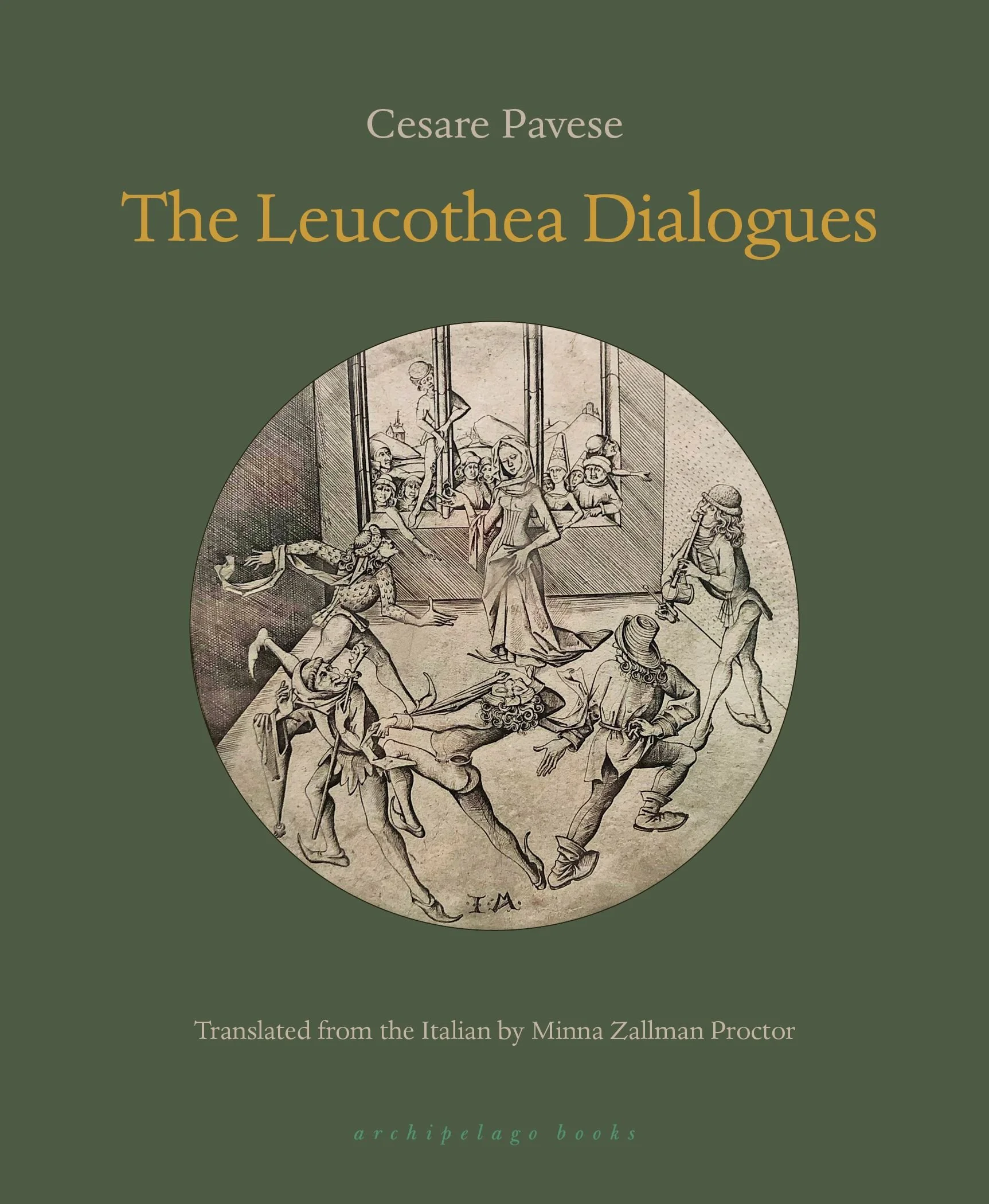
The Leucothea Dialogues by Cesare Pavese, in Minna Zallman Proctor's translation from Italian, is available from Archipelago Books.
Special thanks to Jillian Kravatz, Sarah Gale, and Proctor for permission to republish the book’s introduction.
This text accompanies Archipelago Books x The Theater of the Matters: These Encounters of Theirs, a special 35mm presentation of the film by Jean-Marie Straub and Danièle Huillet, adapted from Pavese’s text, taking place at the Brooklyn Academy of Music on December 10, 2025.
THE INTRODUCTION THAT FOLLOWS IS NARRATED BY ARACHNE, ON BEHALF OF THE TRANSLATOR. Before relinquishing the stage, the translator would like to acknowledge that the author and many characters in this book died by suicide. There is biographical evidence substantial enough to support one interpretation of this complex work as, if not a preamble to the Author’s suicide note, then at least a detailed philosophical exploration of the meaning of life and death—with human mortality and divine immortality as inextricably twinned embodiments of the debate. Because the Author wrote his last words on the title page of this book and set it beside him on the nightstand of the otherwise empty and anonymous hotel room in which he took his life, it is difficult not to assume that he meant this book, too, to represent his last words. What’s more, just days before his death the Author wrote in a letter to a dear friend: “If you want to know who I am now, reread ‘Beast’ from my dialogues.”
“Beast” is the story of young Endymion who was imprisoned by Artemis in a perpetual sleep, because she thought him pretty. He’s exhausted, deranged, and frustrated by Artemis’s refusal to smile at him the way she did when they first met: “If she would only smile again, I would bleed for her, be the flesh in her dog’s mouth.” Tortured by the goddess’s unkind love, Endymion asks, “Have you ever known someone who was many things at once, who contained all—every gesture, every thought you’ve had about her—who holds vast things from your world, your sky, and your words, memories, days past you’ll never know, future days, everything you’re sure of, and another world, another sky that you can’t have?” He continues, “What if she were the beast, the wild thing, the untouchable nature that has no name?”
But who really is the Beast in this equation? The goddess with her fierce incomprehensible passions or the trapped, sleepless youth driven mad with love? Who is the animal? Who is the “wild thing”? And who is the Author, hunter or prey?
The great Sicilian writer Leonardo Sciascia said, “A man who dies tragically is, at any moment of his life, a man who will die tragically.” The end colors everything that precedes it. There is an irresistible invitation to speculate, and yet, there is also something sordid about trying to find an explanation for personal tragedy in a work of literature, even one that vastly contemplates life and death. In the years after Pavese’s suicide, Natalia Ginzburg, another of the Author’s closest friends, resisted the urge to pitch an explanation and instead made this observation:
He didn’t have any specific motive for killing himself. However, he’d assembled a variety of motives, adding them up with lightning precision, combining them this way and that, proving to himself that from any angle the result was the same and therefore definitive, a decision he confirmed with that wicked smile. He also gazed beyond his own life into the future to see how people would behave with respect to his books and his memory. Like those who love life and don’t know how to detach them- selves from it, he looked beyond death and imagined death to the point where it was no longer death he imagined but life. In any case, he didn’t love life, and his gaze beyond his own death was not driven by love of life but rather a shrewd calculation of circumstances so that nothing, even after he was dead, could take him by surprise.
TRANSLATOR’S INTRODUCTION IN ONE ACT
Arachne enters center stage, emerging into the spotlight from total darkness. She takes a seat on a plain wooden stool. She looks uncomfortable, and then stands again. She will disdain the stool for the entirety of her monologue.
ARACHNE:
Here’s the story… This is a story about a translation of the book, Dialoghi con Leucò, a story I have to tell, because the translator [gestures vaguely to the wings] is so exhausted, she couldn’t bear to explain one thing more. But if you ask me, she couldn’t bear to understand one thing more. It is an unusual book. Here’s the story: Cesare, ch-ey-SAH-ray, Pavese, pah-VEY-sey, was an Italian poet, novelist, and translator. He is a great hero for figures like me, who don’t exist without people to write about them. I would have thought I’d be a hero to him too, as a story weaver myself and all. You’d think I was a hero to him, but he never wrote about me so… So so so sew. So that makes me the perfect choice to introduce him. I am unbiased [makes a snorting sound, pauses for laughter]. As you all know, “without bias” is a myth.
Mostly Pavese wrote poems and novels about very ordinary things, about cats and young women, unattainable love, village life, death, and about the war—because that’s what was going on in Europe in the nineteen thirties and nineteen forties when he was writing. Some say his most important work was his debut poetry collection, Work’s Tiring; others claim it was his last novel, The Moon and the Bonfires, which was published in IDED, the year before he died at only forty-two years old. No one ever claims his most important work was a peculiar little collection of twenty-seven lyrical dialogues featuring the gods and heroes of ancient Greece, Dialoghi con Leucò… Hold on—parenthesis.
(That title literally translates as “dialogues with Leucò,” where Leucò is short for Leucothea, the sea nymph whose name was Ino when she was mortal, before she threw herself off a cliff with her baby son in her arms to escape the curse of insanity that Hera had put on her. Sometimes she’s referred to as the White Goddess. People, especially women, are always throwing themselves off cliffs in Greek tragedy and mythology. Though that’s not how I went, and that’s not how Cesare Pavese went.)
It’s probably also important to parenthetically mention that the translator is proposing an entirely different title. She likes changing titles and always has excellent and long-winded reasoning to justify it. Nothing I’ll bore you with. She calls the book The Leucothea Dialogues. [Shrugs.] I guess that sort of makes sense even without a tiresome, self-important justification. That said, this translated title doesn’t really accurately represent the original title, and when you start changing things like that, someone might complain that you’re challenging the real author—like you’re saying to them, “Hey, you know how you titled your book in this slightly obscure way, using the nickname of a slightly obscure goddess? Well, I have a better idea.”
I’ve “heard” that comparing yourself to gods can make them mad. And for a translator the dead author is a kind of god—the unreachable, singular intelligence who created the world that you’re supposed to re-communicate in a whole new language? But then again, although Pavese acted like a god—all writers do—he wasn’t really an immortal, otherwise he’d be here fighting his own battles.
I’d say he’s more of a myth, an immortal myth.
Looks at invisible person sitting on the stool and grins.
You see how I just brought things back around to mythology?
Turns attention back to the audience.
As I was saying, no one ever claims that these dialogues were Pavese’s most important book. When the book came out in Italy, there were hardly any reviews or letters from colleagues eager to discuss. He was terribly disappointed, but also perversely pleased. In a letter to a friend, he wrote, “No one dares speculate about the meaning of my book—and that delights me to no end.” To one of his unrequited loves, he wrote, “I want you to understand it, and it’s a bitter thrill that you don’t.”
But all these years later, seventy-five years later in fact, people still can’t shut up about these dialogues. They’re “unreadable.” They’re “difficult.” They’re “allegories.” They’re “autobiography.” They’re “a suicide note.” They’re “a mystery.” So many theories and academic papers and doctoral dissertations and unresolved Reddit forums . . . [Yawns.] Look, Italo Calvino wrote that “a classic is a book that has never finished saying what it has to say.” Which maybe sums up what’s happening here. It does strike me, however, that all Reddit forums are essentially unresolved.
Either way, there’s this important, complicated book by a dead white European man and everyone with a robust tolerance for dead white European men is either fascinated by it, or repelled by it, or [shrugs] I guess maybe hasn’t heard of it.
So, the Italians said to the translator, “These dialogues are so incomprehensible, hermetic, intentionally difficult . . . We can’t even understand them in Italian, how will you translate them?” Maybe there’s also the implied question, “Why will you translate them?”
I can tell you [lowers voice and leans forward to share a secret] she didn’t really have an answer. Not a rational one, anyway.
Translation is a world of pain… You have to understand what you’re translating—or what comes out is second-degree gibberish—and this text doesn’t give itself away. That’s why she’s off resting [nods toward the wings again]. You can’t translate incomprehension or ambiguity, secret references, private symbols, invented idioms. You have to parse and then re-create. Create it all over, as if from scratch, as if you were the author—as if you could ever inhabit the mind of another person. The hubris.
She disengages. Turns her back to the audience for a moment, then walks in a dreamy circle around the stool, coming back to face front, a refreshed expression on her face.
I keep thinking about that “wicked smile” from the Natalia Ginzburg quote. He didn’t have any particular motive for killing himself. However, he’d put together various motives, adding them—combining them—proving to himself that from any angle the result was the same and definitive, a decision he confirmed with his wicked smile. Do you know that smiling appears forty-four times in this book? And in none of those occurrences does it ever have to do with a joke or joy. It is a wicked smile. It has divine properties. The gods smile and marvel to each other about how none of the mortals know how to smile. I think that this wicked god-smile has to do with knowing—knowing something so definitively, so fully and absolutely, that you have no choice but to accept it. You know and understand and accept it all because that’s just how it is. [She smiles broadly.]
On the topic of Italo Calvino, let’s talk about me for a minute. Since Pavese didn’t. [Pauses thoughtfully.]
Do you think Pavese was jealous of me? I am quite a renowned storyteller. [Makes weaving motions in the air above her head like a spider.]
Either way, let’s take me as an example. According to my biographer Ovid [swooning a little and fanning herself], in my looming contest with Athena, I wove stories of the gods doing their basest, most criminal things—all that raping and deception, jealousy and impatience. Whereas she loomed stories of the gods viciously punishing mortals who challenged them. Got it? She was trying to induce holy terror. I was inciting people to irreverence and moral relativism. At least, this is how Italo Calvino breaks it down in his critical commentary on my biographer.
Calvino says it’s a mistake to think that because Athena gets so mad about me beating her in the weaving contest that Ovid is telling a story about Athena’s absolute power. And it’s also a mistake to think that Ovid is casting me, little old me, as a hero, just because, obviously, I’m the more sympathetic figure. I also think it’s confusing in terms of moral coding, because I was, strictly speaking, a suicide. True, I was driven to suicide by Athena’s wrath. But in the last moment, she saved me. She took pity on me. An ambiguous salvation… to be turned into an immortal spider.
[Assumes a flirtatious pose.] I look pretty good for an old spider, though, right? Bear with me, this is what Calvino says about Ovid, and about gods and mythology: [takes out a notebook and puts on her reading glasses if she isn’t already wearing them]
Ovid’s Metamorphoses aims to represent all that is worth telling of what has been passed down by literature, and with all the force of images and meanings that this implies, without deciding between the various keys in which it can be read—in accord with the ambiguity that is proper to myth. Only by giving a place in the poem to all the stories or implied stories that flow in every direction, that push and shove to channel themselves into the well-ordered expanses of his hexameters, can the author of the Metamorphoses be sure of presenting no partial design, but rather a living multiplicity that excludes no god known or unknown.
That’s very generous of him. [Puts away notebook.] A living multiplicity that excludes no god… Gives a place to all the stories and implied stories. That’s the kind of book that can’t finish saying what it has to say.
She hangs her head and grows very still. After a moment, she quietly continues.
Suicide is ambiguous. The person who dies leaves their pain behind for everyone else to deal with. [Shakes head.] But I don’t think Pavese really thought he was escaping anything when he took his own life. Because all the mortals in his book are disappointed in their afterlife. And all the immortals in the book are terribly emphatic that mortality itself is a precious gift, the one thing humans have that the gods don’t. They’re always complaining about how humans have the unique capacity to value their fleeting existence, the moments past, the moments to come. Pavese’s gods get very angry when the humans take that for granted. You see, it’s ambiguous, and the ambiguity isn’t vague, it’s faceted, it’s a living multiplicity!
Why did Pavese leave his odd, cryptic suicide note (“I forgive everyone and ask everyone’s forgiveness. OK? Don’t gossip too much.”) on the title page of this book and place it on the nightstand beside him in the anonymous hotel room where he took his own life?
During the final few moments of the monologue, the stage has been growing darker, and the spotlight on Arachne more intense. She is practically a floating white face, cut with fierce shadows that make her look even more like a spider.
I think it’s because he didn’t want resolution. Like Ovid, he wanted to contain all the stories he’d told and the ones those stories implied, a living multiplicity that extended far beyond his own self.
The spotlight extinguishes. Arachne delivers her last line in complete darkness.
He never wanted to finish…
xx