Cathédrale de Verdure: An Interview with Jean-Pierre Duret
Dylan Foley, 2025
Interpreted by Hicham Awad
Of the many forces which the films of Jean-Marie Straub and Danièle Huillet resist, near the top is the overburdened visual field of modern life. Their art forged towards the smallest cinematic unit, as Rilke did with writing: “I too must find a way of making things; not plastic, written things, but realities that arise from the craft itself. Somehow I too must discover the smallest constituent element, the cell of my art, the tangible immaterial means of expressing everything.”
Informed by the peasantry and landscapes where they filmed, Huillet and Straub’s form moves in a time signature at odds with the city dweller’s rhythm. German philosopher Georg Simmel described the urbanite’s sensory bias as an emphasis of the eye’s activity over the ear’s, a consequence of the rise of public transportation, where people are forced to sit and stare at strangers without exchanging a word.
Simmel also remarks however that, “someone who sees without hearing is much more uneasy than someone who hears without seeing.” Huillet and Straub understood this deeply, from their use of direct sound to how they treated a text first as a musical composition before focusing on its story. No member of their crew was more instrumental in the battle against superfluous visual stimuli then, than the person recording sound.
Jean-Pierre Duret worked as Straub and Huillet’s sound engineer and recordist beginning in 1999 on Sicilia! after their regular collaborator, Louis Hochet, passed away. He worked with them for over twenty years on films such as These Encounters of Theirs, Workers, Peasants and Umiliati. In anticipation of the Theater of the Matters’ screening of These Encounters, we spoke with Jean-Pierre about their collaboration.
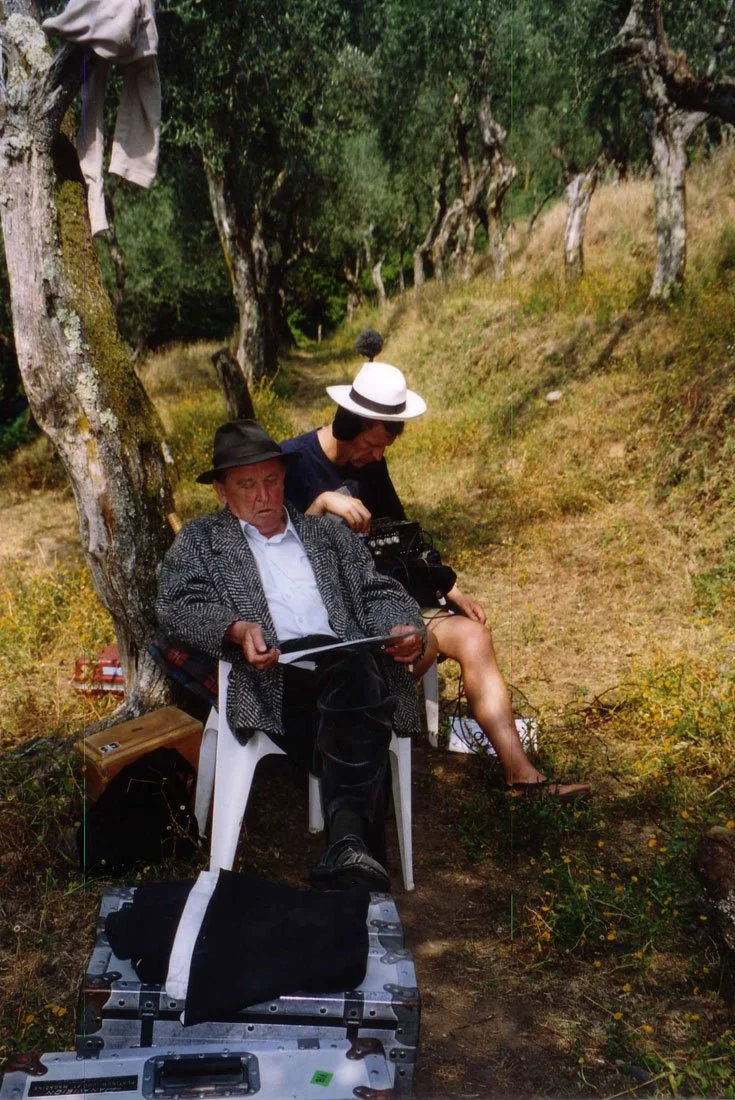
Jean-Pierre Duret (behind) on set with Jean-Marie Straub
Dylan Foley: What was your first encounter with Jean-Marie and Danièle like?
Jean-Pierre Duret: William Lubtchansky, the director of photography, introduced me to them to replace the sound engineer they were working with at the time, Louis Hochet, who had just passed away. They invited me to attend the premiere of Sicilia! in the town of Buti in Tuscany.
When I first met them, they were very worried because it was the first time they were working with someone new. They had their previous engineer for a while and were trepidatious about it. They asked me questions about the way I worked and what equipment I would be using because Hochet used a Nagra while I was mostly using a digital audio tape and a counter at the same time.
Eventually, I proposed to work on two-track stereo and not one-track mono like their previous films, but when we first started working together I made no specific demands. On the first day of shooting, during this kind of long, introductory scene, the sun was setting and I had to pull back my microphone because of the change in the light. I brought it to their attention and Danièle stopped the shooting to listen to all the takes, which they did all the time. They listened to all the takes in their entirety. After she finished, she pulled down her headphones, smiled and told me I did a good job.
This ceremonial aspect was very important, with Danièle always half-listening and Jean-Marie walking. After she pulled down her headphones and smiled at me, Jean-Marie held me very tight. He gave me a lesson about the voices that are outside of the field of the frame, la voix off. He wanted me to record these voices with the same presence as I would someone in the frame, diegetically.
Jean-Charles Fitoussi said you were the first to suggest working with a second microphone because you wanted to record the sound of a river. Did you encounter resistance from them after suggesting this? Straub was against sound mixing and the frictionless quality it creates but also against any systematic approach.
The Straub’s gave an immense freedom to their collaborators. There was no conflict. When I proposed that, it was because I had watched their previous films closely at the Cinématheque before working on Sicilia!
I noticed the presence of birds, nature, water and wind in them was as significant as that of humans. So when I started recording the voices of the actors, the levels were very important because it wasn’t melodrama, it was people being outside in the landscape. So I thought nature should seep into the human setting but also for their voices to be part of the landscape. I suggested that the second microphone should be far away from the scene in order to catch the elements and the birds, the water and the wind.
I wasn’t mixing after shooting per se, it was more a mixing of direct sound as I was recording, because what happened diegetically in the shots was important to the Straubs. Direct sound was very important to them because space and—more than anything—time was important for them, the time of the shot.
The sensual quality in their films comes in large part from direct sound, it often goes back to the basic elements of the wind, water and earth, as you’ve said. Do you remember any of the conversations you had with them about direct sound?
The conversations weren’t so important as the way they worked, how they saw and trusted their collaborators. Confiance was essential. They took their time to get to know their collaborators, but it was also about me encountering them and getting to know them as they did me. There was a great level of respect for the work that I did as well as the work of their other collaborators.
They never permitted themselves to say, “this is the way to do it.” They believed in their collaborators and their way of working. It goes back to the ceremonial aspect that I mentioned, whether it was Danièle listening to what was recorded or watching the rushes, with sound or without.
And this resonates also with the work they did with the text and their actors, how they read and delivered it. They worked on the music of the text, not the psychology of it or the characters; the musicality and intonation of how the text was spoken was more important than the psychology behind it. And this was the same way they worked with their collaborators. It wasn’t about psychological direction.
Straub compared the work of the text and the actor to a glade in thick forest, a clearing. This was striking to me, that the text should function like a clearing, that it should allow the light and sun to come in. Focusing too much on acting, especially in a psychological register, and not on the text, blocks off this clearing in the forest. It blocks off all the elements around it. Focusing too much on emotion creates un ligne directe chemin, a linear path that goes one way and doesn’t allow for contingencies or this open space in the forest. The importance they placed on working with the text as opposed to psychology and emotion allowed this clearing to be rendered.
And this is something they said about Bach, they called his compositions une forêt en marche, a forest in movement, walking from one place to another. I found this image magnificent.
When you met this couple and spent time with them, the films they made but also beyond that, the way they thought and felt about cinema, the intensity they had, how they devoted their lives to cinema—they lived in poverty, the money they got from their films they poured into the next one they were making, often they were eating one meal a day—they channeled everything into the film and how to make it.
I would see them on set looking at the sky for 10 or 15 minutes without saying a word. Then they would narrate all the sounds they heard and describe what they saw with such intensity and precision. I learned more from this than any indications or being told what to do and what not to do. To live with them, to watch how they carried their lives, contemplated the way they lived and how they viewed cinema, that helped me form my own sensitivities.
Can you talk about your experience working on These Encounters of Theirs? A lot of these qualities manifest in the force and musicality of the non-professional actors who were workers from the area and had already staged the dialogues as a play.
I knew all the actors on These Encounters except two, from Sicilia! It was my fourth film with Danièle and the last. The framework was this small town of Buti and most of the actors were Sicilian. Their voices were the voices of peasants which was very important to me since I’m the son of a family of peasants. Before they said anything and before the text arrived, came the sonic and phonic quality of the voice. Their voices had their own stories, the quality of the voice itself tells its own story and serves as a record of their lives. The voice is the most intimate thing we possess, whether we like it or not, it’s what represents us the most.
There are two types of voices: as we hear it or voix de gorge and as it is heard by others. André Malraux talked about the voice we perceive and the voice perceived by others, the voice in the atmosphere, as it is heard in space. The difference between my voice as I hear it and as it is heard by others constitutes the experience of the human condition.
I heard their lives in their voices. That’s something very dear to me about my job, hearing this distinction of their lives and stories in the voices themselves. I’ve maintained relationships with some of them as well, we would have dinner together; they possessed extraordinary voices.
You mentioned it was the last film you worked with Danièle on. Straub said that nothing would have worked without her, that their partnership was how they managed to resist for so long. Did you feel any changes in the filmmaking after she passed?
It’s difficult to talk about. After her death, Jean-Marie didn’t make feature films, it was something that belonged to them together as a couple. Danièle transmitted something to Straub’s second wife, Barbara. She told her to take care of Straub. Jean-Marie was a poet in his own reality and the way she took care of him was essential. He would have let go without Barbara’s presence in his life. The passing of Danièle marked the end of any big projects or feature films.
Jean-Marie lived, manifested, and represented the hopes for freedom and liberation. He was someone who committed a lot of acts of resistance: he deserted the French army, refused to fight in the Algerian war, refused the draft. A film like These Encounters pays homage to this ethic in civilization of the peasant that was being destroyed at the time. Of course there are many critiques one can level at that, but the peasant’s way of life has a very important role in the relationship between man and nature.
Right after the 70s, when the political hopes were diminished from the effects of raging liberalism, the destruction of nature, the effect of that on peasants and so much else…it didn’t create a defeatist moment per se but Jean-Marie didn’t know how to respond, though he never said that outright. But there was work to be done, the work they had to do as a couple. And really they were doing it before then. At this point of extreme liberalism and the destruction of nature, they did the work they had to do. His Marxist ideals and commitments, his acts of resistance were all reflected in this film through the homage he paid to the peasant.
This reminds me of what Daney said about sound in their film. He speculated about what a peasant cinema would look like and said Straub and Huillet re-educated our ears from the training of mainstream film music and dialogue by using subtle, “weak” sounds like the wind and the river. Is there anything you miss today about their style of making films?
Of course, there’s a lot that I miss, first and foremost the level of rigor and engagement they had. I know this firsthand from my work in the industry since and it’s not something I see anymore. But most of all the ethic that they had was almost unattainable. It was incomprehensible to a lot of spectators. An ethic so demanding, so clear.
They had an honesty towards the people they worked with, but also an honesty in how they related to texts. Theirs was a cinema stripped of all artifice. It had this quality of being brute, something very simple. In one shot from These Encounters, we were filming actors in a ravine and after a moment the camera begins to look upwards, across the trees. It almost doesn’t end but then it comes back down. It relativizes the actors in relation to the scale of the trees and the world.
This cinema that is exigent in the sense that it asks a lot, a cinema that is very demanding but also crystal clear, limpid. The language is simple. That scene is like a cathédrale de verdure, nature’s cathedral. The humans are very small in relation to the trees, to their world, and the trees don’t end in the shot. They dared to do shots like that, that were very simple but strong.
Their cinema can be spoken about in terms of this kind of simplicity and honesty, raised into three things: the text, the image and the sound. And the sound of course also includes the voice. Part and parcel with these three things was time and duration, the blocks of time that they were working on. Something they worked on constantly was presence: the presence of the self, of people, of all life, living and non-living. Stone, trees, etc. But the simplicity was always infused with political discourse and commitment, they went hand-in-hand.
I rewatched These Encounters 10 days ago and it was more moving for me than I remembered. It’s about essential things, they filmed essential things. This film demands us to contemplate these blocks of time made up of moments of intense contemplation. That was reflected in everything they did; working with image and working with sound, recording the birds, the wind.
Their ethic was crystal clear, no sound was to be added in the mixing phase. Everything comes from direct sound, like Renoir and Pialat, the tradition of filming what’s there, filming life. Everything is there, so nothing needs to be added in the mixing.
What the Straubs ask of us is to accept and receive this simplicity, the simplicity of the image and sound. That we make ourselves available and lend ourselves to them, especially at a time when we are inundated with a barrage of everything from Trump to fake news; to make ourselves available to the cinema.
xx