Remarks on Film Comedy
Boris Barnet, 1954
Translated by Galya Stepanova
Boris Barnet’s essay was written in 1954 for the collection “Questions of Dramaturgy,” published by the Soviet art magazine Iskusstvo. The following translation was included in Outskirts Film Magazine (Issue no.1). Eternal thanks to the Outskirts editorial team for allowing us to republish here.
This text accompanies Boris Barnet, A Soviet Poet, a retrospective of Barnet’s films taking place from March 13 - April 11, 2026 at Metrograph.
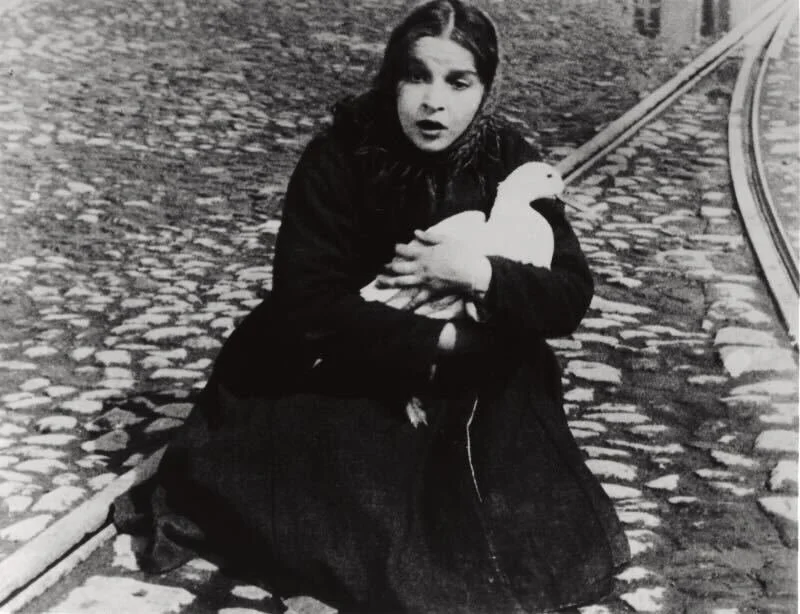
Questions concerning film comedy have recently been attracting greater attention from the general public as well as from artistic professionals. Audiences love comedy. They willingly go to the performances of plays such as Dragonflies by M. Baratashvili, Not Naming Names by V. Minko, and Where is This Street, Where is This House? the comedy-drama by E. Dykhovichny and M. Slobodsky. One should not think that the audience does not notice certain, and at times, rather important flaws in these works. But it is ready to forgive many things, such as lack of taste and craftsmanship, in exchange for the truthful portrayal of certain aspects of life that have been neglected by our art for some time - the vivacity, the optimism, which permeates these comedies, and the happy moments of genuine laughter they give us.
Several new comedies have appeared in cinemas recently. But, firstly, there are fewer of them than in theatre, and secondly, except for Faithful Friends (Vernye druz'ya, 1954, directed by M. Kalatozov, and based on the script of On the Raft by K. Isayev and L. Galich) they are inferior to the theatrical ones in terms of their ideological and artistic qualities. As for the comedies currently in production, most of them are either adaptations of short stories and theatrical plays or works of a genre that is difficult to define - films about well-known Soviet pop artists. I have no doubt that the art of these entertainers is loved by the people and deserves to be popularised in every possible way, but if their staged concerts become the main sub-genre of film comedy, it may be very good for the entertainers, but it would be bad for film comedy. So what is now needed for its true revival? Primarily, it is the creation of new, fully developed comedy film scripts.
We have a wonderful tradition of film comedy. We have the experience of such films as Volga-Volga (Grigori Aleksandrov, 1938) and The Rich Bride (Bogataya nevesta, Ivan Pyrev, 1938), Tractor Drivers (Traktoristy, Pyrev, 1939) and They Met in Moscow (Svinarka i pastukh, Pyrev, 1941, also known as The Pig-Tender and the Shepherd), A Musical Story (Muzykalnaya istoriya, Ivanovsky Aleksandr and Gerbert Rappaport, 1940), and Foundling (Podkidysh, Tatyana Lukashevich, 1940). A careful study of these films, and also of many others, is a prerequisite for mastering the skills of a comedy director, without which it is impossible to create a good film. This paper does not purport to create a coherent and complete “theory of film comedy.” Moreover, it does not claim to establish any theoretical position whatsoever. Having worked in Soviet cinema for many years, I have naturally accumulated many thoughts and observations, particularly on questions related to comedy. If they prove useful, I will consider this article to be appropriate.
As a director who has worked on comedy scripts, I would like to point out the sometimes very unexpected difficulties and dangers inherent in the making of a comedy - a genre, which I think has some very specific rules of filmmaking. Naturally, the essence of any cinematographic phenomenon, its significance and meaning is clearest for me when I consider the films I was directly involved with in the production. Therefore, most of the examples in this article are taken from my own experience. This does not mean, of course, that I regard the films mentioned in the article as a standard worthy of imitation. I am simply more familiar with and understand better the reflections, concerns, and questions connected with the making of these particular films.
One of my colleagues received a letter from an aspiring screenwriter. Describing in detail the nature of the material which he intended to use for the screenplay, the author of the letter asked: “Should this material be used for a comedy, or perhaps would it be more appropriate to give it the features of a drama? How should one work with it in either case to produce a comedy or a drama?” What could be the answer to such a letter? Perhaps only this: “Write as you see, as you imagine the events and the people, and try not to stray from the truth of life.” Indeed, experience shows that a preconceived intention to write as funnily as possible inevitably leads to the comedy turning out forced, and its humour stretched and heavy-handed. As you know, the genre of a work is determined by many factors. The main ones are: the nature of the material drawn from life and selected for depiction, the author's attitude to this material and to the set of life phenomena it implies, and more precisely - the nature of the author's perspective on it. For instance, one could create a comedy, a melodrama or even a tragedy about an amateur music club. Yet the authors of Volga-Volga have outlined one of its brightest and most essential aspects, namely the resistant and independent nature of amateur art, which has no patience for bureaucratic violence against itself - thus the inevitable conflict between the gifted and enterprising club members and the backward, woeful director Byvalov (Igor Ilyinsky). Presenting the conflict between the members of the club and the bureaucrat in a truthful manner, the scriptwriters, Volpin and Erdman, gave this conflict a comedic development and resolution.
The second example is Pyrev's They Met in Moscow. The peripeteias in the relationship between Glasha (Marina Ladynina) and Musahib (Vladimir Zeldin) could have provided material for both a melodrama and a comedy. By telling the story of the pig-tender and the shepherd truthfully, showing the viewer the different stages of their love and coming together, Viktor Gusev was bound to have his own perspective on the nature of these events. Had he been more impressed by their dramatic side, the whole story would have acquired the character of a drama, and in this case, a melodrama. In the case of this script, the author however, saw clearly the comedic nature of the twists and turns of this relationship, and that the obstacles in Glasha's and Mussaib's way could not be seen as truly dramatic ones. So, the comedic note in the depiction of these hurdles and the script's overall conflict was natural. These are examples of how the author's attitude towards material rich in comedic possibilities has defined the genre of the work. However, it is also often the case that a certain plot, imagery, and situations cannot be resolved in any way other than comedically.
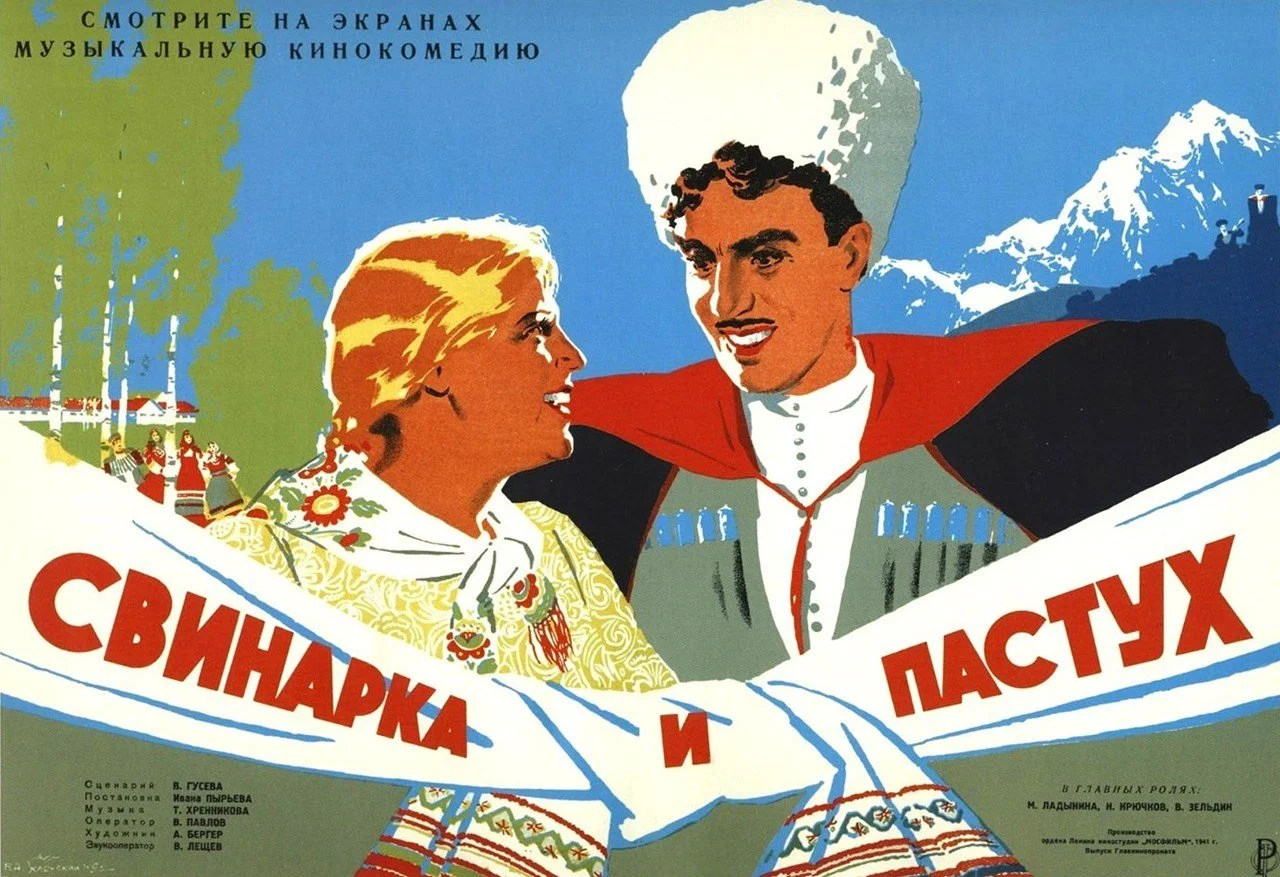
They Met in Moscow (Ivan Pyrev, 1941)
Personally throughout my directing career I have never had a preconceived intention to create necessarily a “comedy” or certainly a “drama” (I intentionally put the words “comedy” and “drama” in inverted commas because in practice these two notions often merge and penetrate each other). My main aim has always been to express what is most distinctive and most vital. Whilst the genre specificities of the work were revealed in the process of understanding the material of the script. And that, it seems to me, is the only way to combine in a single work such diverse elements as the epic and the dramatic, the tragic and comic, the sentimental and the severe, in an organic rather than an eclectic way. For me this is the only way to master the material.
Of course it would be wrong to assume that creativity is a spontaneous, unconscious process. On the contrary, all of the above does not exclude, but rather presupposes the author's understanding of the genre specificity of the work. The point is for the author not to artificially attempt to give the work a comedic form. In that case, failure is inevitable. If comedic intent is born out of the awareness of the possibilities inherent to the material, then it is a powerful stimulus. But even in this case, the author should never aim to make the audience laugh as much as possible. The ability to feel the comedic possibilities of the material, the ability to see the funny in it, is an integral part of the talent of a comedy director. The desire to be funny at any cost is the worst pitfall that can await a comedy writer. This desire must be resisted and opposed with a rigorous insistence on the truth of life. For it is the sense of truth of life that determines the artist's use of the full palette of colours, the desire to enhance either one side or the other (the comic or dramatic).
The use of comedic shades in a dramatic work most often enriches it. Indeed, if one takes as example some of the best works of film dramaturgy (Chapayev [Sergey Vasilev and Georgi Vasilyev, 1934], We Are From Kronstadt [Efim Dzigan, 1936], Baltic Deputy [Iosif Kheifits and Aleksandr Zarkhi, 1937], Ivan Pavlov [Grigoriy Roshal, 1949], and others), it is easy to see how much humour deepens the characteristics of the characters and of the environment in these films. The interweaving of the elements of the tragic and the comic in art comes from the fact that these two elements are often closely intertwined in life. So to deprive a film that strives to reproduce life in its fullest of one of them is to create, as a rule, an incomplete image. And if an artist succeeds in creating the strongest impressions with those works in which elements that are heterogeneous in mood interact, it happens because these works produce the feeling of greater depth and fullness in their depiction of life.
xx
Since I want to highlight in this article that life dictates the artist's need for an organic combination of comedic and dramatic elements not only in comedy films, I'll be referring to examples from films of different genres.
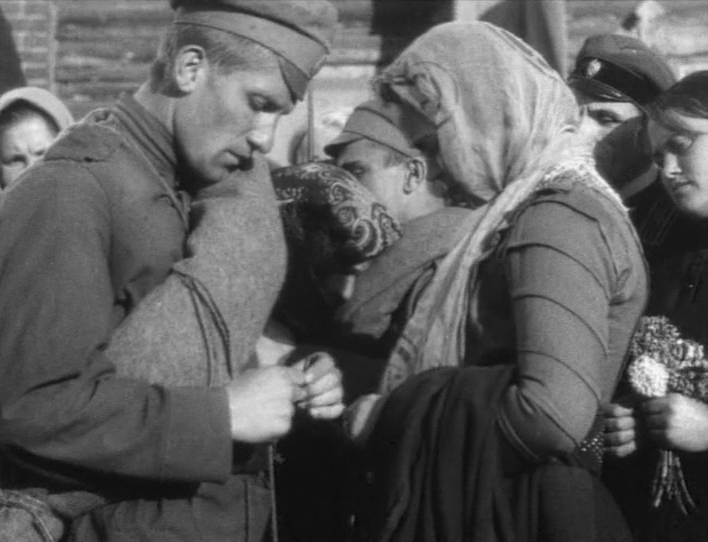
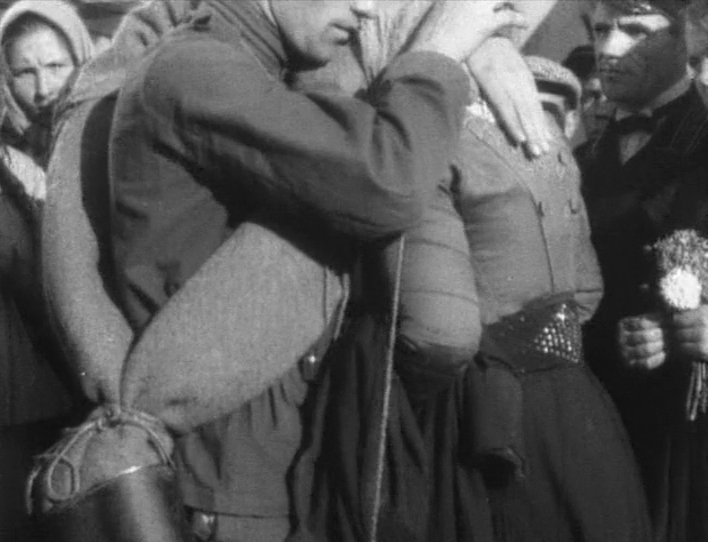
In my old film Outskirts (Okraina), released in 1933, there is a scene where soldiers are being seen off to the front in 1914. The situation itself, the gloomy landscape, the despondent crowd - all this created an atmosphere of depression and melancholy which reached its climax in the final scene, where two elderly men lead an old weeping and exhausted woman under their arms. The scene had a strong emotional impact, but it also left a certain feeling of artifice. I wanted more from it. I wanted to make this scene more alive, to make the spectator feel all of its tragedy more deeply. It wasn't there yet. It wasn't there because for all the logical faithfulness to life, there was a detail missing that would suddenly make the viewer forget that there is a screen in front of their eyes.
And then that detail came to me. One of the film's characters (incidentally, it was Nikolai Kryuchkov's first film role) was going to the front as a volunteer. Not long before that Senka - that's the character's name - had met a girl walking a little dog on a leash on the boulevard. Senka was a decisive lad and, sitting down on a bench next to the girl, he simply pushed the little dog that had come between them to the ground. The viewer remembered this funny detail. When the girl came to see Senka off, she took the little dog with her. In the last, most frightening moments of farewell out of nervousness Senka automatically takes the leash from the girl's hands, plays with it in his hands and twists it around his finger. When his arms flew up for the farewell embrace, the little dog was flung up and hung in the air twitching its legs amusingly. Laughter erupts among the audience at this point of the film. This tiny detail obliterated the feeling that we had painted the scene too black on purpose and grounded the dramatic event as it unfolded.
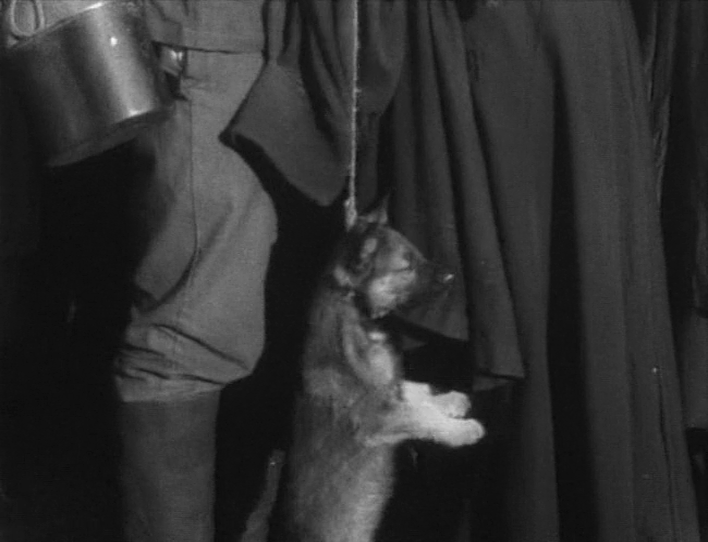
Another scene in the same film also shows how the interweaving of the tragic and the comic allows us to strengthen the viewer's emotional perception of what is being portrayed on screen. It is hardly necessary to explain the sensations that the trenches of an imperialist war were meant to evoke in the viewer. We could endlessly paint the scene in gloomy and monotonous colours, but we would never achieve the desired effect. The task was further complicated by the fact that the viewer at that time could not perceive the scene in the trenches so directly, owing to the layers of literary, pictorial, and cinematographic associations that had been accumulated over the years. The repetition of the same techniques in many works led to clichés, which no longer made the necessary impression on the viewer.
I am trying to work out what it was that caused us to add a new shade to this scene. At the time it was intuitive. We were dissatisfied with something and we were acutely aware of the lack of persuasiveness of the scene, but we could not articulate the nature of this feeling. But subconsciously what was probably happening is what I am describing now. You can obviously build up the dramatic effect of the circumstances and situations all the time, but it will not have the desired effect. Even if we succeeded in achieving the best possible result with this approach, we would still be unable to avoid distance in the viewer in relation to the depiction of the soldiers and the trenches. To illustrate my point I shall remind the readers of two paintings by Vasily Vereshchagin. The first one, “The Apotheosis of War” (1871), depicts a huge cone-shaped pile of human skulls. The second, “Mortally Wounded” (1873), shows us a man who is still running but he is taking the last steps of his life. His hand clutches the wound, trying to stop the flow of blood, and there is both fear and bewilderment on his face. His dusty boots, a uniform scorched by the sun, and a cap pulled down to one side, immediately ground the image, making the viewer feel its authenticity, and believe in the poor soldier feeling pity for his fate. As for the men whose skulls are depicted in “The Apotheosis of War,” the viewer feels pity only intellectually, and the horror of the massacre is perceived indirectly, as a symbol. When Vereshchagin painted “The Apotheosis of War,” he set himself the specific task of creating a symbolic representation of the horrors of war. Such a decision would have been inappropriate in a film.
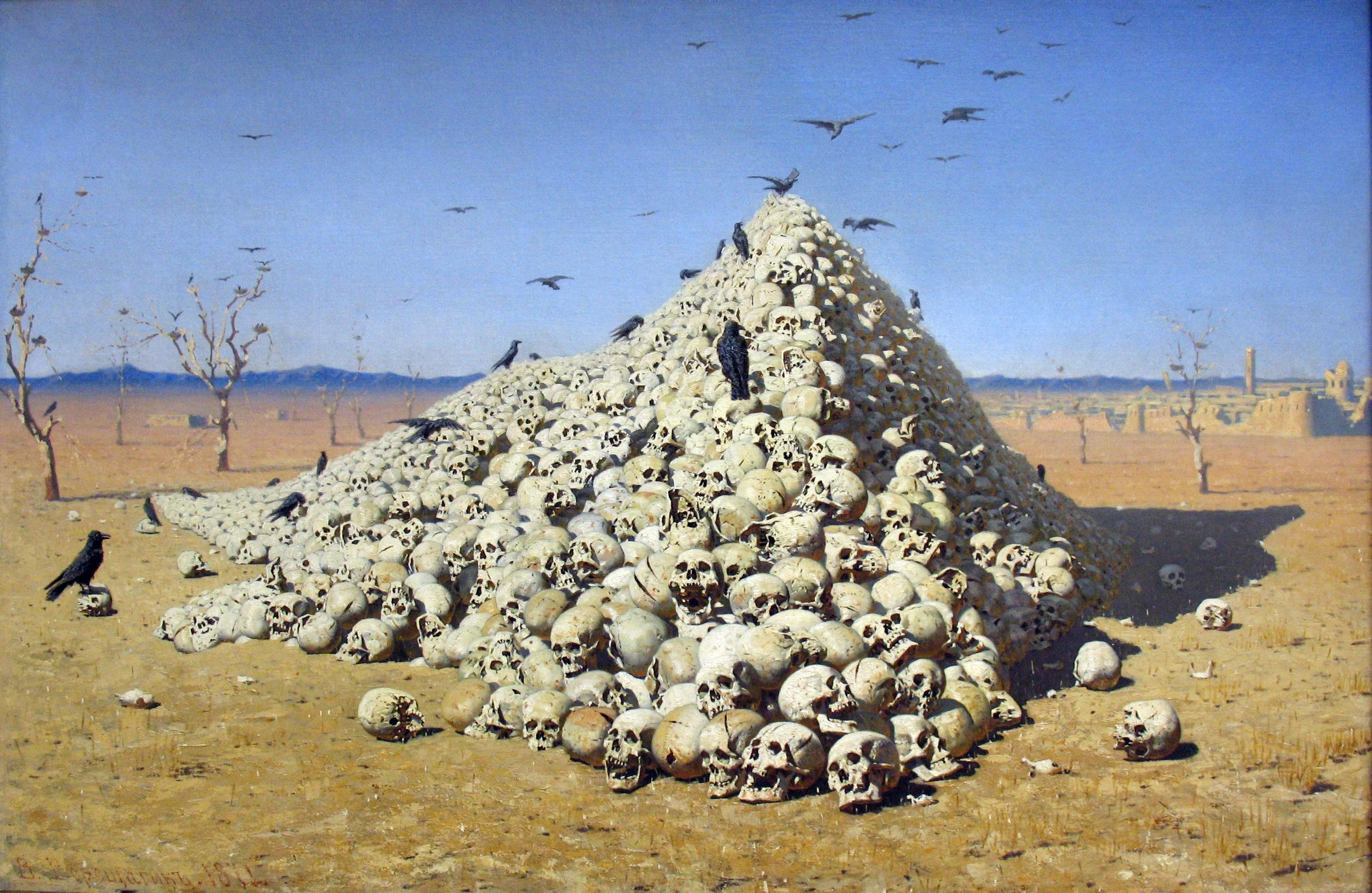
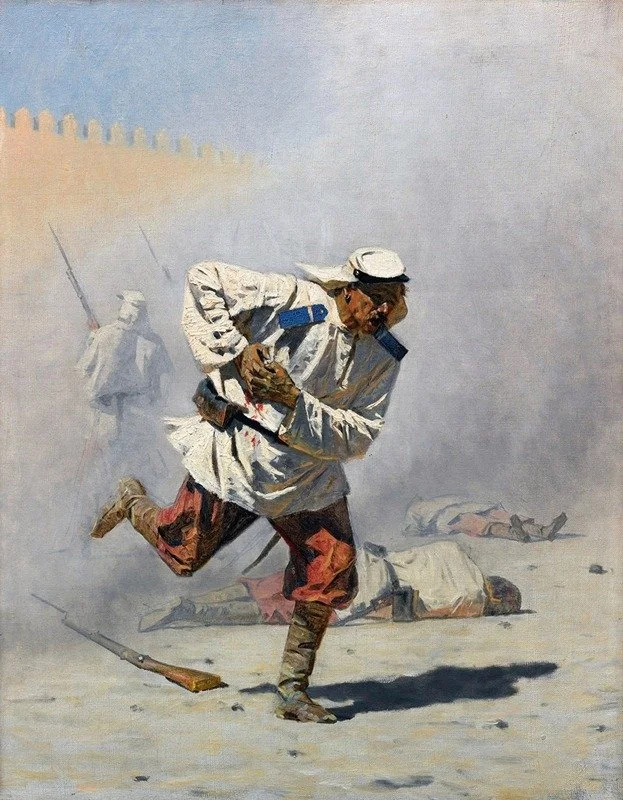
The difference between “The Apotheosis of War” and “Mortally Wounded” is the concretisation and individualisation of the image. How could it be achieved in a cinematic scene? I think that the search for characteristic features of everyday life and the relationships between the soldiers were the only possible ways of finding a convincing solution. Another scene was born as a result of that search. A German shell explodes in the trench where Senka and his older brother Nikolai are sitting. Nikolai shields his younger brother from the shrapnel, stones, and lumps of earth that fly upwards with his body. But he decides to play a joke on his brother. When the artillery barrage subsides, Nikolai pretends to be dead. Senka shakes his brother by the collar, then shouts hysterically: “Kol'ka, Kolya, Nikolai, Kolen'ka.” And suddenly, the “dead man” yells mischievously: “What do you want?!” There's deafening laughter all around. The soldiers are laughing at this rude joke, Nikolai is laughing and Senka is sobbing…”The joke” allowed the sense of the trench life of a soldier to be intensified. The “material” provoking the audience's laughter in this scene in no way violated the tragic sensations evoked by it but, on the contrary, intensified them. And at the same time, it transformed the soldiers from abstract figures of martyrs into living people with all their human qualities and, above all, with their love of life (which made the awareness of the constant mortal danger they are in all the more terrifying!). One does not, naturally, feel as much pity for a man who had already accepted his imminent death, who is spiritually “cold,” as you do for a man who still has a great reserve of energy and passion for life in his soul.
Moments of the most relaxed merriment may be permeated with tinges of sadness; moments of fright are often accompanied by elements of amusement; heights of happiness are often accompanied by moments of serious contemplation. If when we replicate life on screen, we always stick to a straightforward, unambiguous presentation of emotions, we may end up substituting a superficial scheme for the phenomenon of life, or a movement of emotions for a logical move. Art gives way to logic, the viewers do not see real human passions, they only receive information about what is going on. This kind of portrayal of an impulse of the soul cannot ignite, involve, or captivate the viewer. In short, the conflicted, contradictory nature of life also requíres a conflicted, contradictory nature of the life portrayed on film. When we forget about this, or simply do not know how to convey life’s multifacetedness, if not complete, then a significant failure is inevitable.
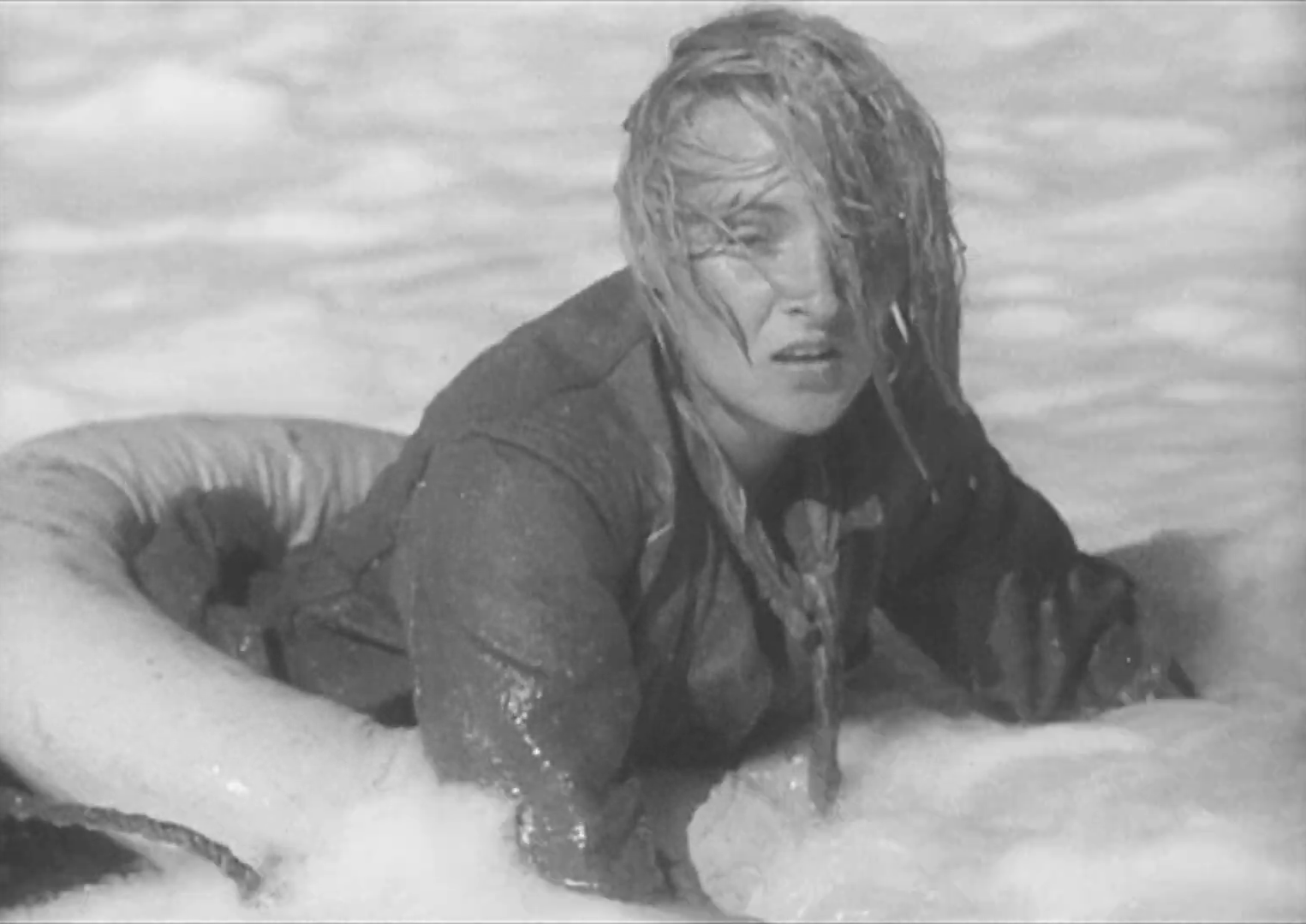
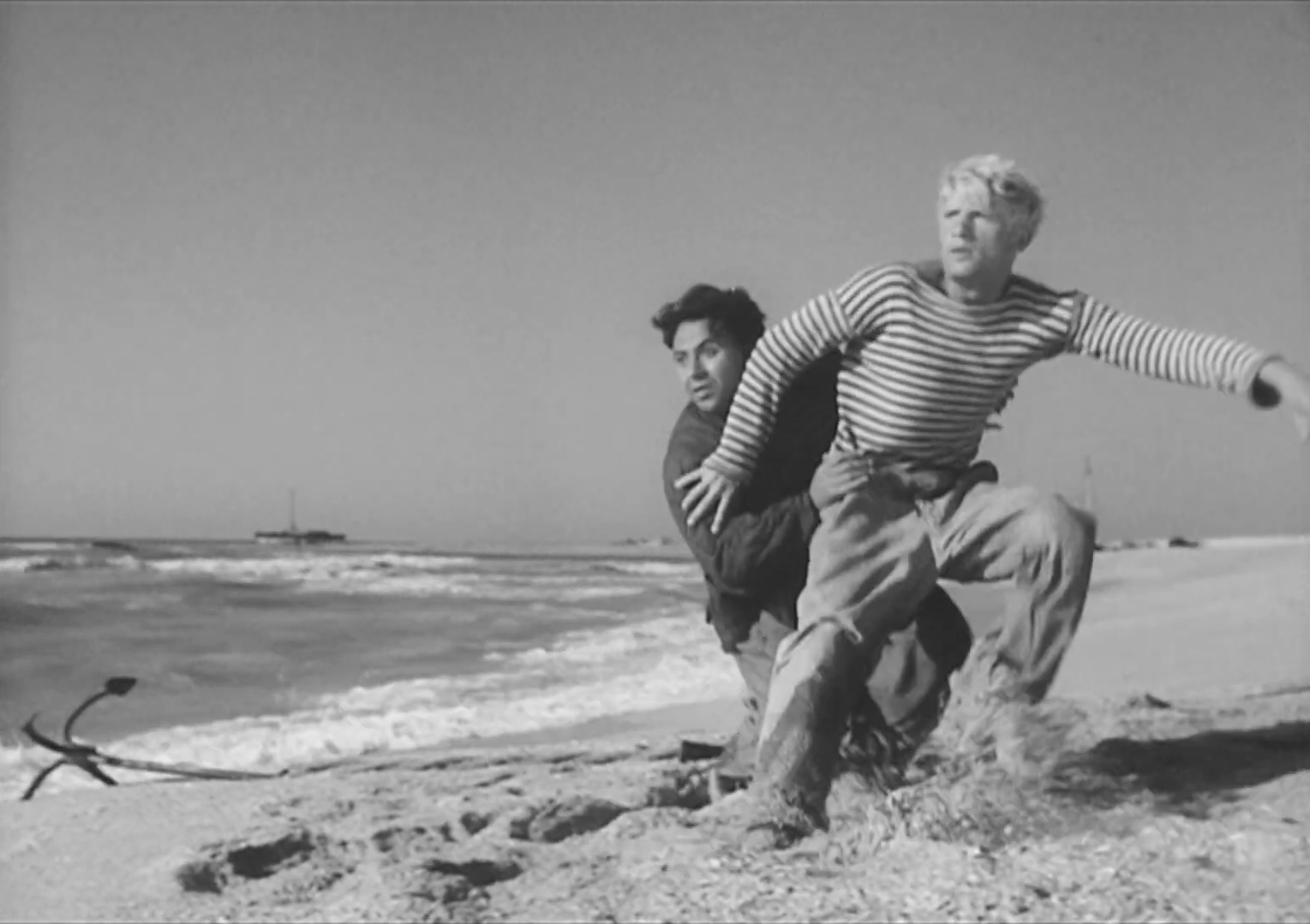
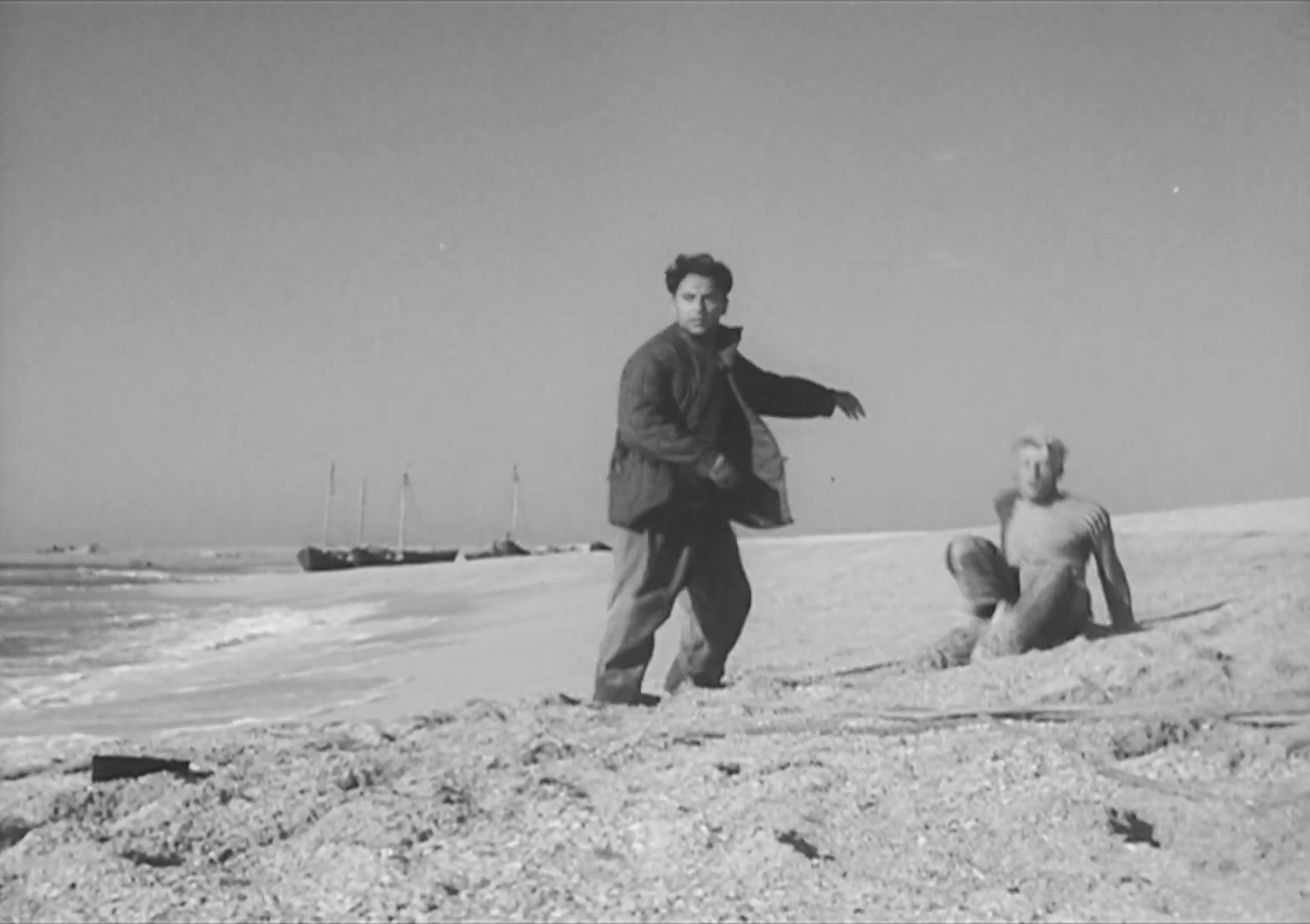
I remember our entire team agonising over a scene from the film By the Bluest of Seas (1936). The protagonists of the film, Alyosha (Nikolay Kryuchkov) and Yusuf (Lev Sverdlin), are sitting on a sandy seashore, shaken by the death of Masha (Elena Kuzmina), the girl they both loved. She was swept off a boat at night by a wave, and was carried away by the sea. A life-buoy was thrown to her and Yusuf jumped overboard trying to find her, but it was in vain. The two young people sit on the shore looking at the sea in sorrowful contemplation... Suddenly the face of the girl appears amid the waves! She has been on a life-buoy for over 24 hours and now the tide has carried her towards the shore... “Inevitably,” “logically,” and “naturally” Alyosha and Yusuf should now move towards the girl. It would seem that they could do nothing else but immediately and desperately throw themselves into the sea. But the sensation of a certain “flatness” of the scene and insufficiency of this movement did not leave us... And then another solution came. Instead of immediately rushing to the aid of the girl, the two protagonists (and we have already seen that neither of them are timid men), in terror, as if they have seen a ghost, retreat backwards into the depths of the island. And only after having come to their senses, do they rush to the aid of the girl. Now we avoid the feeling that Alyosha and Yusuf were sitting on the shore by the author's will, specifically to save Masha, who by the same will was washed ashore at this very spot. It was this moment of shock, of being caught by surprise, that created the viewer's sense of the truthfulness of the characters' behaviour. The departure from the formal logic of behaviour - not the logical movement forward to help, but the “illogical” movement backwards, allowed us to feel keenly that Alyosha and Yusuf are real people, that what is on screen is true! And this has strengthened the viewer's faith in the rest of the story many times over, directing their perception in the right direction. Indeed, wasn't the “illogical” action the most logical for the behaviour of the film's characters - humanly justifiable and truthful! And laughter in this scene accomplished another task - it removed the threat of bad melodrama from it.
We have discussed the presence of the funny in the serious. This, as we already noted, appears in drama. And comedy has the inverse phenomenon of the presence of the serious in the funny. An interestingly written and excellently performed role of Burmak (Boris Andreyev) in The Tale of the Siberian Land (Skazanie o zemle sibirskoy, Pyrev, 1948) would never have been genuinely funny, and would not cause warm and sympathetic laughter, if the hero hadn't been touching in his wonderful love for Nasten'ka (Vera Vasileva).
The grotesque scene of the “singing taxi” in A Musical Story, when the driver, while forgetting about the car, gives himself over to singing, would be seen as just a ridiculous trick. Try to believe that the driver is so carried away that he can't see anything around him, and that the car makes almost ballet-like pirouettes in the night street in tune with the singing! And there is nothing really funny in this show of an almost “drunken” car. But before that we saw some naively touching elements in the driver's character, the tenor Petya Govorkov, and in the sweetest old man, Maestro Makedonsky. So the episode with the “waltzing” car becomes real and funny, and when the angry policeman indignantly blows his whistle, and Makedonsky exclaims “How is it possible such a note!”; not noticing that anything else exists but Petya's wonderful singing, we laugh sincerely for we believe in the sincerity of his indignation.
There is a reverse example in this same film. The superbly written character of Gabbie Tarakanov (Erast Garin) is nevertheless perceived as a comic one, specially introduced to complicate the plot. And this happens only because the brilliant actor, Garin, and the director did not set out to show a touching, true love of his ridiculous character for a young girl - the heroine of the film. And one doesn't believe in Tarakanov either. Despite all the brilliance of Erast Garin's skill, he remains only a schematic figure, devoid of flesh and blood. He does not attempt to rise to the real truth of life, although he has all the abilities for this.
There is much debate now as to why The Hypnosis Session (Seans gipnoza, Khanan Shmain, 1953) does not provoke laughter. I think it's not difficult to find the reason for this: the supertask of every character in this film is the same - to make the viewer laugh! And since in real life, with very rare exceptions, there are no such tasks for real people, I can't believe that they are real people on the screen. The film distorts the characters, they are at odds with the main element in the script - its content, its main situation. And the passions of the characters seem conventional, no one believes them to be real, so no one laughs. “But is conventionality the enemy of laughter?” - one might ask me, - “What about the grotesque, the farce then? After all, it's naive to believe in Munchausen's stories.” Yes, but in those cases one believes in something else! Specifically, in that which is the true subject of art! The viewer or reader tacitly accepts the conventionality of the external form. And, reading the same book about Munchausen, no one laughs at the fact that the thawed postal horn began to make sounds - it is perceived as an obviously conventional lie. But with a trusting smile the reader accepts, and moreover believes in the comic passion of the baron for lies, he believes in the created image.
Speaking of mixing the serious and the ridiculous, I would like to underline one thing in particular: the stronger the means, the more it requires precise dosage. In By the Bluest of Seas, there is a dramatic scene where Alyosha and Yusuf are being carried by a stormy sea after a shipwreck. The characters are rescued by a fishing boat. Yusuf is lifted on board the boat by his sides, and all of a sudden he (the role is wonderfully played by Sverdlin) shouts with genuine terror: “No tickling!” This humorous detail made the episode more convincing. But if the viewer would have laughed not once but a few times in this stern and serious episode, then the whole rescue could have acquired a vaudevillian character - it would have looked untrue. To show the soldiers at the front in the above mentioned scene from Outskirts continuously, or at least frequently, making jokes would be to destroy the realistic atmosphere of life in the trenches.
When shooting the comedy By the Bluest of Seas in the summer of 1934 on the shores of the Caspian Sea, we were unable to get to the scene of the first conversation between Alyosha and Yusuf about Masha for several days. The situation was, as we thought, quite interesting and funny. The viewer could already guess that both young men are in love with Masha but both hide their feelings from each other. Alyosha assures Yusuf that only Yusuf is in love with Masha, and that he, Alyosha, does not care for the girl, and teases his companion about his crush. Yusuf does the same.
And yet the scene was not working out. It was built quite excessively in terms of mise-en-scène and the actors performed as if they had found the right intonation, but at the same time the scene came out absolutely ridiculous and inexpressive; it lacked lively details. No one knows how much we would have suffered with the scene if we had not brought lemons from Baku, which were considered as a good antimalarial remedy at the time. We were diligently destroying lemons. The contorted with grimaces faces of our workmates gave us the idea of giving the two friends each a sour fruit - let them eat the fruit while talking. They began to eat - and this was the missing detail, so the scene began to play out.
The fact that Yusuf was treating Masha with this sour fruit with the best of intentions, while she winced and groaned, made the conversation both funny and convincing. And finally, when Yusuf, walking behind the girl, stumbled and went limp - the sense of truthfulness of what was happening on the screen became complete. Once the characters “came to life” and became tangible, the scene was corrected. Thus, the truth was confirmed once again: for a feeling of liveliness and vividness of the conversation, you need liveliness and vitality in the characters' behaviours. This scene, I repeat, was full of important content for the whole film script, but without the lemons and a limp leg, it would have passed unnoticed.
This incident was the impetus for us to look for a clearly visible comedic solution to each scene. To make it clearer what we are talking about, I will allow myself to recall some parts of the plot of the film in general terms. Two friends, Alyosha and Yusuf, arrive from the mainland to a fishing collective farm on an island. They have to stay there for the whole fishing season, which is three months. They both fall in love with Masha, the leader of the first womens' fishing brigade, and they both court her. During a storm, a wave washes Masha into the sea, and despite the attempts of her friends and the other fishermen to save her, she is carried away by the sea. Everyone thinks that Masha has drowned. The day celebrating the end of the fishing season is overshadowed by Masha's death. The whole collective farm gathers at the club to pay their respects to their much loved comrade. Only Alyosha and Yusuf are sitting on the seashore in grief. The waves wash ashore the girl who had been saved.There is universal joy and delight. Alyosha declares his love for Masha, but she says she loves someone else. Alyosha runs out of the car, sees Yusuf, sends him to Masha, and in anguish he rushes to the boat which is due to leave for the city. Yusuf goes to Masha and discovers that the “other” is not him at all, but a distant fiancé serving in the Pacific Fleet. Yusuf catches up with Alyosha and they leave the island together. So this is the simple story. The funny side of this film was mainly based on the fact that, while competing in their love for Masha, Alyosha and Yusuf continued to be friends, and their friendship was very honest and pure. However, with a little cunning, of course, they invented various excuses and ways to be alone with the girl, but each time the vigilant companion suddenly turned up, and a real date or even more so, the long-awaited explanation, were prevented.
The most important date was, of course, the one after Masha's rescue. Alyosha was leaving the club with the girl, and Yusuf had to be held up by something. Naturally, he could have been delayed by a talk about work, or by performing any duty. But although it would have added new shades to Yusuf's character, it would not have created the combination of a touching and humorous moment necessary for an emotional (and not just a logical) impact on the viewer. Only a plastically expressive solution gave the right key. At the moment when Alyosha and Masha are leaving the club, Yusuf, as a front-runner who has just been given a suit as an award, starts to be rocked up in the air. He tries to break out, shouting that there are other front-runners, like Alyosha, that they too should be rocked up in the air, and that he should be let go because the girl he loves is being taken away in front of him. But Yusuf's screams are drowned out by the general noise. The collective farm workers are eager to pay their respects to Yusuf, the marvellous lad. And, despite the viewer's sincere sympathy for Yusuf, this scene elicits collective and good-natured laughter at every screening of the film.
A small and purely pictorial detail helped to create the right mood for the following scene as well. Yusuf, who has been forced to put on the new jacket and new shirt to see if they fit, at last runs towards Masha's house. Yusuf's tie is half untied, he is wearing new trousers and a new light jacket, and he is barefoot. And here, the marvellous essence of laughter comes into play. The fact that we laughed with amity at the sight of Yusuf running has created a special, very friendly attitude towards him, he becomes particularly sweet and touching for us. And I take the liberty of insisting that we could have written the wittiest, funniest, and most vital dialogue in this scene, but it wouldn't have aroused the same pure feeling of sympathy for Yusuf as it did with this unusual situation as he is running.
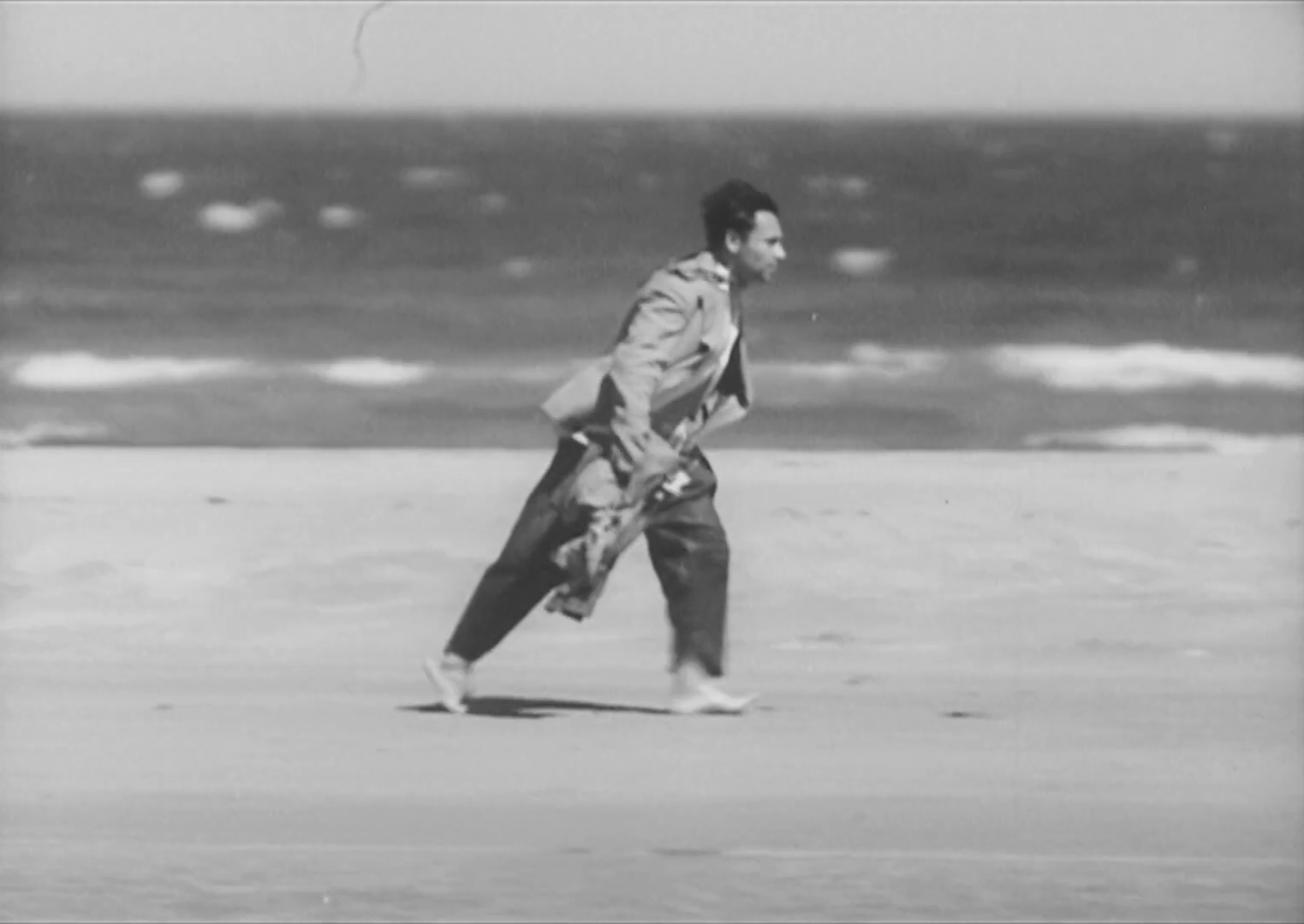
By the Bluest of Seas (1936)
I want to emphasise the importance of comic solutions that evoke open and happy laughter, which awakens bright feelings of sympathy for people and instills confidence in them to triumph over all adversities big and small. It is this laughter that helps develop an optimistic attitude towards the environment, and to appreciate the importance of little things. It is a witty laughter that banishes anger, vindictiveness, mistrust, envy, jealousy. Let the readers not misunderstand me, I am not at all contrasting this laughter with the flagellating laughter of satire.
One could, of course, make Yusuf's run even funnier, find some extra details to make the audience laugh. But it has never been and never will be our job to make you laugh for the sake of laughing. It is a completely different task: we must achieve the greatest truthfulness of the scene and the utmost vitality. And so, the next comic detail is not presented to the audience immediately, but only after a certain length of time, at precisely the moment when we need to reinforce the impression of the truthfulness of the unfolding events.
Yusuf has finally made it to Masha's door, but Alyosha has managed to close it in time. Yusuf pulls the door handle as hard as he can. One more effort and the door, unable to withstand it, will open. But... the handle falls off and Yusuf tumbles in the corner of the veranda without letting go of it. In the room, Alyosha is confessing his love for Masha. I think that the reader can already understand why this particular moment was chosen for the introduction of a comic detail. In this case, the combination of the funny and the serious breaks up the sense of sentimentality that was unnecessary in the scene above. What is funny here, incidentally, is not that Yusuf has fallen down, but that the handle of the door is no longer there, that there is nothing to pull. In his zeal, Yusuf deprived himself of the only means of “catching up” with Alyosha, of catching up with what he missed at the club.
Speaking of the importance of the plastic solution, of the comedy expressed in visual images, I would like once more to stress the idea of the interaction between the image and the word. In their correct combination, the precise, clever, and organic connection of all the components in one whole, lies the secret of the success of film comedy. A funny image and funny dialogue, when combined, are not equal in their power to simply the sum of the impact of these components taken separately. A new quality is born within the image, one in which the impactful moment is multiplied. But it is precisely this power that demands the greatest precision in the way it is combined. A single pistol shot hitting its target is more dangerous than a hundred cannon shells flying past it. And this precision in the combination of components is something you have to learn continuously, persistently, and vigorously.
Nothing is more terrible for a film comedy than the waste of artistic resources. No wonder that one of our most prominent masters of film comedy, Grigori Vasilyevich Alexandrov, once called film comedy “the art of the sniper.” A good comedy manages to achieve a rare and impressive force by minimal means; a few strokes are needed to rise to great generalisations. Byvalov, while walking in Volga-Volga, declares: “I refuse to engage in self-criticism in the street,” and thus exposes the essence of the bureaucrat more faithfully than any clever, hefty, scholarly treatise on the subject. But such power requires very careful handling, because if one exact stroke can give the right idea of the image, one inexact stroke can distort it completely. Therefore, again and again, one has to remember that one has to master the art of developing the expressive side of film, to learn to build dialogue, to remember the power of music in film, but most importantly, to firmly grasp that it is not any one of these components that matters, but their totality, their combined power.
xx
I would like to conclude this article with a few more remarks. All that has been said here about the work of the screenwriter and the complexity of that work shows how challenging and strict the demands placed on the screenwriter are. The responsibility of the screenwriter is much greater than that of the theatrical dramatist, for the screenwriter is given an immeasurably larger audience, and the impact of the screen is much more significant than that of the stage.
But anyone starting to write for film will always need the help of the whole film crew in their work. One of the peculiarities of filmmaking is precisely the mass, collective nature of the creative work. And the polishing, the tweaking, and finding of the necessary precision we have been discussing is the task of the director, and the actors, and the cameraman - in short, of the whole film crew.
The more thoughts and feelings an author has put into a scene, the more it sparks the thoughts, the imagination, and the temperament of all those involved in the work on the film. More difficult creative issues will arise at first, but that's the nature of the job. It is the task of the author to 'plant the dynamite for the scene', and naturally, the stronger the charge, the stronger the explosion.
This does not mean, of course, that the screenwriter can limit himself to “sketching” scenes. On the contrary, his task, as I have already mentioned above, is to sketch images, phenomena, and situations as fully and accurately as possible. Without this completeness and accuracy, the film is bound to have a breakdown, in the course of which, as a rule, more value is lost than found.
xx
Cinema does not have the freedom of experimentation that theatre has. Unlike theatrical productions, cinematographic productions are one-off affairs. The team cannot hope that the subsequent performances will find a better, more correct resolution. Hence, there is such concentration of attention, and such acuteness of feelings.
It seems to be a strange situation - the better you write, the more the director and the actors will want to add their own personalities to it. Yes, that's exactly right. But it should not embarrass the author, for the better he will write, the more interesting and meaningful the script is, the more the author will receive help and support from the director and the actors. But a bad, false script cannot count on such assistance - as it has no creative beginning.
Of course, this article is not meant to be exhaustive. It leaves unanswered questions of major importance - such as comic dialogue and the techniques needed for working on it as well as the various kinds of film comedies (lyrical comedies, musicals, satire, vaudeville, and even varieties such as detective comedies and fantastic comedies, which are still awaiting their discoverers). In conclusion, I'd like to remind young writers, future authors of film comedies with whom I mainly intended to share my experience, of the difficulties of their work. It is difficult to write very seriously and very truthfully and yet to make the audience laugh. It is difficult to take on the brunt of a “comic charge,” to look for unusual yet truthful situations, to polish them, to hone the dialogue. It's much easier to delegate that to actors. It's difficult to learn to master all the “cinematic weapons” and all the components of a film. It's much easier to find purely literary humorous solutions.
No genre in cinema forces those working in it to be as demanding of themselves as comedy. For happy moments of laughter in the audience one has to pay with months and years of laborious work. But one mustn't get upset or lay down arms at the first setback. One must learn well and be tougher on oneself, develop an irreconcilability with untruths in art, honesty in one's work, and an aversion to compromise with one's own conscience as an artist.
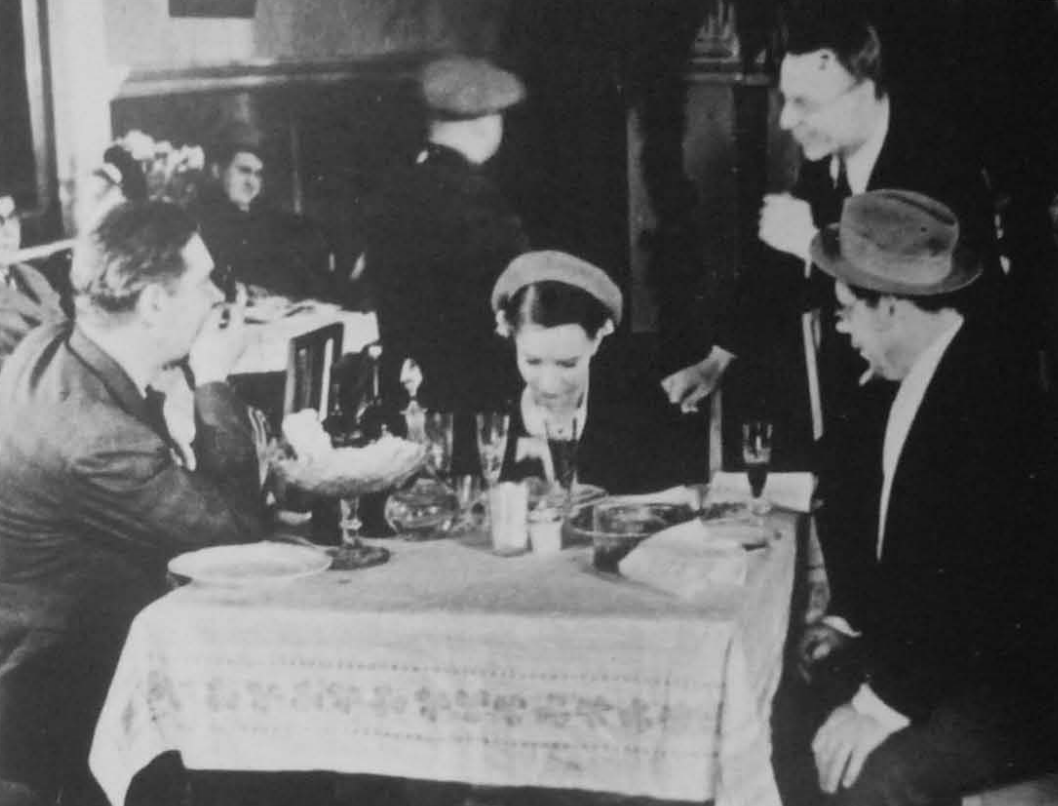
Barnet (left) directing The Old Jockey (1940)
-end-
Translation: Galya Stepanova
Excerpt from the collection Questions of Dramaturgy
(Volume 1. Moscow, Iskusstvo, 1954).