The New Face of Modesty
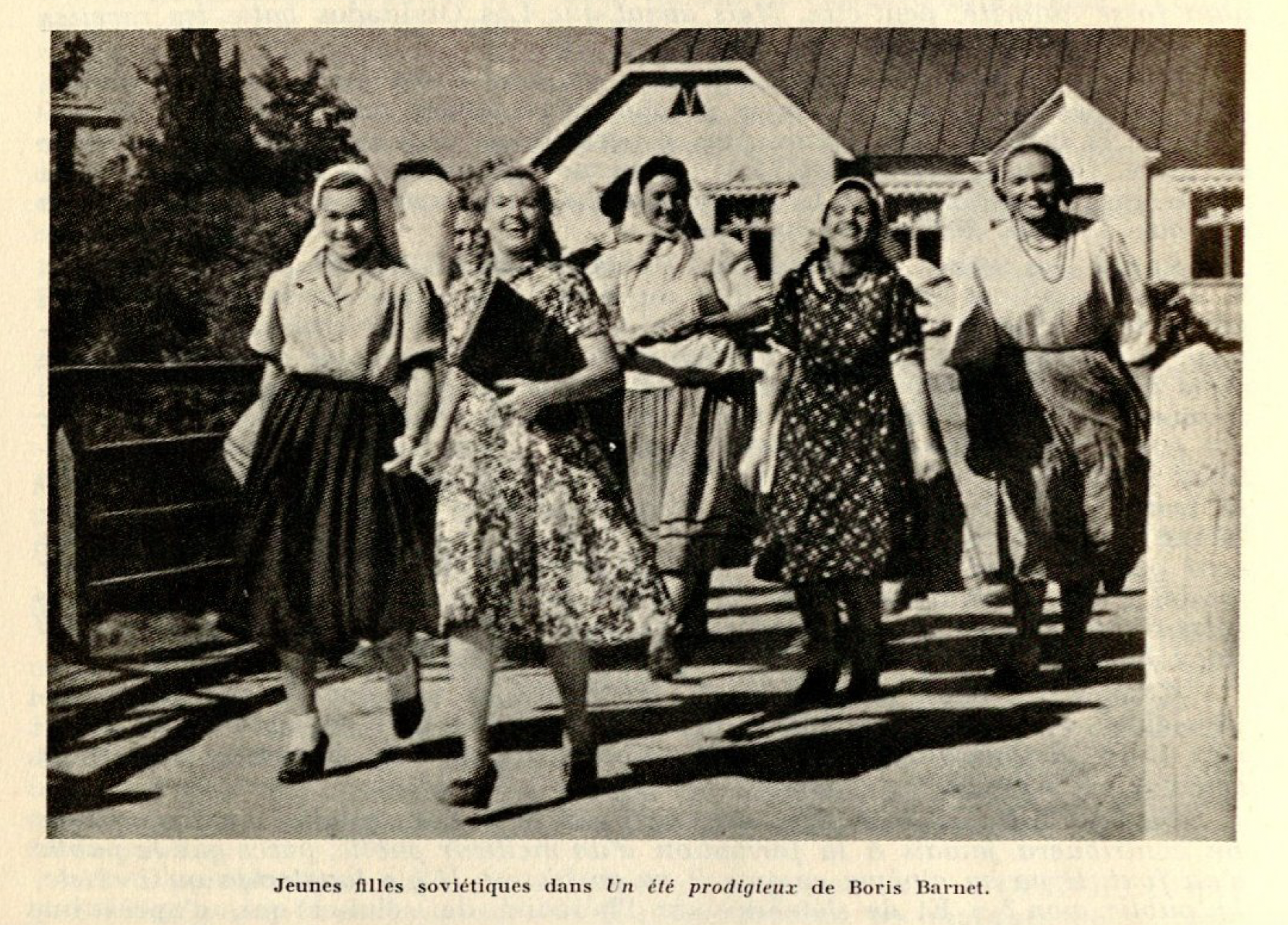
Shchedroe leto | Bountiful Summer | by Boris Barnet
Jacques Rivette, 1953
Translated by Andy Rector
The following text, on Boris Barnet’s collectivist musical-comedy-romance Bountiful Summer, was the first article Jacques Rivette wrote for Cahiers du cinéma, at the age of 25. This translation accompanies Boris Barnet, A Soviet Poet, a retrospective of Barnet’s films taking place from March 13 - April 11, 2026 at Metrograph.
Special thanks to Andy Rector for the translation and to Hannah Yang for the scan of the original text.
The truth is often silenced; thus: with the exception of Eisenstein, Boris Barnet should be considered the best Soviet filmmaker; to which it must be added straight away that ignorance of this has many excuses; some historians mention Outskirts in passing, with a certain disdain, but then the fortunate spectators of The Girl with the Hatbox need to be swiftly, undoubtedly taken into account. Add to that his spy film**, perfectly "in the style of Hitchcock," which was furtively shown to us a few years ago, and that's all the diligent viewer could boast of adding to their list.
But who is Boris Barnet? No one will ever know, he murmured; certainly a man of intelligence, of taste, of heart––isn't that enough for you? As for genius, rest assured he possesses it in one of its most subtle forms, which is knowing how to pass it to his young women as they climb into trucks or horsecarts, to the delight of Stendhal. Let’s add to that: he seems modest and takes pleasure in hiding there; here, some malicious tongues will claim that he is camouflaging himself; but through poor nets and weak sails a smile soon pierces.
There’s the fear that Barnet’s latest film will hardly alter the critical situation of its auteur and will be confused immediately with the rest of the comic-operas about kolkhozes, The Cossacks of the Kuban*** being one of the more enjoyable examples. As any reservation or hesitation whatsoever could give ammunition to indifference, I will therefore say without further ado that I love this film, this falsely naive film of a true and profound naiveté [film faussement ingénu et d’une ingénuité vraie et profonde]; Barnet's view of the world, and of the Soviet universe, is one of innocence, but not the view of an innocent man; he knows the demands of purity and prudently keeps it a secret within himself as his most precious pledge, as the surest guarantee against, perhaps, a cruel world, which his instinct compels him to defy.
On the theme, so dear to Renoir, of the pain of loving without being loved (or of believing this to be true, which amounts to the same thing), here we have a softly poignant, thankless yet endearing film, the naive appearances of which are merely a mask, a trap, or some kind of defense—a film that hides an enigma beneath its sometimes too conventional exterior, so as not to reveal the effort and cunning behind it [l’application et la ruse]; a few brief sequences of tractors and combine harvesters serve as oratorical precautions.
It’s difficult not to be moved by the constant rightness of tone; whether in the dialogue, written with great pains, where the lines swirl around feelings always left unsaid, as in Marivaux; in the strangeness of the construction through short sequences that quickly close off their secrets; or in the playing of the actors: as soon as they begin to play their roles in the social game, the mise en scène becomes, at times, deliberately theatrical; but a glance soon betrays them, if not some unexpected outburst; as Barnet knows the power of abruptness, the young women turn away, suddenly sulking, or run off with the bouquets they came to offer; and finally, an unpredictable wind of madness blows and everyone throws themselves in the water (this is no euphemism): a revenge against long constraints, against a carefully prolonged reserve.
From one film to the next, Barnet's universe is populated by the same shy, secretly impulsive, discreet characters whose humor or heroism leaves them poorly protected still; but here we have the invention of a new form of modesty: Stakhanovism.
Why take offense at seeing these familiar harvests and greener pastures once again? Instead, recognize the faces of these overly sensitive young people who, in an attempt to vanquish their feeble hearts, decide to immerse and numb themselves with work, and, strange as it may seem, manage to take an interest in it—as do we. But their thoughts, like ours, are elsewhere: no one can fool themselves completely.
The amiable anarchy of the 20s, where a young girl, her hatbox, and her lovesick admirer strolled about, is no more; seriousness became obligatory, and there they were, despite themselves, drawn into the Stalinist world of plans and record-breaking harvests; since records are all the rage, young women are keen to become heroines of labor too; but despite their best efforts, no one can lose their soul, which continues to torment them with a poignant secret. Some resigned themselves to remaining "capitalist" amidst the indulgent laughter of the party officials; and what did the others care about the new name of the future city? They immediately sought out their little house: not the one in the middle of all the others, but this one, among the trees, set apart.
"When one loves, doesn't one have a right to torment?" But what do rights or interdictions matter, since they love this dear torment above all else; "it’s sometimes difficult to have confidence"; peace in the heart, blissful self-satisfaction, is so unfamiliar to them that they will create their pain and their confidential disarray from their imagination alone, from the natural movements of their hearts which invents its torment out of a need to be tormented. Because one evening, at the end of an amicable meal, Petro will have leaned towards Oksana and whispered a few words to her with a smile, and love will blind a kolkhoz leader to the point of jeopardizing the community's destiny through his stubbornness; and a heroine of labor will be born from the resentment of a little girl who reads her name on a placard less attractive than that of her imaginary rival. And, it must be added, in their defense, that their partners would hate to let the slightest hint of their love be revealed and would rather conceal it beneath the same polite smile (remember Anne Baxter's in Ambersons) or frenzied calculation. Though their hearts deceive them, they cling to this deception, this silence, this suffering, tokens of their ever-young and restless blood; peril, the anguish of existence, assures them of their real life.
I mentioned earlier the secret of this film; barely a riddle. It hides its soul, with a certain shame at its weaknesses, its tenderness, and is instantly alarmed by a glance—like a young girl concealing her troubled heart beneath diligence and fixed smiles, and the futile chatter of a schoolgirl.
x
Cahiers du cinéma no. 20, February 1953
Translation: Andy Rector, 2026
* Written at age 25, this was Jacques Rivette’s first article for the Cahiers du cinéma.
** The Exploits of a Scout a.k.a Secret Agent, Boris Barnet, 1947.
*** Popular Soviet film by Ivan Pyriev, 1949.