Precious Stakhanovite: Bountiful Summer
André Bazin, 1953
Translated by Andy Rector
This text accompanies Boris Barnet, A Soviet Poet, a retrospective of Barnet’s films taking place from March 13 - April 11, 2026 at Metrograph.
Special thanks to Andy Rector for the translation and to Hannah Yang for the original scan of the document.
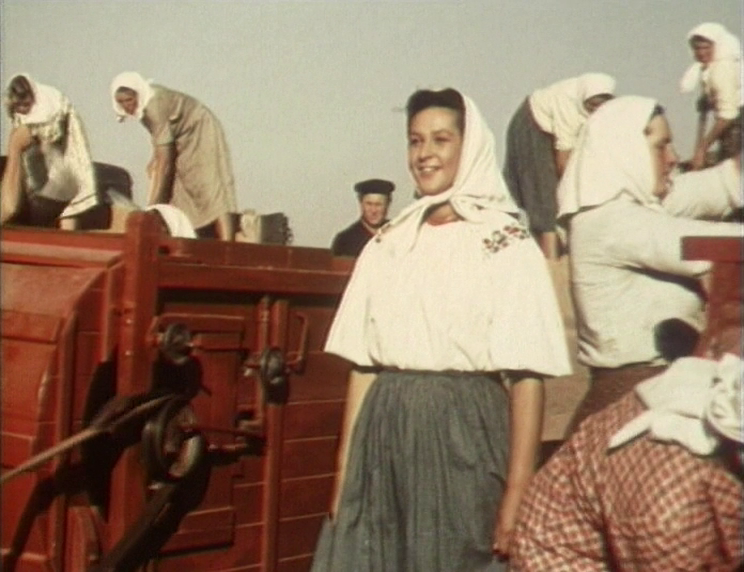
The reservations one can have about the Soviet cinema of recent years are of several kinds. We’ve already discussed one of them here [in Esprit]. But not all the films show Stalin exercising his infallibility. A good part of recent production is devoted to depicting Soviet life in the Kolkhozes. Such are, for example, The Cossacks of the Kuban* and Cavalier of the Golden Star**. But another kind of objection arises. It is pointed out, with some semblance of reason, that the scripts are terrifyingly, pedagogically naive. It is always a Kolkhoz more backward than its neighbors because of a chairman who is stubborn, individualistic, and resistant to new methods. The essence of the film is employed to convince him of his error (and secondarily to neutralize his bad advisors) and everything ends in an apotheosis of agricultural Stakhanovism.
Barnet's Bountiful Summer conforms perfectly to this terrifying pattern. Yet it is a disturbing film of subtle and convincing humanity. Its charm certainly does not lie in the political aspect of its scenario. In this respect, the story is as conventional as one might imagine. At most, one can find a certain documentary interest in this aspect. Indeed, one has no reason to doubt the effect of realism offered in the portrayal of life on a Soviet Kolkhoz. These films are primarily for internal use, and their pedagogical intent guarantees their veracity. It would be absurd to base a demonstration of the proper functioning of a collective farm on an imaginary or simply ideal model: on the contrary, as the Kolkhoz in question is precisely not being used to the best of its resources. What we see in Bountiful Summer is that the average standard of living in the rural Soviet Union is not what we see in Farrebique. But whatever the matter’s interest, the artistic question is not all. Bountiful Summer is also, and above all, a delightful love story.
And yet, all told, the film will not only seem as conventional as its politics, but, more seriously, entirely subordinated to its thesis. A chairman of a Kolkhoz is in love with a sweet heroine of labor who criticizes his timid spirit and reactionary prudence. A young Stakhanovite accountant arrives, full of modern ideas, and the heroine soon devotes her every waking hour to discussing improvements to the farm’s livestock with him, at the expense of the poor chairman, who becomes tormented by jealousy. Together, the accountant and the enterprising heroine's point of view ultimately wins over the council of the Kolkhoz, whose achievements are a grand success. Converted to the new methods, the chairman then discerns that the accountant was in love with a different woman all along, that the attentions the heroine showed to the accountant were purely professional. Everyone is happy in the finest of the Kolkhozes.
It would be too easy to mock such a scenario, to declare it puerile and conventional. Doing this, I believe, would keep us insensitive to Barnet's art, and deny him the author’s rights long recognized and granted in Western literature. Truth in art, as we well know, accommodates itself to conventions. Were those of the 17th-century society any less rigid, any less alien to the spontaneous movements of the human heart than the administrative regulations of a Kolkhoz? Rodrigue's "point of honor"*** distinct from a Stakhanovite’s competitive spirit? Soviet society, it is true, created a new social morality, but not new passions. Isn’t it precisely the nature of classical art (and particularly the theater) to make the eternal truth of the human heart perceptible only through the moral conventions that constrain it? Barnet’s young women, who pride themselves on surpassing their rivals, are coquettes of a new breed. Lysenko is their map of Love.**** Their white zootechnician coats suit the new pastoral romance well. Trianon, too, was a kind of model farm. These comparisons are not sacrilegious in either direction. Affectation has always been a subtle form of the seriousness of passions.
We must speak of a "heroine of labor" as we speak of a "heroine of Corneille." Barnet paints the Soviet peasant woman "as she should be," but here, naturally, duty is only a fulcrum, a shadow imposed on the passions we all recognize.
When the Kolkhoz chairman realizes his own jealousy, and is torn between his political duty and his feelings for a colleague, he goes to the local Party secretary and asks him to consult the books, to be certain that "jealousy is a relic of capitalism." The secretary says he’ll be sure to check, but fears that it is. To which the unfortunate man retorts, "If we love, don’t we have the right to worry?" At the end of the film, when everything returns to normal, the commissioner comes smilingly to congratulate the newly engaged couple and incidentally informs his former consultant: “I’ve researched, I've read, and indeed it’s a relic." The irony of the remark is too obvious to leave any doubt about Barnet's intentions. There is no new man or new woman, only a new morality, whose very rigidity, and its permanent and constraining presence in all aspects of social life, undoubtedly leaves Soviet literature and cinema only one aesthetically valid option: a classicism bordering on preciousness, in any case, an art opposed to romantic and realist expression, where the apparatus of political propaganda will play the role of a sentimental code, a grid of decorum that simultaneously conceals and reveals the eternal truth of passions. This third dimension of the script is a true aesthetic measure which, at last, a Bountiful Summer allows us to glimpse.
x
Esprit, Nouvelle série, No. 200 (3), March 1953
Translation: Andy Rector, 2026
* Ivan Pyryev, 1950.
** a.k.a Dream of a Cossack, Yuli Raizman, 1951.
*** The reference is to Corneille’s Le Cid, 1636.
**** Trofim Lysenko, Soviet agriculturist. Carte du Tendre, “was a French map of an imaginary land called Tendre produced by several hands, including Catherine de Rambouillet’s. It appeared as an engraving attributed to François Chauveau in the first part of Madeleine de Scudéry's 1654-61 novel Clélie. The map represents the path towards love according to the précieuses of the 17th century.” (Wikipedia)