Waiting for Godard: An Excerpt
Michel Vianey, 1967
Translated by Gregory Hermann
The following—a report from the set of Contempt—is an abridged version of the first ‘chapter’ of Waiting for Godard, an experimental work of journalistic portraiture written by Michel Vianey, published in 1967. While the text is based on real conversations and observations, Vianey called his main character “Edmond,” rather than “Jean-Luc,” in order to “scrape the received ideas of the public image off the character and to start with a fresh canvas.” A full translation of Vianey’s book by Gregory Hermann is forthcoming from Film Desk Books.
This text accompanies Metaphysics of the Pratfall: Jerry Lewis and Jean-Luc Godard, a series of Lewis/Godard double bills at Anthology Film Archives, March 19-31, 2026.
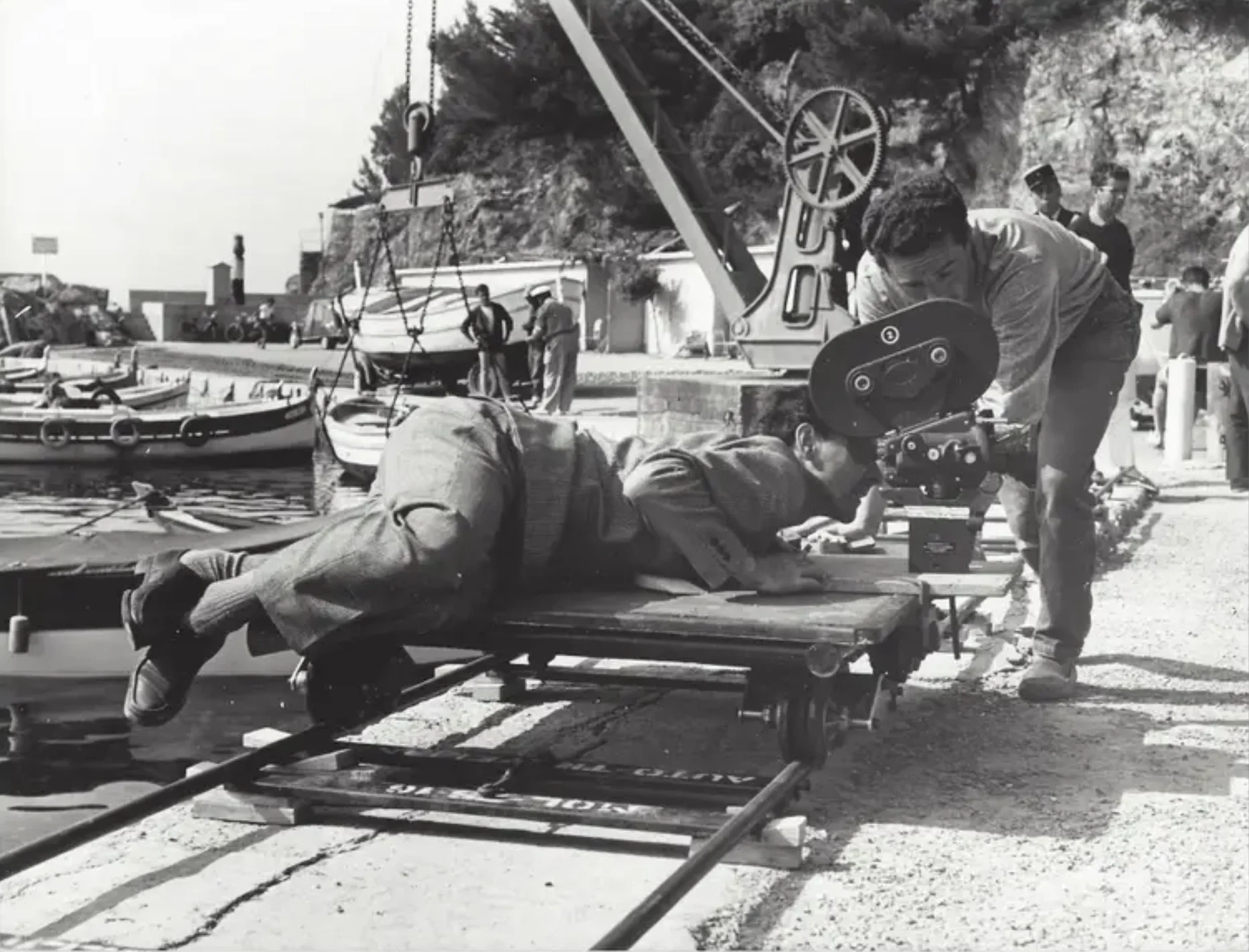
He appeared on the terrace of the Gatto Bianco, eyes concealed behind dark glasses, attuned to a distant sound—the pizzicato of a violin, the drone of a haymaker, or perhaps the way they interplayed. The group of chattering men who had followed him there dispersed, waving their arms as they went, and Edmond Godard was alone.
“Ah, minavoruixy nava,” said one as he sat down, opened a menu, and motioned to a khaki-colored cloud.
This was June 1963 on the island of Capri.
Edmond stood at the top of the stairs like a startled pheasant, hat in hand, his attention fixed on a row of tables. Though I had never seen him in person, I recognized him at once by his solitude. Loners are easy to spot. They exhibit a perpetual unease, a reluctance to be anywhere at all unless brought there by force.
I stood and introduced myself.
“Ah, perfect!” he said without missing a beat, patting down two strands of black hair disheveled by the lukewarm breeze. “We’ll have lunch.”
“Alright,” I said, but he remained where he was, looking around as if he’d come ashore after a long swim.
“Your timing is perfect,” he said. “I wanted to talk to someone. And you’re the only one here.”
He was yet to move. A bird plucked a bug from the air, landed on the pergola, gulped it down in two or three attempts, ruffled its feathers, and flew away. Finally, he sat.
Apart from a first kiss, few things in life can be more embarrassing than a meal with a stranger: the business of chewing and swallowing, of forcing your mouth to eat, smile, and talk in the proper sequence. But against all odds, he spoke at length, took a few disinterested bites, then spoke at length again in his slightly sibilant voice. His tanned hands looked almost black against the white tablecloth, and they rose to gesture only when necessary.
He lamented the isolation of the creator, alone at the center of his creation.
That’s true, I thought. Everyone else simply moves on, whereas the creator…
He’d really needed someone to hear him out.
His next layer of isolation: the indifference of the cast and crew. What could be done to rouse them from their apathy and make them care about something above their belts? Do they even think about what happens after the camera stops rolling? What will become of the image? What is its future?
Their loss, I thought. The future will be written without them.
The sun glanced off an aircraft gliding high above us. Where was it headed?
As for Brigitte Bardot, he had no complaints.
“She’s wonderful,” he said. “I expected more trouble. Very obedient. I try not to upset her, but if something goes wrong, I do a handstand and walk around. That cheers her up.” She thinks it’s quite funny. Oh yes, Edmond, walk around upside down! She laughs and claps her hands.
The madman—brutal one moment, bashful the next—got up with a strained smile and lit a Boyard cigarette. “Let’s go to the Casa Malaparte.”
The Casa Malaparte overlooks the Tyrrhenian Sea. A few days later, Brigitte stood on its rooftop, tossing orange peels over the edge. She watched their muted descent into the waves lapping against the cliffs sixty feet below.
“I’m just like everybody else,” she said, leaning over the precipice. “I long for happiness. How I’d love to be happy.”
Countless men had tried to make her happy; none had prevailed. I didn’t know what to say. Perhaps I should have taken her hand, but the sun complicated things.
Weary of his own voice, Godard said nothing. With long strides, he paced through the rooms and about the terraced rooftop of the garage-shaped villa. Then we returned in silence to the center of Capri.
From the winding mountain path, we saw small boats rocking in the bay. Partway down, he turned to me.
Chirrup chirrup chirrup went the crickets.
“I like the heroes of Homer,” he said. “Their way of life was more noble, more virile, more intense than ours.”
The air was heavy with lavender, pine, and warm light.
I was surprised to find him so enamored of Homer’s brainless muscle men, who dreamt only of cuts and bruises. Perhaps he sought in the example of their exploits the courage to finally divorce himself from the world. He was in pain, clearly, but his was no common despair; it did not leave him sterile. Rather, pain was his muse, a necessary suffering, and he refused to let it go.
A figure appeared in the background: Fritz Lang, the German director, sporting his costume-party monocle.
Every evening at six, Lang armed himself with drink to ward off the fear of death that crept in at twilight. Then his heart was laid bare, and words came freely. He dined at Godard’s table, where the man himself sat perched like a night owl, silent and still.
“Edmond, the yellow dress you had Giorgia in today—a representation of jealousy, is it not? Splendid. That Giorgia. So well-versed. Reciting poets in their native tongue, and looking lovely as ever. But will anyone catch it? The jealousy, I mean, natürlich. These clever allusions and symbols we weave into our films—lost on the public.”
Godard chewed with zeal. He thought of Flaubert: forceps for every novel. He hadn’t shaved for days and bent low over his food.
“Garçon, more wine,” said Fritz, sworn enemy of the unfeeling bastards who populate the industry. (“Just watch,” he’d told me an hour before. “The producer will cover everyone’s tab—except the script girl’s. Every single one but hers. Careful now, nothing gets by old Fritz.”)
“What time is our call tomorrow?” Fritz asked.
Edmond lifted his troubled eyes—blue in fact, but black in my memory.
“Don’t know.”
“Will you need me?”
“Don’t know.”
After dinner, I joined Fritz for his nightcap under the lanterns on the Piazza Umberto.
“Brigitte stirs up chivalry in young men,” he said. “They feel called upon to protect her.”
“She’s a Lorelei.”
“Yes, but the man who wins her hand will be the one who makes her laugh.” (“He’s wrong about that,” Brigitte told me later. “But I still like him. I went up and said hello before he had the chance.”) “She came up and said hello to me before I had the chance. Such grace… Such grace.”
Mandolins, violins, bobbing heads, crème Chantilly—and just beyond the pool of light around our table, the allure of the devouring sea.
“When I return to my hotel room alone at night, I look in the mirror as I brush my teeth and say: Fritz, you’ll be dead soon.” He looked up at the full moon, hanging there as it had outside the great hall of the Macbeths. “Then I ask myself: what will remain of you after all these years of existence—pardon me, what did you say?”
“Nothing. I didn’t say anything.”
“And that is what I say: nothing. There won’t be anything left.”
How many years does life owe us? More than a lifetime.
I quoted some Schopenhauer. “In death, we cease to be what we never should have become in the first place.”
“Schopenhauer was a miserable cuss.”
“He was.”
“Now listen to this—”
What haven’t you seen, Fritz, with that third eye of yours?
It was the tale of a young woman who entertained an Argentinian dancer whenever her old husband was away, until one evening he came home to discover another man’s undershirt draped over a chair, and the scoundrel was likely still hiding in the armoire, but the husband said nothing and took his wife straight to the Stork Club, where he gave her an exquisite pearl necklace, after which she was forevermore faithful. He told me all this because he saw in it a beautiful depiction of love worthy of the stars themselves. Or perhaps I had misunderstood. Perhaps he was simply putting off, as long as he could, the moment when he would have to close his eyes to sleep. One evening or another, we all must close our eyes.
But tomorrow, by God, we had a movie to make.
It must have been May by then. Beautiful as the morning light, Brigitte sat on the windowsill, dangling her bare legs over the edge.
“He’s weird weird weird, this guy. Don’t you think he’s weird? I like him, but he’s so weird.”
Weird weird weird
An odd Swiss duck
We have nothing to say to each other
A carp that cannot talk but walks around on its hands
“He’s in so much pain he can barely talk. You know what I mean?”
I did. It made him hard to be around. Imagine a conscientious objector whose conscience objects to everything.
“A movie theater is like Plato’s cave,” said Godard, seated on a rock above the molten-metal shimmer of the sea.
The image aligns well with his dialectical approach, which is built on contingent truths that shift from moment to moment. Sitting on that rock, hands cradling a knee, it occurred to him it might be useful to one day write a book about the making of a film.
“Should the cinema disappear—who knows—there ought to be some traces left behind,” said the medium’s doubting Thomas. We’ll never have another like him.
Three years later, I was asked to write that impossible book. I flew into action, ecstatic. I still haven’t come down.
x