Five Poems by Víctor Gaviria
Víctor Gaviria, 2003
Translated by Garrett Phelps
The following poems originally appeared in La mañana del tiempo, a collection of poetry written by Víctor Gaviria and published by Hombre Nuevo Editores in 2003. In “The Cans at the Bottom of the River”, Gaviria and Fr. Luis Alberto Álvarez write that cinema is born in “a moment when raw material seeks to appear as such, without transformation,” and that “only in this way can the director’s gaze pass over living things, things that sparkle, that possess intent. Only then will there be characters who do more than simply represent.” The distinctions between poet and filmmaker in Gaviria’s work, as between film critic and Catholic priest in Álvarez’s life, remain, and it is tempting to dwell on them. Yet these five poems remind us that the distance between them is not so great, and that the raw material of the poem can appear as such to close that distance, just as it does in film and in life.
These poems were translated by Garrett Phelps and accompany Love is Strong as Death: Luis Alberto Álvarez & Víctor Gaviria, taking place on October 18, 2026 at Light Industry.
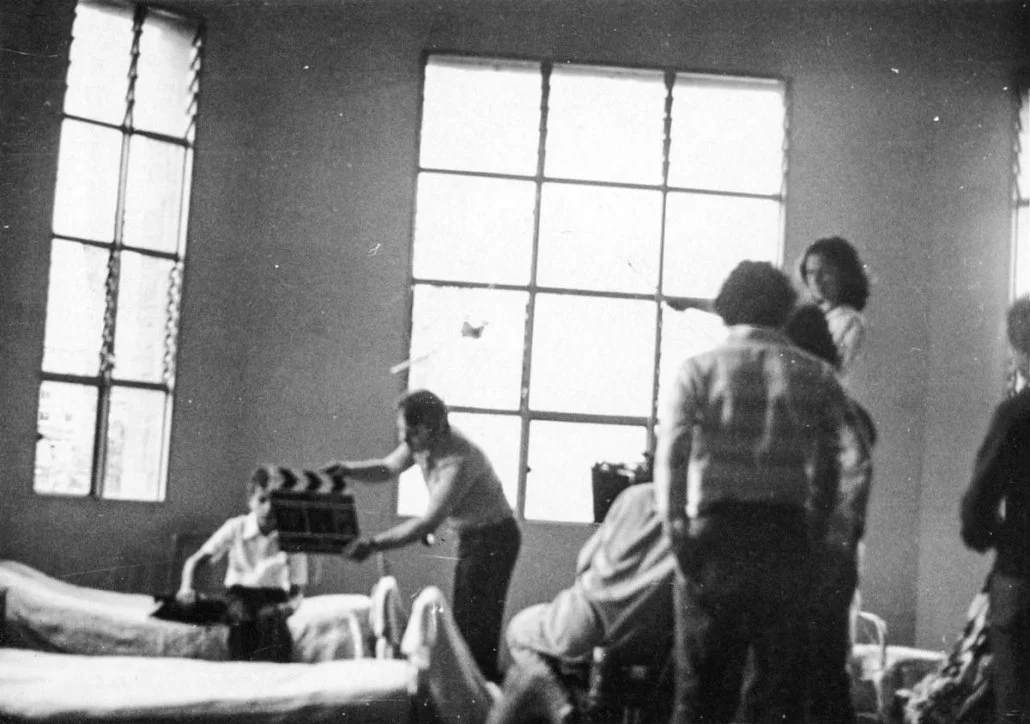
On the set of Buscando tréboles (1980).
POEM OF THE ILLUSTRIOUS DRUNK
I don’t know if it’s the shape of his face
or because aguardiente (beer too, also brandy and rum)
makes it appear so innocent, even coy.
I don’t know if it’s simply because
an alcoholic is an indestructible force
who staggers and falls hard
to the laughter of peasant girls
who are amused by anything new
(that’s their lifelong curse).
I don’t know if it’s because all night
he speaks the bitter drunken truth
until words fail him (the silence of great trees,
the idle chatter of little blades of grass).
I don’t know if it’s because his shorter leg
slips down the slope as he stumbles
over black crumbling clods of earth.
Stupidity like that is rare around these parts.
I don’t know if it’s because his body
grazes the thickets of quickstick and stirs
the blades on its branches
like that dizzy motor of clouds
until he drops anchor in the slim shade
of an elongated willow.
Or if it’s because he pays generously
for the drinks that pickle his brain
and more still for that cheap glass display
that shattered into a thousand pieces
beneath his heavy stone hands,
like the drunk’s overemotional mind
shatters into thousands of stars
when he finally crosses the bright tunnel
into the afternoon:
oranges, water bottles, lemons and austere limes,
rainwet treetops and little crystal cups
spread atop the tables of the field.
All come to the aid of Distracted One
(the Lesser), Drunk of Hours, the Bachelor of Days,
boyfriend with no busfare to reach
his girlfriend’s door.
But the drunk had dozed off
and woke with such urgency
he visited the home
of each and every acquaintance
and called on them like friends from years back
—which went to their heads, because in the country
few show any interest in anyone else. And some
went around with him, arm in arm, until sundown
when everyone went home
like children called for dinner.
Once they had abandoned him
he went by all the lighted windows,
which are deceptive because at night they look alike
with false promises of what can never occur
because of the children.
No one saw him after nine o’clock.
He disappeared like someone who leaves
for the city on the last bus, or stones
the wind erodes in an empty lot
after night falls. He disappeared in the mystery
until two children found his body on the road
and called to him and nudged him with a foot
but the silence and stillness frightened them
and they ran to share news that the drunk
who talked on and on and made them laugh
was now dead, his forehead encrusted with
a crown of blood.
Adults neared on tiptoe and hopped over bushes,
were afraid to reach the summit of night,
which is death itself. And it turned out
the drunk wasn’t dead, but had toppled
in the grass like a country bicycle,
his head crowned with bloodsplatter,
and now was out cold, like a sleeping child
or a virgin. Illustrious drunk
who acted out the death
that would only come years later, now,
in this bed of fragrant countryside
where everyone loves him
in the great sigh
of crystal clear
night.
xx
NEW YEAR
Like most adults, he received no gifts
from the son of God
and spent the days of December far from holiday sales,
from noise, and concentrated on what was inside him
rather than a month in the year, July or September,
in the hands of the breeze that knows neither firsts
nor last,
until the night of the Thirty-first,
under the starry old hat of the sky
he received, like a golden balloon, an idea
that he had searched for in days past
and failed.
It happened fast
like a wink,
like the eyes open and close
when a blast of gunpowder
tells you, “Now it’s time to change your life.”
There, at the threshold of the year,
that idea became precious
like a secret, like a distant light
projecting shadows of all the things
we otherwise fail to see.
xx
I HAVE READ PRAYERS that say
I shouldn’t despair for my life’s endless downward spiral.
“Don’t be anxious,” they tell me, but wait suspended
in the threads of each day with faith that you’ll never fall
down the bottomless pit.
But the truth is that
I am still anxious and scared and unable to read
a word of any book, nor anybody’s face. Agitated
like leaves before the rain. This morning
I cannot stay away
from the solitary summer pool
where the crystal water reflects my face. I can’t obey
the sudden voice that commands me: “Do this, do that.
Now don’t think, let whatever happens happen and fall asleep
in the afternoon light
as if in the belly of a chocolate whale.
Never again will you have to plan
because now everything you do will be
unannounced, with little foresight, one thing
after the other, all inclined at a natural slope,
so though you may do different things each day
you will experience them as one and the same,
it extends itself, forever the same in a thousand forms,
like a woman whose words only ever seem to say
one word (‘closer’) or the way that light is carried
from one room to the next.”
Now I’m anxious again—I’m in flight. Nothing will stop me:
not my mother when she invites me on Sundays,
nor a broken foot, not the fatigue that forces me to sleep,
not the encounters that fill me with kisses,
not the sudden inspired ideas that seem
like doorways to places I ought to return.
Maybe it’s all just scattered like body parts,
a mutilated body from a child’s story,
a body with no hands or feet
and a blank face
like an old television screen
or someone used to being beaten
who falls to sleep with open eyes.
xx
MY THOUGHTS, I thank you
because you never betrayed me
and kept hidden behind my face
so that even around lots of people,
at parties or meetings, you kept quiet
so that nobody ran from me screaming
and you never let out a loud inadvertent sound
like glass or a chair beneath the strain
of my strange nerves. I thank you
because you’ve endured for a long time
this final profound act of my life
and even made people in it love me:
I listened to them but said
not a word. Thank you because
you were always there,
a needed companion
on those long nights
when we were no one, please, were
no one and
the wind would only sweep us—
xx
WHEN IT DAWNS I verify
that everybody moved places in the night,
that my daughter wandered into our bed and
that my wife made her pilgrimage to the bed
of every child. None are asleep
where they should be. All have
bare legs and face the wall
or window, almost as if
deposited there from above, as if they’d simply
fallen from the ceiling.
Each sleeps in a bed that isn’t theirs
and breathes the lonely air
with hair in a mess
on their foreheads—unaware,
like somnambulists
who can’t find each other in the night,
like after a bender,
like after
a party.
xx
Translation: 2026, Garrett Phelps
From: La mañana del tiempo
Publisher: Hombre Nuevo Editores, Medellín