The Cans at the Bottom of the River
The Colombian Cinema Viewed from the Provinces
Luis Alberto Álvarez & Víctor Gaviria, 1982
Translated by Andrew Castillo
The following essay was written by Colombian priest and film critic Fr. Luis Alberto Álvarez with filmmaker Víctor Gaviria. In addition to a brief history of cinema in Colombia, the text amounts to a manifesto for their generation of cineastes. Álvarez and Gaviria outline a new aesthetic and ideological program against the national film industry as it stood in the 1980s, ideas which would later be actualized in Gaviria’s cinema: the need to make films in the provinces, despite the infrastructure being centralized in Bogotá; the need to use non-professional actors; the need to defend colloquial and regional speech against dubbing and the dominant language of Bogotá; and the need to use real locations and landscapes. It was originally published in Revista Cine de Focine, Issue 8, May-June 1982.
The text was translated from the Spanish by writer, teacher, and programmer Andrew Castillo, who also contributed the extensive footnotes. Castillo’s translation accompanies Love is Strong as Death: Luis Alberto Álvarez & Víctor Gaviria, taking place on October 18, 2026 at Light Industry.
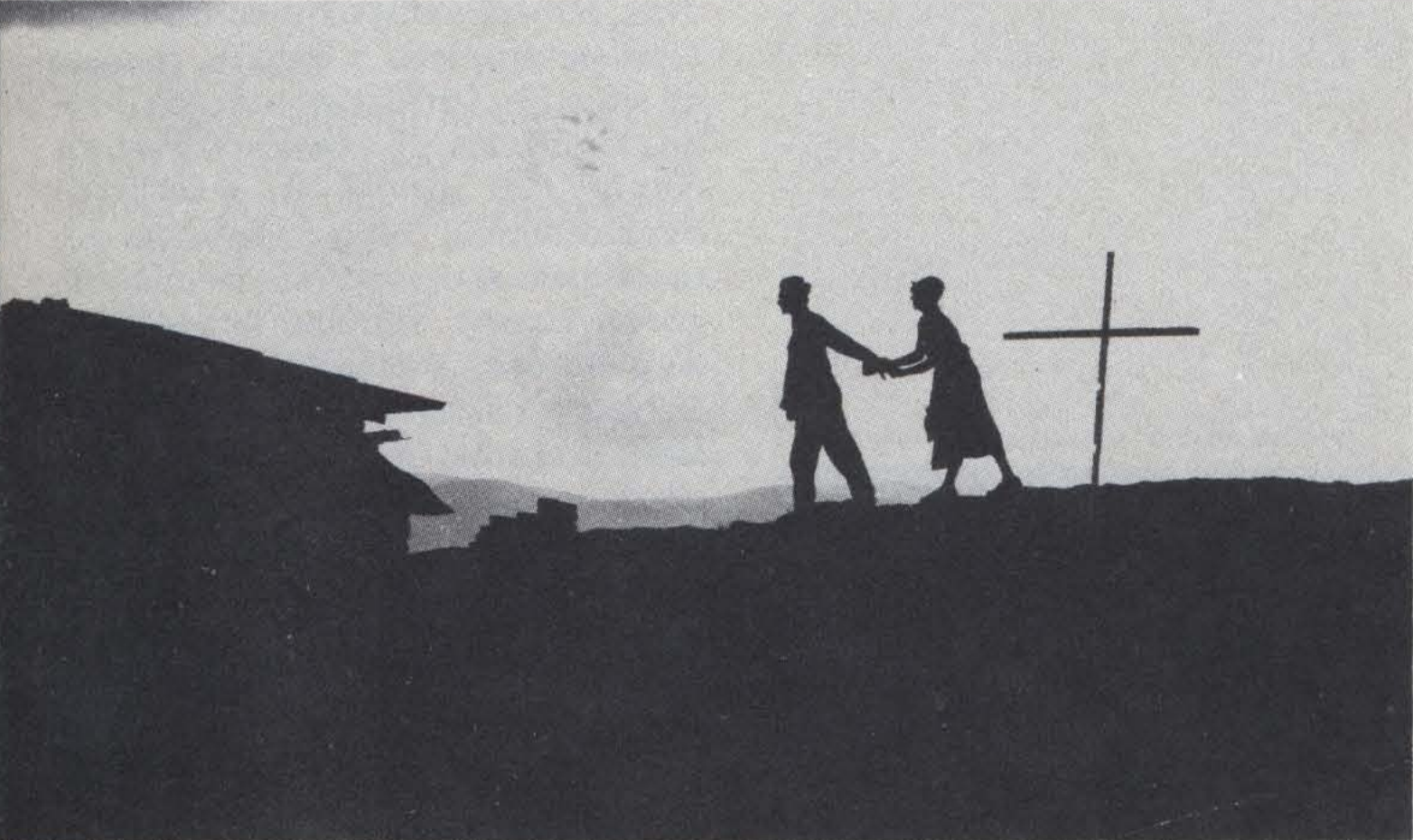
José María Arzuaga’s Raíces de piedra (1961).
One man who knew what was at stake arrived in time to prevent the rusted and dusty cans from ending up at the bottom of the Medellin River. The Moviola had already been sold for 25 dollars, but the mountains of greying celluloid had become an unbearable nuisance for the court executor. The man who arrived in time understood that what was ceasing to exist there was important. He knew that by salvaging the cans, he would rescue the spirit that dwelt inside them. When he took them home, he did not open them, so as not to let the genie escape. Instead, he set aside a resting place for them, taken from his own. Dailies, image and sound negatives, fragments of events, news clippings, advertisements, bits of stories, pieces of films, lost or never finished, people’s faces: some that everyone knows, and others forgotten by nearly everyone. A record of a past shaped by someone who once aspired to “be” the Colombian cinema.
The cans are still resting under the eaves of an ancient house along the old road from Itagüí to La Estrella, near Medellín. In the home and laboratory of Guillermo Isaza, the cabinet of a Caligari who dreamed of cinema and pledged his unique and practical talents to it, only to end up like all those who dare undertake these things in the obscure provinces: as the pioneers in books, distant and nostalgic beings who receive bland tributes but never the opportunity to speak for themselves, to take part in what they love and know.
In one of those cans that Guillermo has jealously guarded since the 50’s (which contain the remains of the national film production company PROCINAL [1]), you can see the full scope and the ambition of its sponsors. A short promotional film introduces us to the facilities, studios, laboratories, offices and equipment, plans for the future. Images that do not lie, amazing because they reveal something much bigger and more serious than one could imagine. And something even more incredible, and most unexpected: before television, at a time when radio and movie commercials were not the norm, PROCINAL and the Colombian film industry invoked the lively energy of Medellín; a parade… or rather, a procession. Schools in full dress uniforms. At their side, the clergy, the Christian brothers, and the Sisters of the Presentation with their legendary headdresses, white and starched. Marching bands and beauty queens in pink and crinolines on flower-covered floats. Fire trucks in a grand parade. Is it Holy Week or carnival? A popular celebration or political rally? Everyone holding banners proclaiming that Colombian cinema must exist, that PROCINAL must be supported. A thought that would’ve made Fellini die of envy. What became of all this comes to us via the history, already consigned to print, of what we might call with a touch of condescension, the Colombian cinema. Those who attended the procession and many others truly helped PROCINAL. Hundreds of townspeople of modest means, domestic workers and laborers, invested their small savings in shares of the company. What could be more beautiful than being able to invest in one’s own dreams, than being a stockholder in a factory of dreams? A “beautiful Colombia” was born, and then came bankruptcy. The synchronization of image and sound in the film is described by Guillermo Isaza as follows: “The music was still playing when the members of the trio had already hung up their guitars.” Well, we may have understanding in these kinds of instances, but not for thunderous economic failures. The PROCINAL affair was a major scandal of the 1950s. The people have not forgotten.
Today we are more professional, have better executives, more educated economists, fewer dreamers. We know what a good investment is and we understand the laws of profitability. But one thing remains true: there were far fewer resources in 1981 to make a film in Medellín (and Cali and Barranquilla) then there were in 1954, when, following court orders, an executor put a stunning Moviola on sale for 25 dollars; 25 dollars of the time, but still, 25 dollars. Medellín today offers no more guarantees than it did then, in 1954, when reels from the PROCINAL archives threatened to sink, like the treasures of the Nibelungs, into the then clean waters of the Medellín River.
Camilo Correa, soul of the PROCINAL enterprise… Guillermo Isaza, film craftsman and inventor of instruments, his image and sound laboratory assembled by hand, piece by piece… Enoc Roldán, whose biography-turned-bioscopy of President Suárez [2] drew more viewers and grossed more than all of our “industrial” productions combined… Ivo Romani, molded amid the inventive thrust of Italian neorealism, thoroughly knowledgeable of all technical filmmaking equipment… Between all of them, a Medellín cinema could have existed long ago in the province. A cinema undoubtedly more vibrant than any current model. But they didn’t succeed. Their effort, much greater than that of any Bogotá TV personality, has yielded immeasurably less. This enigma has a name: the province. The failure of this gifted and intelligent group has a root cause: the curse of having stayed in Medellín, the punishment for not having settled in Bogotá. Because - shall we say it once more? - Bogotá has been established not by divine providence, but by clear and precise political and bureaucratic interests, as the sole, fixed place for all in this country who wish to undertake a venture. David Wark Griffith and other pioneers of American cinema who followed decided to head west, fleeing from the Patent Company gangsters. They also fled from bad weather, from the ambient gray of New York, searching for prolonged sunshine and a stable climate. The Los Angeles suburb called Hollywood was the most remote province, far removed from culture, finance and politics. The Colombian system works in reverse. In the beginning, it was still common to film Under the Antioquian Sky [3]. Later, Bogotá was designated the undisputed capital of cinematographic activity, after which point aesthetic decisions were made to accommodate the demands of the climate and the city atmosphere. This meant accepting without question a perpetually blue cinema, full of gray skies and characters in sweaters. It doesn’t matter that the temperature isn’t ideal for laboratories or that the weather is the most unpredictable in the entire nation. Save for a pinch of Girardot, Melgar and Villa de Leyva [4], Bogotá's privileges have nothing to fear. Of course not - it is, after all, the place where the country’s only television network is based, where the Minister of Communications and Quality Board are located, where Colcutura reigns (and acts with near-complete dominion), where Focine rules, where the only cinematheque is housed and where the embassies have their headquarters, the stronghold of the Grancolombiano Group and its faithful daughter, Cine Colombia, the seat of the shadow distribution monopolies, the place from which planes depart to, and later arrive from, the United States and Europe, a place where it’s easiest to solve things with an invitation to eat, where it’s less of a hassle to hand over an envelope, where you can shake hands and be introduced to the people who decide our fates, with the obvious advantage of being able to relate. That’s why in Colombia, like it or not, to say cinema is to say Bogotá. That’s why those of us in the west have to take the path opposite the one followed by the American pioneers of the last century, and the pioneers of cinema at the beginning of this one. In our case, the call-to-action should be: “Go east, young man!”
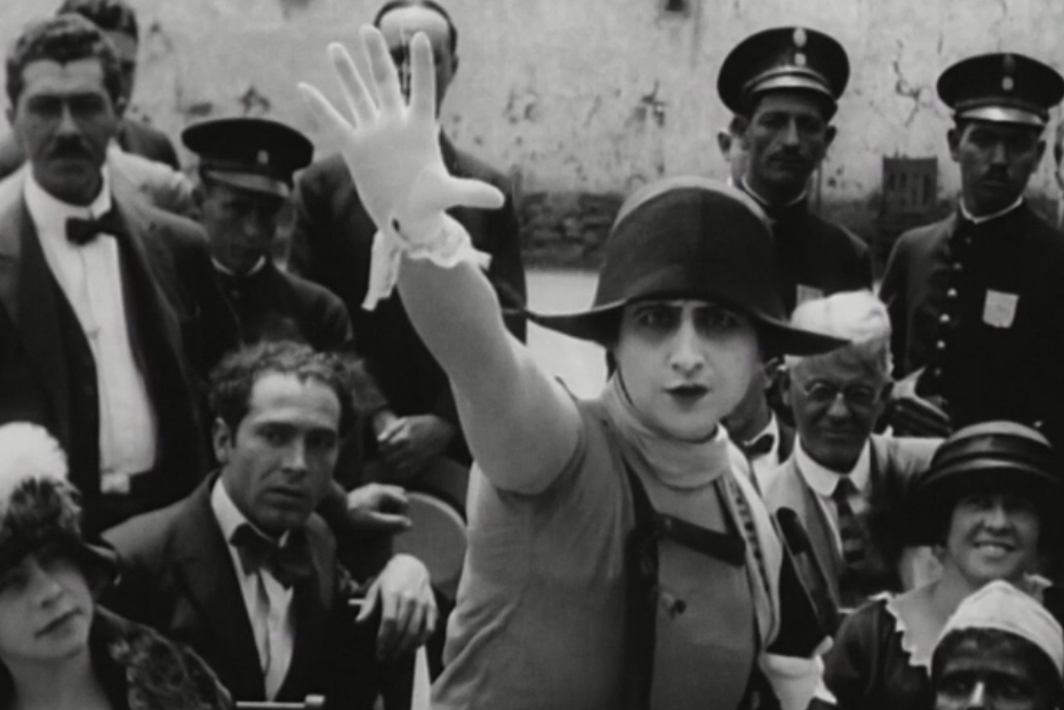
Arturo Acevedo Vallarino’s Under the Antioquian Sky (1925).
Nestled in the deepest depths of the Amazon rainforest, accompanied by armor-clad Germans, director Werner Herzog shared with us the fate of sub-technification. There were no rushes of Aguirre, The Wrath of God until several weeks after shooting, when the exposed film had time to be sent to Germany and return developed. In Colombia, not only regional filmmakers experience the gnawing uncertainty of not knowing what has become of their work, of hours, days and entire weeks; of not being able to divine whether the thousands of meters of expensive film stock contain any useable footage, or if perhaps some technical or artistic eventuality has reduced it all to nothing; of not being able to know whether that unique, unrepeatable shot, the shot that even the most skilled editor could not salvage, has turned out as expected or has succumbed to one of the many variables that render it fallible. In this field, equal conditions prevail in Bogotá and Medellín. If a Colombian lab were to one day guarantee acceptable work, the situation would change again. Because that lab would be located, naturally, in Bogotá. Right now, we’re all down on the floor. If circumstances were to change, only Bogotá could make it up in the bed.
But let’s not exaggerate. In this case, the complaint is only rhetorical, as we cannot expect every city in Colombia to have a well-equipped laboratory. It’s almost too much to ask that Colombia as a whole have one. For the purpose of viewing dailies, being in Bogotá or Medellín is the same as being in the Amazon. But we could not say the same about the metropolis and its outlying neighborhoods, and their profound differences. The concentration of film crews in Bogotá is not necessarily an insurmountable coincidence. There is a fundamental structure that could be organized differently: national television. As television acquires more importance at every level of activity, from education to consumption, from information to the shaping of leisure time, it becomes undeniable that neither sports, nor the Church, nor advertising, nor politics can do without it… nor the cinema, naturally. All over Colombia, there is sports, the Church, advertising, poltics… but only in Bogotá is there television. And Bogotá is not the headquarters for Colombian television, but rather, for Bogotano television.This reality means that those with all the interest in media, all the cinematographic talent, all the technical knowledge in the country have to choose between going to Bogotá or changing their profession. Hence why the use of crews based in the capital can only essentially function as a kind of gracious condescension, with all the limitations that this entails. If you need some lights in Bogotá for a scene that lasts a few seconds and takes an hour or two to shoot, you can rent them or borrow them from a friend for the hour or two you’ll use them. They’ll be returned by evening. If you’re shooting in Medellín, lights are not sent by mail. They have to be brought by the technician coming from Bogotá who will work with us, and who, because he is from Bogotá, is trusted by the owner of the lights. The technician comes for the three or four days that the shoot lasts, and there the lights are, in their cases, until the very brief moment when they’ll be used. In the meantime, you’re paying for them, by the hour or at a stipulated global rate. But this is the least of it. The real problem is that the lights are the smallest manually operated model, and also the least powerful. They may not be suitable for what the provincial director wants. With these lights, there will be no opportunity to create spaces because they cannot provide deep lighting. They serve the same purpose that lighting used to before the Italians of Cabiria began to use them creatively, so there was enough light, so you could see what was happening. But these lights are the only ones that can be brought in from Bogotá without issue. At moments like this, when the director makes their deaf and futile gestures of defiance, the response is always the same: “But why don’t they make their films in Bogotá? Everything is easier there.”
The consequences of this response - and the fact that it is accepted with alarming frequency - are of a more profound nature than the purely technical. Temptation arises at every turn and behind every difficulty; when choosing a shooting location, when selecting crew members and actors, during editing and dubbing. Every mistake is met with the comment, from others or from oneself. “Why wasn’t it made in Bogotá?” And so one becomes part of that great current that lies at the root of the perpetual aesthetic failure of Colombian cinema, the belief that things are interchangeable, that one place is the same as another, one object as another, one person as another. That tendency that believes it possible, for technical reasons, to transform a script or story with impunity, to change its setting, its atmosphere, its ambience. That way of thinking that maintains that there is no difference whether the protagonist is an architect, musician or doctor. That style, which leaves its very clear imprint of mediocrity on our national cinema and television, which was not the one used by José María Arzuaga in the two feature films he made in the sixties [5]. That’s why they’re there, monolithic, as if they’d fallen from another planet, antipodal to films that feature the same people, the same places, the same stories.
The desire to make films at any cost leads to many concessions and many oversights, some more and some less conscious. Of those oversights, the most fundamental and pernicious is that of the real as a physical fact. The Colombian cinema forgets that the basic cinematographic choice must stem from an attraction (or hatred) for things left to their own reality. The method we use is this: we imagine a story first, and then, as if it were something we could construct like a studio set, we imagine the location where that story will take place. Encouraged by the dominant cinematographic structure, what we do is adapt the story to the place where filming is technically more feasible or more comfortable. We believe, however, that the process should be reversed: a river, a dusty road, a house, the sky itself, each should be sufficient on their own. Only in this way can the director’s gaze pass over living things, things that sparkle, that possess intent. Only then will there be characters who do more than simply represent. Cinema is inevitably a modern art: it is born at the moment when poets effortlessly introduce laundry lists, timetables and the names of train stations into their poetry. That is to say, a moment when raw material seeks to appear as such, without transformation.
In Las cuatro edades del amor [6], to portray a “repressed” woman, a workshop of religious imagery is used. And in contrast, to portray her friend who leads an open, urban lifestyle, an equally typified setting is used: the crowded windows of a tax office. For Colombian cinema, like the painted backdrop of a theater, reality illustrates the concept of the director. For this cinema, reality is always public, and directors succumb to the fascination for public spaces that elicit immediate recognition from the viewer: a house in La Cadelaria, Carrera Séptima, Unicentro [7], the trendy nightclubs, the drag shows… places that have only symbolic value. The director’s eye does not scrutinize them nor view them ironically, does not fall in love with them.
Reality that does not immediately obey any notion, that does not represent a social value, seems not to exist. The simple staircase, the anonymous street, the sidewalk, the park that does not resemble any “known” park, the real apartment, the small cafe… the setting that has no prior representation and, therefore, forces the director to construct it based on a deep understanding, with every gesture of the characters. “The” avenue, “the” discotheque, “the” park and “the” cafe should not exist in and of themselves, but always as concrete places that the director “initiates an encounter” with.
***
The first encounter with cinema often leads to a painful, progressive dismantling of purely cinematic standards. This is even more painful in the provinces. The possibility of finding a local producer is very slim, and only very few do. This luck stems from sponsorship or spontaneous enthusiasm, never from an organized and professional production. The first cinematic standard is invalidated right away: How much time can I devote to telling this story, given the demands of its structure? Then, how much time do I need to make it with the necessary zeal and focus? The number one disappointment when it comes to the chain of command is learning that neither the screenwriter, nor the director, nor even the producer of the film are in charge of providing these answers. For short films, there is a supreme legislator, an aesthetic criteria that cannot be appealed to: Cine Colombia. Their law states that a Colombian short film cannot be longer than 13 minutes, and that the ideal length is eight or nine. It is the space allotted to comply with the onerous pricing overage laws (less onerous when Cine Colombia have produced it, and get the money right back), and ideal for placing the film in the midst of highly profitable advertising. The practical result of this aesthetic limitation is that one has to undertake a terrible process of purging and mutilation. In this process, images and locations that had excited you die, characters that appeared important or useful fade away, you turn your back on beautiful things, begrudgingly convincing yourself that, deep down, they were superfluous or inconsequential. And one comes to invent an ideology: that this is a work of discipline, that it is the asceticism of cinema, that it is the way to make cinema like the Americans… Out with everything that is extra! What is extra?
Everything is interchangeable. To improve effectiveness, many things can be changed. Direct sound? No one can do it well here. You need a camera with a blimp, since a standard ARRI camera is no good… and besides, what’s the point? With dubbing, things can be done much better! Furthermore, we only have three days of shooting. Direct sound would interfere with everything, and many takes would have to be reshot. Extend the shoot? Don’t even think about it. The technicians from Bogotá get a fixed rate for their work, and they are the ones who determine how long the shoot lasts. After all, their work here is just a concession, done in support of regional cinema. After all, it’s only three days, not a single day more… there are juicy commercial contracts, etc., etc. But… it’s just that… besides… we can’t do the dubbing in Medellín… there’s nowhere to do it here… In Bogotá, naturally. And how can we take all these people to Bogotá to do the dubbing? Take them? What were you thinking? In Bogotá there are voice actors, professionals, television actors, people who know their stuff! For the children’s voices, you can use the child actors from Radio Nacional, they’re terrific! But… what?… they’re Bogotanos? So what? Well, can I imagine a story set in Medellín spoken in Bogotano voices? It doesn’t matter! That’s the least of it, these people are very professional… besides, viewers are used to it… and the Paisa accent [8] is so ugly that dubbing benefits the film. If you had made the movie in Bogotá you could have made it with direct sound, if you like it so much. And everything else, faster and easier. There you have professionals… real actors. Why don’t you offer a part to el gordo, Benjumea [9]? It would give the film so much prestige!
The “professional” actors of Colombian cinema are, as a general rule, television actors. There are no professional film actors. Who should have this title if not the ones from television? It has been proven that theater actors distort the cinema even more. Television actors already possess an accepted level of acting skills, which negates risk and criticism, and, incidentally, spares directors the meticulous work of screenplay development. Just as there is the tendency to depict public and recognizable spaces, we can say that, as a related consequence, there is a tendency to use the public image of television actors. Although in their faces, their gestures and their diction, they retain the class from which they come - almost always an ambitious middle class for whom pretense is second nature - for the viewer, their constant presence gradually polishes the image until it eliminates any rough edges that threaten a life-like, contradictory recognition of one’s self. The image of the television actor is free of contradictions. They are not a mirror for anyone, for they have become disembodied. No viewer can say, “I am like them,” but rather, “I want to be like them.” From the many who desire and strive for it, they have managed to become the representatives of the anonymous, with a fixed, celebrated face. To the general spirit [10], they are the older brothers with a face and an identity, only their identity does not pass through the flesh. It hardly matters that they are fat or bald, or covered in acne, or that they age. They are, before all else, names and blank bodies that have crossed the threshold of the everyday, of daily life in decline. They are, according to ancient tradition, “those who embody everyone’s desire for pretense”; in other words, no one. When el gordo Benjumea appears as an immigrant in the United States [11], his identity is not that of an immigrant, which would imply a contentious presence, but that of someone to whom we have assigned “the virtue of playing all roles,” including that of an immigrant.
Television actors have portrayed the people of Bogotá on film. But they are not from Bogotá, they are merely its public image. They are the static, sanitized image, the illusory image of the city’s people. And cinema, like any art form, should be wary of this illusion, and shatter it. Just as we tend to perceive the camera as untainted, television actors are a floating assortment of public masks, of refined, conflict-free images that have very little to do with the ambiguity, the richness and the attrition of reality.
Watching a scene being filmed with el gordo Benjumea, you suddenly realize that the location, the open countryside and the buildings, are identical to those in Arzuaga’s Pasado el meridiano. What’s terrible is that the people making the movie don’t even realize it. They’re like madmen trying to light a car, to make it look like they’re somewhere else, on a street in the middle of the capital. They’re making a fake film in the middle of a real one, or from the reality of a real one. And people, Bogotano faces, crowd around to watch the movie being made. They look like they’ve stepped out of Arzuaga’s film. They’re watching a movie being made that they will not appear in… and yet people will say it’s about them. The day there’s a real Bogotano cinema is the day there can be provincial cinema.
***
When making cinema in the provinces, it is difficult to find sufficient time to conceive of a film in terms of space. Owing to Eisenstein, time and space are one and the same, in the sense that rushing takes away from the staging. Perhaps this is what makes our television among the shallowest in the world, to the point where one might think that all the shows are filmed in a studio no deeper than our TV set. One step forward and the actors’ noses would press flat against the glass of the screen. And behind them are Pizano’s plywood walls [12], shadows painted in the style of German Expressionism, because real shadows take time, and Estudios GRAVI [13] has an army of technicians working in shifts. That Colombian aesthetic - in which an actress walks with candle in hand through a house illuminated by high-wattage lights, glaring unobstructed from above as if there were no ceiling - has been inherited by the bastard child of Inravisíon [14], mainstream Colombian cinema. The solution for a film, then, is to always make the lighting as simple as possible, and to arrange the actors and props according to the lightning, and not vice versa. If necessary, one must change the concept of the shot, the location, the script, the story. It’s not that there aren’t people who can do things differently. The problem is that, if there are only three days of shooting, any other approach would be an impossible luxury. There would be no problem in Bogotá. There, things can take a little longer, and the director of photography can come back next week at his leisure for evening reshoots. But in the provinces, whatever wasn’t settled during the three days of filming was left dead and buried forever. You can imagine how awful it is to think that there is no final shot for the film because it was done on the last working day, and it was 4:00pm, and the child actor wasn’t responding to directions, and then it was 4:15 and the camera, powered by a motorcycle battery, wasn’t running at 24 frames per second, but at 20, 18, 16, and it was 4:30 and the light was beginning to change, and it was 4:45 and you had to wait for the only magazine to be replaced because the other one was chewing up the film, and it was 5 o’clock and the kid actor, beset by everyone’s nerves, couldn’t manage the required expression for the last shot, and it was 5:15 and the director of photography solemnly announced that this was the last chance: if the shot isn’t nailed now, no matter it turns out, there will be no more takes. It’s the last day and there’s no more time to waste. Bogotá can’t wait, and it’s 5:30 and you think that if you don’t get it, there won’t be a final shot, not now, not ever.
Weeks later watching the footage, you realize that - how could this be? - the shot isn’t what you wanted. If this happens in Bogotá, it’s possible to take the equipment out again, gather the crew and spend two hours on a weekend reshooting. In the provinces, it’s impossible. If there isn’t another shot in your footage that can replace it, you have to make do with the one you have, flaws and all, and be grateful that at least it exists. In principle, one could rent the equipment again, cross the Magdalena [15] for the second time and once more ask the cinematographer to set aside two or three hours of their time to come and save the day. The problem is that not even the richest or most generous producer would do such a thing, because this sort of production - even those made in 3:1 or 2.5:1 [16] - ends up costing more than three hundred thousand pesos, and Cine Colombia, as much as they deserve our utmost appreciation, gives four hundred thousand pesos and not a cent more.
Experimentation, exploration and expression can only occur if one possesses a sense of improvisation and a speed of execution well beyond the ordinary. What’s left behind though is the nostalgic dream of an open window, backlit, light flowing over sharply defined figures; a camera that delimits the space, letting the character exit the frame only to capture them a moment later from the other side, now moving in the opposite direction; the desire to move the camera in sync with the action; the desire for a wide shot from above, contemplating two figures pummeling each other while traffic flows on indifferently; these remain behind like a screenwriter’s imaginings, like dreams of a poem that, in the end, forced by circumstances, one must write in the prose of a lawyer. There’s no way to discuss a shot, to sit together and watch, to let ourselves be absorbed by places and things.
In the cinema of José María Arzuaga, at least in Raíces de piedra and Pasado el meridiano, there is a conception of space that does not exist in any other Colombian film. The characters move and become part of a real space, and there is a harmony between the movement of these characters and the camera, and their relationship with objects. One feels the air moving through the cracks. In the 1960’s, Arzuaga responds to the breakthroughs and explorations of the new cinema, and with his own sensibility, not out of pedantry, integrates those breakthroughs and explorations into his films. The problem is that he can’t find an adequate technical response. His dolly shots, his handheld camera work, his camera angles, they are not executed by skilled camera operators. And among his cinematographers, he cannot find one who knows how to craft a visual beauty that matches the discernible beauty of the concept. In Arzuaga’s films, one can easily sense his intuitions, imagines what he’s trying to say, and then it ends up left unsaid. Arzuaga’s courage lies in his refusal to abandon his ideas, despite the shortcomings of his films. The fact is, our films have fewer flaws than his because we have stayed on this side, in that conservative space where we appear composed and dignified, refusing to leap into the void. Arzuaga, on the other hand, cannot help but leap, even if the leap isn’t pretty, and results in injury. Take, for example, that complex camera movement in the bank in Pasado el meridiano, which, despite its genuine clumsiness, offers a glimpse of one of the most wonderful moments in Colombian cinema.
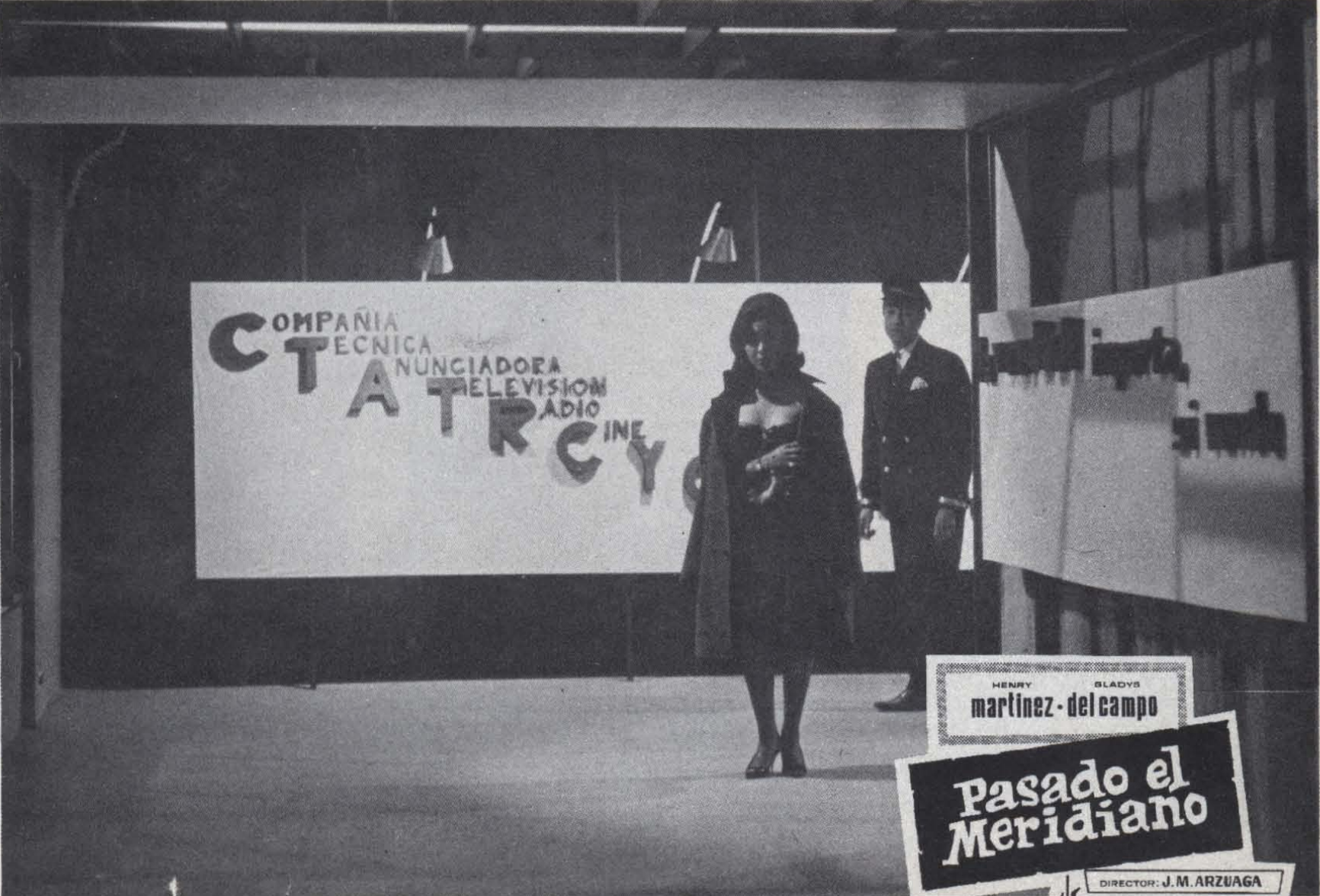
José María Arzuaga’s Pasado el meridiano (1965).
The way the characters move in Arzuaga’s films, the way they’re integrated into their world - a man bathing on a terrace, a madman and his daughter on a cliff in the slums, the employees and security guards in an office - is a phenomenon, a unique vision that has yet to be replicated. It is possible that, as a foreigner, Arzuaga has acquired an uncorrupted, dignified, detached view of people and things (a phenomenon that seems to be repeated with the Chilean Dunav Kusmanich). There are no more dignified, more three-dimensional, more real beings in the entire history of the country’s cinematographic record. Contemporary Colombian cinema, the cinema of interchangeability, of forgetting physical reality, the cinema of illustrative public reality, the cinema of simulation and non-space is a cinema that has embarked on a radically different path than that of Arzuaga. By asking ourselves here in the provinces if it might be worthwhile to encourage a “return to Arzuaga,” we would not be promoting a reiteration or a cult of something that ultimately is not sufficiently developed to constitute a model; we’d be promoting a way of seeing things, an approach, a sensibility that we urgently need.
The pole most radically opposed to Arzuaga’s is that of our television aesthetic, with its omnipresent, myopic style. Television is such an obvious enemy of what we consider the noble language of Colombian cinema that one gets distracted and overlooks its manias, walking past it and only hearing blah-blah-blah, without realizing that behind it there is a stupid, dull, malicious eloquence, but an eloquence nonetheless… an eloquence that influences.
When someone among us sets out to make films, they discover that they have already been subject to countless lessons, that they have already inherited eyes and a distant, sinister gaze. We must start from this basic truth: in more than a quarter century of existence, that eye that is Colombian television has never seen anything. Someone who wants to make films must strive to take inventory, to compile a list of the distortions that affect this sad, ambitious gaze. For example, real objects do not exist on television. Enigmatically, human beings on television carry out complex activities without using objects, like spontaneous Platonic beings that move among shadows and objects that are merely reflections, representations of other things. On television, nothing can be looked at, no thing has earned the respect to be gazed at intently for a few moments. The table is the reflection of a distant and impossible table, the idea of a table. The ashtray (if there is one) represents another ashtray that it outside, one that no one has managed to bring inside. The lamp is there, as a symbol, but no one has turned it over to make sure it’s real.
It is pointless (though interesting) to try to define what constitutes a real object and what is merely a simulacrum. In major studio films, objects have come (been brought in) from outside, from places where they served their original purpose. Upon entering the studio, they have lost their original “human” function, but that does not mean they have ceased to be real. In cinema, a real object is one that demands to be looked at, one that winks at you, emanates a certain power. You either engage with it, or move away from it. It can be rotated, like any other body.
On Colombian television, these bodies do not exist. Its objects do not scream, do not give off smoke, do not transform into other things. Is it possible to make films when all one sees are abstract signs? This is the reason for the absence of space in this country’s cinema and television. Even before the lack of scripts, actors or literary works to adapt, before the lack of that ever-ambiguous “talent” and “commitment” demanded of filmmakers, before all of that, from the very beginning, there is the absence of space. Space is the only thing that allows the viewer to engage with the image confrontationally. The image is no longer just a reflected message but the presence of bodies that relate to one another, impeding, separating, drawing closer. Television has given us a sinister education in this regard. The in-existence of real objects corresponds to a disdain for the unique reality of places and, even more, a disdain for the space that comprises these places. If the lamp has no value it itself, as an object that can be looked at, and neither does the window, and even less that which is implied behind the blinds, if none of these three things are real, it is impossible for space to exist between them and for characters who move between these objects to be read as real. Space in cinema is simply the awareness of looking at, from a precise point, a constellation of real bodies, each with its own curious right not to be destroyed, to offer resistance, and though it has none of the same Olympic pretensions, the right to act or move as if they were not there. Ignoring space in cinema is as absurd as walking through a conference room crammed with chairs without dodging them, stumbling over them as if they weren’t even there.
The limited use of tracking shots and the heavy reliance on zooms in Colombian cinema aren’t solely due to financial constraints. There’s something else: almost no one is interested in the spaces where filming takes place; the air, the bushes, the banisters, the doors, or the countless bodies that surround an actor. Why move the camera through a space that is of no interest when the magical zoom can fly over it and bring it closer without us having to move from our spot? Cinema can be nomadic or sedentary. Neither of these forms is, in and of itself, better than the other. In the Colombian cinema, Julio Luzardo’s Tiempo de sequía [17] was a nomadic film. Endless tracking shots through grass and weeds accompany a peasant’s pursuit of his dog. But this could simply be something that was learned in a school. The presence of the bushes and the weeds, the silhouette of the man against skies of a clean, brilliant light, filtered à la Figueroa [18]; if they are just that, if they remain with transforming, they cannot escape the rhetoric of a learned shot. With still cameras or ones in motion, nomadic or sedentary, the essential thing is the space they create.
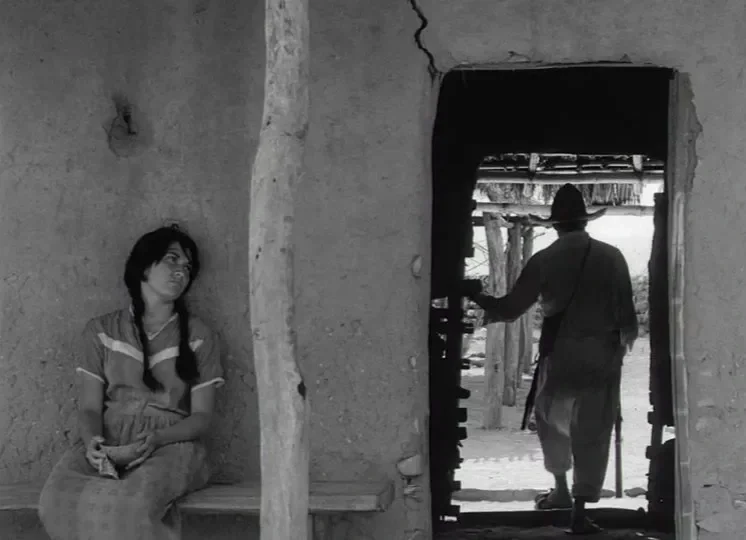
Julio Luzardo’s Tiempo de sequía (1963) (from the omnibus film Tres cuentos colombianos).
Colombian cinema and television have been sedentary in the worst sense. Not the sedentary that looks from a precise place, as far as its gaze reaches, that accepts that there are doors that get in the way, window frames, the torso of someone who crosses, the row of bottles that only barely let the shine of the second row through, the glass of a cup through which the patio is viewed, the back of a chair that hides someone’s hair, the voices that resonate in the street though we cannot see whose they are. The long, empty stretch of wall that you have to pass through with the camera to connect one character to another doesn’t exist in our cinema. Nor the restless, unpredictable camera that accompanies the character to the bedside table then back to the door… and again to the same bedside table because he has forgotten something. This confusion and unpredictability so typical of life are simply the presence of space.
Our cinema and our television have been sedentary in the sense of believing that there should be no obstacle between the viewer and what is being viewed, that what is being is filmed should lie placidly and obediently before the camera, without rough edges, profiles or backs, politely facing the camera. More than sedentary, they deny that there are places to traverse, spaces that differ and come between. This is, simply, the belief and the myth of a smooth, obstacle-free space, always facing forward, toward the viewer like the front-facing, over-lit actors in a soap opera, or the expressionless face of a newscaster. Never mind the patience of a camera that watches the character pass by the window from within and waits, motionless, until he walks through the unseen door and reappears, now inside, moving in the opposite direction until reaching the payphone. Never mind this lesson in waiting respectfully that José María Arzuaga so often teaches us. Nor the distant, dignifiedly penetrating gaze as we witness the first attack of madness in Raíces de piedra, the character thrashing on the sidewalk like an epileptic, seen through the window of a shop where the toy plane on display stands out, unbothered, pristine and elegant.
Physical spaces are also, above all, dramatic. The character in Pasado el merediano runs off leaving his new girlfriend behind, in the hands of a pack of boys who have begun to rape her. From this point on, wherever he goes, whether to work or to visit his mother’s village, the viewer feels that, secretly, the character is either getting closer to or moving farther away from that place, with its grassy hills and ghostly structures, from which he fled in a tragic, ridiculous manner.
Our television and cinema are an image without a back. Are the backs of those shown so indistinct and vulnerable that they would rather simply turn them? Can it be that, in addition to their obedient and stupid faces, well-mannered and mawkish faces, that they also have insignificant backs, identical to all other backs? Has any Colombian director turned his characters around completely, simply to show them as limited, human bodies, from all their many angles? How many times have we had cameras that circled and shown faces, arms and backs… and again, arms and faces? Maybe a privileged one or two. The final shot of Pasado el merediano serves as an example: after leaving the village of his already-dead mother, walking in the opposite direction of a caravan of cyclists circling Colombia and helping push a bourgeois boy's car, the camera begins to slowly circle around the character, to set the limits of a single dignified body, which bears the weight of a unique, extraordinary human fate.
Colombian cinema has rarely focused on a specific individual. The few who have done so observed that individual discreetly or intensely, but always meticulously, circling around them, as if they were looking at themselves. This has allowed them, as with Arzuaga, to raise their heads to take in a flock of children emerging from behind the walls of a cemetery, shouting, laughing and furtively running from one place to another, annoying the solemn visitors.
There are principles that are easily compromised in the face of difficulties, but there are others that, even in the most challenging circumstances, should not be sacrificed. It’s possible that in the provinces, necessity is the mother of invention, and that shortages end up awakening creativity that abundance does not. Dubbing by actors from Bogotá? Never. Traveling to Bogotá with the entire cast? Impossible? Then come many sleepless nights spent thinking of a possible solution that would satisfy both ethical considerations and the budget. Betamax! Why not take the actors to a regular sound stage and record what they say while they watch their own image on a video screen? The synchronization isn’t perfect, and the cassette player’s motor doesn’t run at the same speed as the tape recorder’s… but in any case, you get a very close approximation that can later be aligned as closely as possible with the image, thanks to the magic of Moviolas and the mixing console. The result is, technically, less proficient than that of conventional dubbing, but the characters speak with their own voices and provincial accents, without schizophrenia. Reality is worth a few spelling errors.
Crafting sound mixes for a movie is a process that still functions in a curiously artisanal way, despite the sophistication of the equipment. Assembling a soundtrack is like making a patchwork quilt, joining pieces of perforated magnetic tape with other formats, so the lengths of the various tracks are always exactly the same, and work in perfect coordination. It’s possible that the provincial director hasn’t been told that to get the sound of a bird singing four times, they have to copy the sound of the bird onto four different lengths. Not knowing this might cause them to make one bird sing and leave the other three silent. A lot can go missing in a mixing room, leaving an eerily empty soundtrack. In Bogotá, people don’t bother too much with explaining certain things, as it’s assumed that everyone knows what to do with the equipment. The country mouse doesn’t ask too many questions, because the city mouse might find him tiresome and ignorant. A whole night of sound editing and mixing can cause you to lose certain perspectives, and fatigue can make you miss things. But a film for which you’ll receive, at best, four hundred thousand pesos, cannot budget for an extended stay in Bogotá for two or three people, the same two or three who conceived of it together and would like to see all facets of it through together. It’s for that very reason that they didn’t come to Bogotá, that city where the Moviolas have just the right contrast and brightness, to cut the film. On the only Moviola that exists in Medellín, the images and their nuances can barely be grasped, and only thanks in part to memory and concentration. This Moviola is, in fact, the most “cool” media McLuhan could have imagined [19]: no viewer has ever had to rely so heavily on their imagination. But what is actually contained in each image emerges when the edited copy is projected. The long shot of the face had a completely inappropriate expression that was nowhere to be seen on the Moviola. Unwanted objects appeared at the top of one shot… Out in the provinces, only a rough cut is possible. No one escapes two or three hours of editing on the Moviola in Botogá.
To reject the commercial standards of cinema to reject neutrality, the neural image and neutral language. Cinema is one of the most stigmatized activities that exists. Distribution and exhibition have accustomed us to certain fixed norms, of things that should be and things that cannot be done, codified in the form of commandments and learned by the entire spectrum of industry employees. Every theater owner believes they know the public’s taste and that belief persists through even the worst failures, brought about by a lack of flexibility and no sense of evolution. Film production in Colombia is emerging with deep-rooted taboos, with compulsions, with supposedly infallible rules, as if no lessons have been learned from history and experience. Even very serious and seemingly sensible people are already speaking authoritatively about the tastes of Colombians, about the things people like and don’t like. Three or four topics are cited, and the claim is made that outside of these, there’s no salvation. A list is provided of recipe ingredients, without which all cakes would collapse; these topics and ingredients are always, as we’ve been saying, matters of public policy, and always in exaggerated amounts. Exaggerated but epitomized, and, ideally, mediated by those “famous anonymous” faces that television offers.
In these conditions, it is impossible that reality can be accepted as such, without any kind of filter. It is impossible to accept the outside world without it being neutralized at the level of experience and language. The regional language and way of being do find a way in, but only in the stylized or fixed form of the official television artists. Hugo Patiño can tell jokes in a made-up Paisa dialect, or Clímaco Urrutia can speak in a Bogotá accent on grotesque comedy specials. But in a “serious” program or a movie with realist pretensions, it is taboo for people to talk as they normally would. Not even Bolívar can speak like a Venezuelan, nor can Manuelita like she’s from Quito, and Córdova is forbidden to speak Rionegro Paisa [20], like all the unreal characters from that real and indifferent space that our cinema and television produce. If, in that space, people move among objects and landscapes devoid of any substance, it follows that their movements, their actions, their very beings are those of grotesque puppets, guests at a grand and tedious masquerade.
The provincial director eagerly waits for the public to engage with their film. In just a few seconds, after the reel begins to traverse the sprockets and the arc lamp casts the first signs of life on the screen, the characters begin to speak, to speak like the people watching the film. The initial reaction is a laugh… Amused? Mocking?… Or complicit? People look at each other. It is certainly not usual to hear people on the screen talking like that. On television, the language is sometimes that of Bogotá and almost always a proper dialect, an Esperanto, an artificial way of speaking acquired in multiple stages, through broadcasting licenses from the Ministry of Communications, acting in radio serials, broadcasting sporting events, projecting one’s voice, calling goals, engaging in fictional dialogues with unreal beings, a very serious voice that can’t be taken seriously, like that of circus announcers. And then a taboo is broken, and the provincial director trembles. They think someone should have done it, but they don’t know if the audience will understand. It’s ten minutes compared to the hundreds of thousands of hours spent in front of the TV. Moral certainty is one thing; what people want or are used to seeing is another. The provincial director decides that the audience’s laughter is definitely one of complicity, or at least that’s how they want it to be. And why not? Why wouldn’t people, after a moment’s shock, want to feel as if they’re in familiar territory, amid gestures and expressions they’re accustomed to? Laughter isn’t always a bad thing… even in very serious situations. The provincial director knows that someday, someone will know how to do it better than they do, that people will learn not to be ashamed of themselves.
On a given day, someone requests a 16mm projector so they can watch a movie that interests them. An entire family shows up, eight or ten people of all ages. Children with pacifiers and stern-faced elderly people, boys, girls. The movie touches them more personally than they could have imagined. A relative of theirs has died VERY recently, in a violent manner. And in this film are many images of that relative. The family sits in chairs and on the floor, the small film reel is loaded, and the projector casts its beam onto the green-tinged wall. Complete silence. The film is a short, a fragment of an unfinished project. You see a man in a red sweatshirt running alongside a funny little fat man - on a motorcycle, on a bike, jogging, in bars. The man in the red sweatshirt is the strong one, the athlete, while the other seems to be interested in starting a fitness regiment. The man in the red sweatshirt is the man who has died, the relative of the family seated in chairs and on the floor. A burly, youthful figure, full of life. The faces contemplate him, watch him move, smile, lie down and get up again; they think they’re dreaming. They pass around a bottle of aguardiente as in a libation ritual, in a profound silence before the rattling of the shutter on the projector. A young woman with long hair watches, cannot tear her eyes away. She takes a sip of aguardiente and tears stream down her face steadily. She is like Dreyer’s Joan, or Godard’s Nana gazing at Dreyer’s Joan. Her husband was the man in the red sweatshirt. Before, all these people thought he was dead. Here, on the green-tinged wall, they see him alive again. Now they don’t know whether death exists or not. And the provincial director knows that this silent film clip, unedited and without concept, is Colombian cinema… or what Colombian cinema should be. In that piece of film, just as in the PROCINAL cans submerged in the river, a spirit lives on... the genie in the bottle. What those cans and that film contain can make us tremble, terrify us, make us love, move us, bring us to tears. It is life moving through its own space.
xx
Victor Gaviria (born in 1955) and Luis Alberto Álvarez (1945 - 1996) are two key figures in the history of Colombian cinema. Victor Gaviria is a poet, screenwriter and filmmaker, and has directed the films Rodrigo D, No futuro and La vendedora de rosas, among many others. Luis Alberto Álvarez was a film critic and teacher of an entire generation of filmmakers, cinephiles, film writers and cultural administrators. In 1990, Luis Alberto Álvarez co-founded the film magazine Kinetoscopio.
1 | PROCINAL, or Productora Cinema Nacional, founded in 1946 by Camilo Correa Restrepo.
2 | El Hijo de la Choza (1961), which depicts the life of Colombian President Marco Fidel Suárez.
3 | The English title of Bajo el cielo antioqueño (1925), a silent film considered to be the first feature shot in Medellín.
4 | Three slightly more visually distinct Colombian municipalities.
5 | Arzuaga (1929-1987), who was born in Spain and relocated to Colombia at 30 years old, directed Raíces de piedra (1961) and Pasado el Meridiano (1967) in the 1960’s.
6 | The Four Ages of Love in English, a 1980 omnibus film with segments directed by Ciro Durán, Alberto Giraldo Castro, Mario Mitrotti and Jorge Alí Triana.
7 | A historic, posh area in downtown Bogotá, a popular thoroughfare and a shopping mall, respectively.
8 | The regional dialect spoken in northwest Colombia.
9 | Carlos Benjumea (1941 - 2021), actor and comedian professionally known as “el gordo,” or the fat man.
10 | A possible reference to Baron de Montesquieu’s concept of esprit général, or collective national character.
11 | In Gustavo Nieto Roa’s El inmigrante latino (1980).
12 | Refers to a popular commercial for plywood manufacturer Pizano S.A. in which an animated weevil unsuccessfully attempts to chew through the company’s signature wares.
13 | Los Estudios de Grabaciones Audiovisuales, or Estudios GRAVI, a now-shuttered television studio in Bogotá.
14 | Instituto Nacional de Radio y Televisión, the state entity in charge of public radio and television in Colombia from 1963 and 2004.
15 | The Río Magdalena, the river separating Medellìn and Bogotá.
16 | Ratios of footage shot to final edited film, these being favorable to producers.
17 | One segment of the 1962 anthology film, Tres cuentos colombianos, or Three Colombian tales.
18 | Presumably a reference to Gabriel Figueroa (1907 - 1997), the great Mexican cinematographer renowned in all of Latin America.
19 | As per Marshall McLuhan, “cool” media is media that offers low-definition sensory data, and thus demands completion from the audience.
20 | Simón Bolívar, Manuela “Manuelita” Sáenz and José María Córdova, historical figures from Caracas (Venezuela), Quito (Ecuador) and Rionegro (Colombia), respectively.