Press Kit: The Island of Loves
Paulo Rocha, 1982
The following is a transcript of the original English-language press kit for Paulo Rocha’s The Island of Loves, scanned from the collection of Japan Society. Special thanks to Alexander Fee.
This text accompanies Two Evenings for Sumiko Haneda & Paulo Rocha, a dual program featuring Rocha’s The Island of Loves and Haneda’s The Poem of Hayachine Valley. March 13 - 14, 2026 at Japan Society & Light Industry.
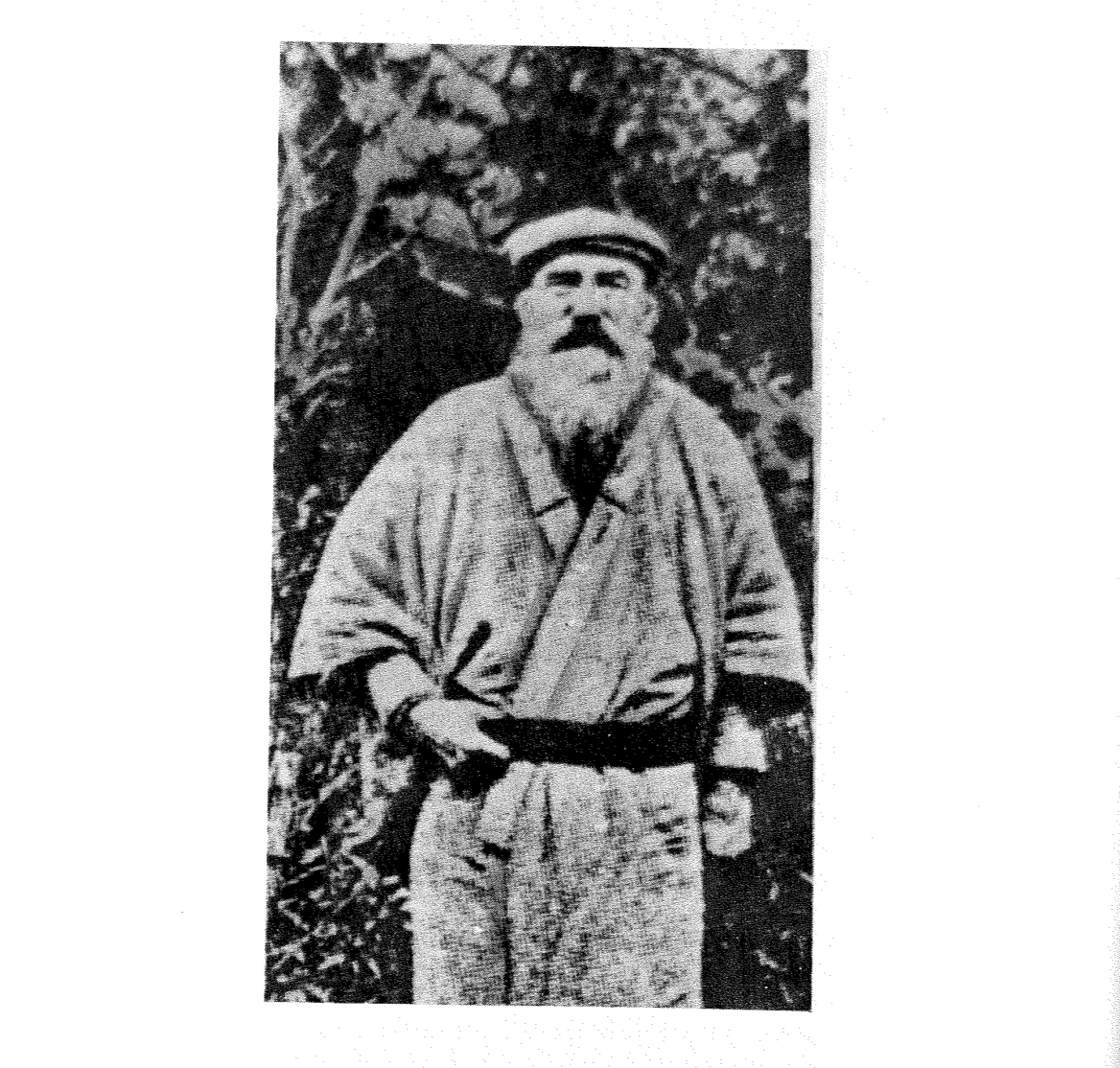
The era, the work, the loves, the life and death of Wenceslau de Moraes, great Portuguese writer of the Far East, born in Lisbon in 1854, who died at Tokushima in souther Japan in 1929.
1885 - a Voluntary exile, the young writer, a Naval officer stationed in Mozambique, Moraes visits Portugal to see his sister, Francisca, his mistress, Isabel, and her husband, an invalid painter. They pose for a painting on the then fashionable theme: “The Island of Loves,” an allegory on “Venus leading Vasco de Gama to India.”
1891 - the monarchy is tottering, Moraes breaks with his mistress and leaves for Macao. He will Never return.
1895 - in Macao, he becomes friendly with Camilo Pessanha, a great Symbolist poet, addicted to opium and also an exile. Fascinated by Japan, Moraes leaves southern China, his Chinese wife, Atchan, and his two children.
1912 - while the republic is proclaimed in Portugal, and while Isabel fights with her husband, Moraes lives and writes at Kobe, in southern Japan, where he is the Portuguese consul. He has a Japanese wife, O-Yone. He is pursued by the vision of Isabel-Venus.
1913-1916 - deeply upset by O-Yone’s death, he resigns his post as consul and goes to live, as if he were an impoverished Japanese, near O-Yone’s tomb, in the small town of Tokushima. He plans to devote himself entirely to his writing, but he falls tragically in love with O-Yone’s young niece, Ko-haru. The war in Europe becomes Morae’s new obsession. Torn between the fathers of her two children, her young lover Asataro and the elderly foreigner, Ko-haru soon dies of phthisis, despite all Moraes’ efforts to save her.
1916-1920 - with his kimono in rags, a straggly beard, lonely, Moraes becomes an almost ghostlike old man, lost in the contemplation of nature, wandering at night near O-Yone and Ko-haru’s tombs. He writes the books of his last period: The Dance of the Dead of Tokushima and O-Yone and Ko-haru. His literary fame continues to grow in Portugal, where Francisca, his sister, Isabel and the painter wonder about him.
1929 - Moraes dies in somewhat strange circumstances: suicide, murder, accident?
WHY THE TITLE THE ISLAND OF LOVES?
It is the best known chapter of the epic poem Os Lusiadas by Luiz de Camoes, the great Portuguese poet (he wrote in the 16th century). The chapter is devoted to Vasco de Gama, who led by Venus, discovers the route to the Orient and arrives at the Island of Loves, where the goddess shows him the secrets of the past and the future, the structure of the universe, of wisdom and love.
This theme has had a tremendous influence on my country, particularly in times of national crisis.
In Moraes’ youth, during the Romantic movement, a feverish “return to Camoes” took place: poetry, architecture, painting, Camoes became the main symbol in the struggle for the founding of the Republic.
In 1891, England sent Portugal an “ultimatum” about Rhodesia, represented in pink on geographical maps. It is the “pink map” incident, which shook the country and was to lead to the fall of the monarchy: demonstrators covered Camoes’ statue with mourning veils. The future national anthem was composed and June 10th, date of Camoes’ death, was chosen as the National holiday. According to tradition, Camoes wrote part of his poem in a grotto at Macao, on the south coast of China. This film is dedicated to all the great Portuguese writers who have lived in the Orient since the 16th century. Pessanha and Moraes are the last of a long line of extraordinary people.
PORTUGUESE CINEMA
When, in about 1963-64, I made my first film The Green Years, Portuguese cinema, after a brilliant period of popular comedies in the 30s, was dying: there were neither technicians, nor actors, neither equipment nor audience.
Apart from the solitary work of Oliveira in Porto in the north, it was a desert. With the help of A. Telles and M. Lopes a “new cinema” began.
Little by little, technical crews and groups of actors established themselves. Manoel de Oliveira came down to film in Lisbon, and with the help of Gulbenkian and the state, five or six young directors started to make astonishing films.
“Artisinal,” anarchistic, and visionary, Portuguese cinema today is a very strange case in the panorama of world cinema.
THE CORNUCOPIA COMPANY
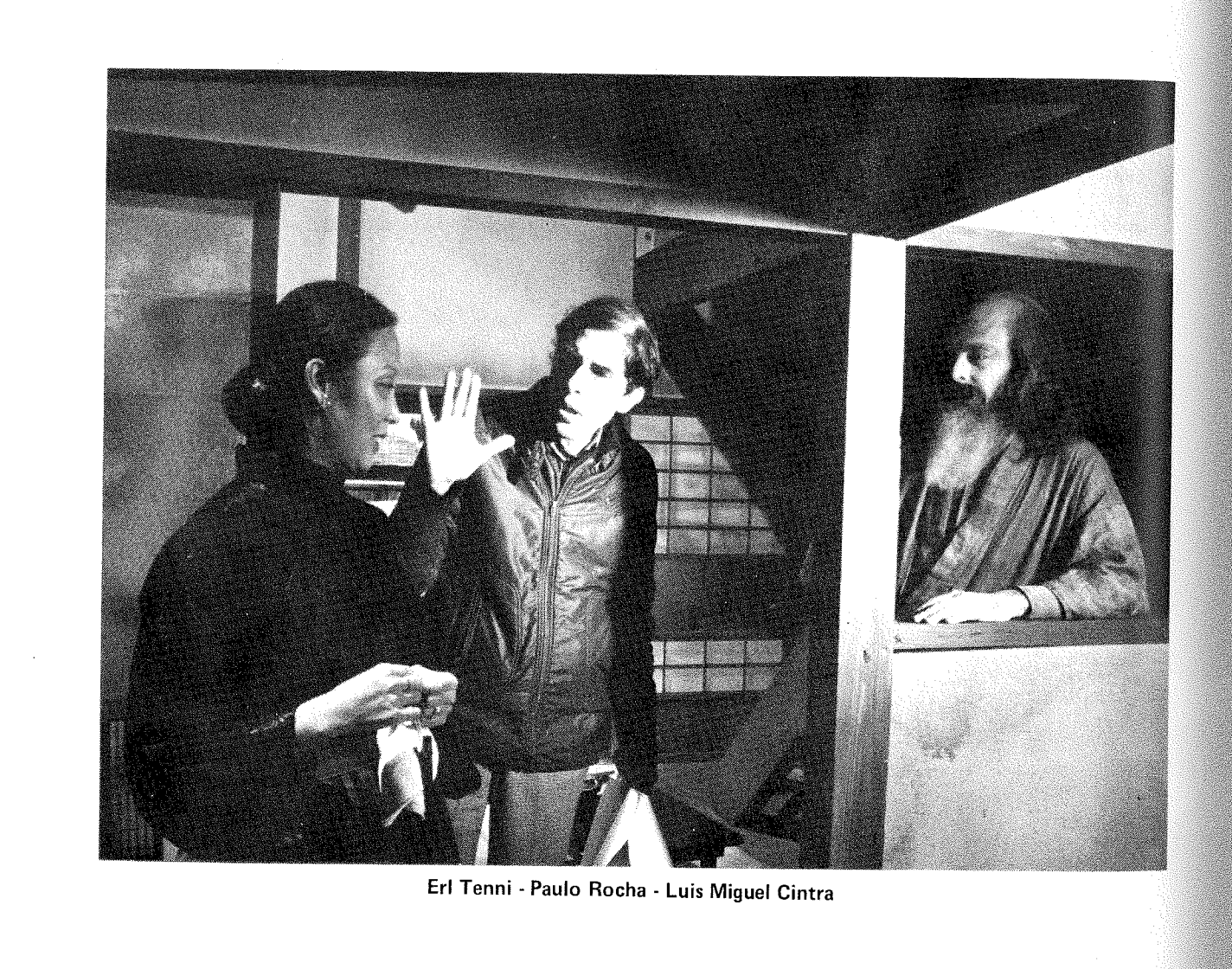
In 1970-71 I made a short film The Inn of Wounds, which was to be the basis for numerous ideas later developed in The Island of Loves: collage of texts, musical recitatives, medieval and Japanese theatrical influences, transformation of real decors into “stages” or “altars”… I have also retained the idea of a “primeval couple” and its actors Luis Miguel Cintra and Clara Joana. Cintra was then 20, and together with Jorge Silva Melo, who was the same age, they founded the Cornucopia, a theatrical group which won immediate recognition for its unforgettable productions of Cervantes, Marivaux…
With Cristina Reis’ arrival, Cornucopia started using enormous, very inexpensive and wonderfully beautiful decors: Brecht, Karl Valentin, Büchner… The decors for Horvath’s Tales from the Vienna Woods, for example, were over 60 meters in depth!
With the exception of Clara Joana and myself, all the artistic participants, on the Portuguese side, come from Cornucopia: screenplay, music, costumes, decors, actors…
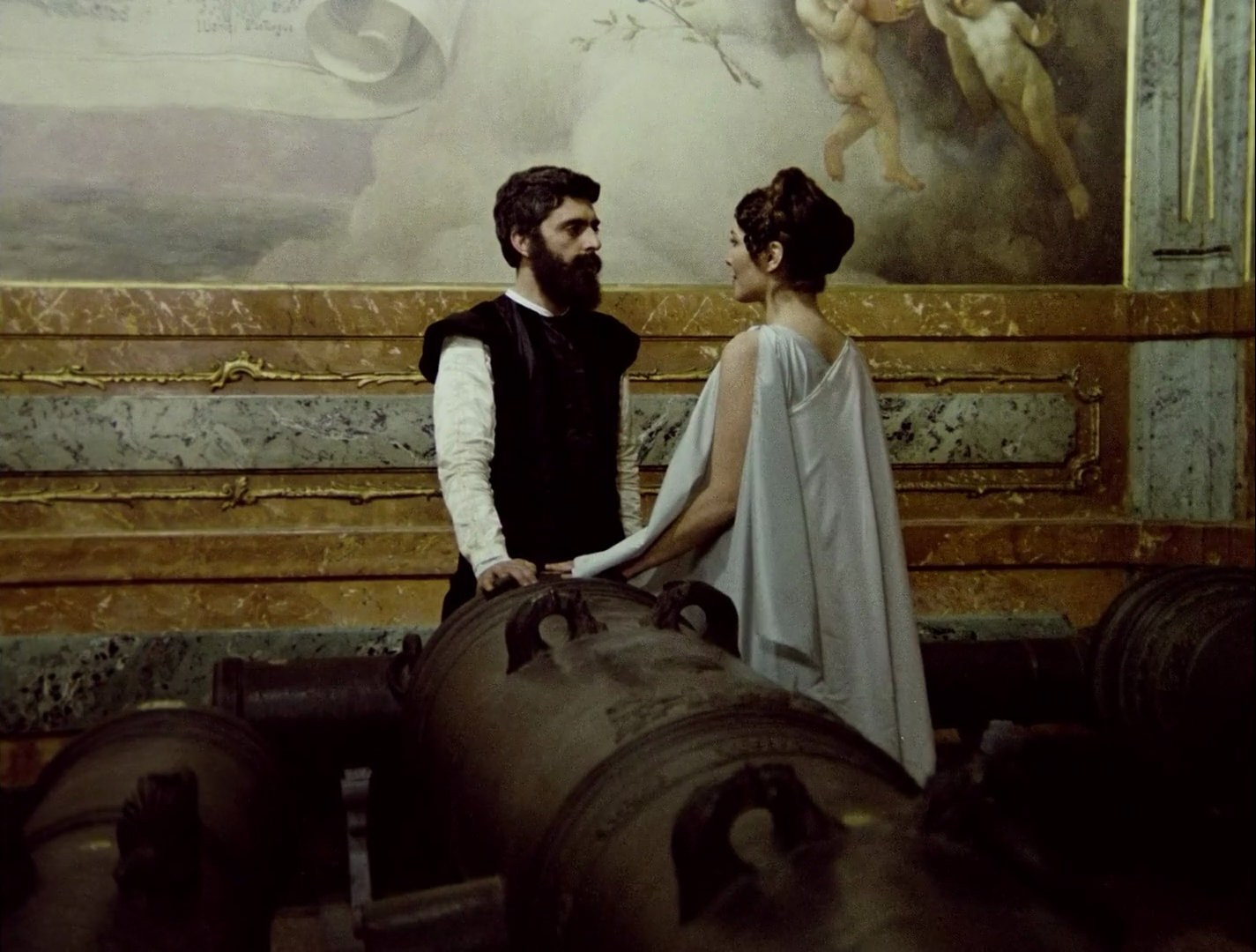
THE ACTORS, THE COMPOSER, THE DIALOGIST
Luis Miguel Cintra : the actor who portrays Moraes is only 31, but he is already considered the foremost actor and the best theatrical director in Portugal. Cintra achieved the feat of learning by heart every evening after shooting, the Japanese dialogue of the film, words, accent and rhythm.
Jorge Silva Melo : the actor who portrays the painter in the film, was for a long time the main director of the Cornucopia. A disciple of Peter Stein, he has produced the major works of the German theatre. He is now a film director: A Passagem (The Life of Büchner).
Paulo Brandao : a young, enthusiastic, internationally renowned avant-garde composer. For the past five years he has been composing stage music for the Cornucopia.
Luiz Neto Jorge : is one of the great, modern Portuguese poets. His dialogues for The Island of Loves required a year of intensive work. Each sequence is written in a different style according to the period: naturalistic, Romantic, realistic-mondain, Symbolist, music-hall, etc, with some striking collages.
CHU-YUAN AND THE NINE SONGS
The film is divided into nine chapters, corresponding to nine songs by Chu-Yuan, the oldest poet of Chinese literature. Chu-Yuan, a prime minister who had fallen into disgrace, he threw himself into a river as a protest against the courtesans who were betraying his country.
His death is still commemorated in the Far East with the festival of “Dragon Boats” and lights floating at night on water to guide his Spirit. He is until today the centre of countless movements and the subject of debates. During the Cultural Revolution it was even suggested that Confucius be replaced by Chu-Yuan. The Nine Songs is his best known collection of poems. Exiled to a barbarous region, he collected shamanistic poems about the doomed loves of humans and Spirits, and about journeys into space necessary for these brief encounters.
The songs correspond to the ceremonies sung, mimed and danced on stages to appease the Spirits and the Gods. They resemble early Japanese forms of theatre, as well as The Dance of the Dead of Tokushima, Moraes' outstanding book.
FOURTEEN YEARS…
It all began about 1967. After presenting my second film Mudar de Vida (Change of Life) in Venice, I felt the need to make a film in the Far East. Since the 16th century Asia has played a very important part in the collective imagination of my country. Camoes, our greatest poet, from whose work I’ve taken the title of this film, wrote and traveled there between 1553 and 1567, as did Fernao Mendes Pinto, adventurer and author of Peregrinaçao. There were many others, less famous, but quite as fascinating. At the end of the 19th century, came Camilo Pessanha, one of my favourite poets (in the film I play his part), and his friend Wenceslau de Moraes, the last great writers of this exceptional line.
Previously I had wanted to make a film about the introduction of firearms to Japan in 1542, based on Pinto’s firsthand testimony in Peregrinaçao. It was a very beautiful screenplay, but an extremely expensive project. Once in Tokyo, and after numerous dramas, I had to give it up. It was then, in the south of Japan, that I discovered Moraes, the man, his books, his loves, the places in which he had lived… Mozambique, Macao…
At that time I did not imagine that this film was going to eat up fourteen years of my life. Fourteen years of traveling, of successful and unsuccessful projects, of disappointments, of promises and refusals. My friends were very shocked that after having become a reputable director in Portugal, who won prizes in festivals and whose films were shown abroad, I should stop filming and spend so many long years pursuing an impossible and dangerous dream.
During these fourteen years I could easily have made four or five films in Portugal. Little by little The Island of Loves became my obsession.
The screenplay, as it is now, has remained unchanged since 1970-71. Many of the most complicated shots were already drawn up in my notebooks at that time.
In recent years, my work has been more concerned with a maturing and a deeper understanding of each shot. I thought about the film unendingly, as if it were a riddle that had to be solved. Numerous shots and superfluous details disappeared. But the “difficult” shots, which frightened me, all remained until the shooting. Simplified, made clearer, with a continuity that rejects editing effects, prevents camera movements, and unites very basic elements.
FILMING IN JAPAN
Filming in Japan frightened me. So many foreign films made in Japan end up with ulcers and promises of “Never again!”. The world of Japanese cinema is a closed on with clear-cut rules: politeness, professional hierarchy, technical and artistic convention, etc… all very different from ours. The golden age of Japanese cinema has passed, it has become a world of superb, proud and embittered professionals, forced to carry out money-making jobs against their will. Having very little money, a screenplay that was difficult to explain, the filming of The Island of Loves presented desperate difficulties. After several years of struggling, I was lucky: two of my films were shown in the best cinema in Tokyo, and received good reviews. From then on, I was able to make up a top quality crew, who worked without remuneration, and who agreed to shoot very quickly. In 18 days, we had more than two hours of film, despite the complexity of most of the shots. For three or four months, I had given complete precisions on all details of the film, which was prepared like a commando operation.
This filming took place in a magical atmosphere: without apparent effort, in silence, communication reduced to a nod of the head. It was a flexible team, almost feline, sensitive to catching the slightest nuance, requiring no explanations: a mixture of perfection and spontaneity, of strength and lightness—purely Japanese qualities—mysterious result. Never in my life have I felt freer.
Total absorption in its work of a whole crew who had become transparent, aerial, silent. Now that all this has become a thing of the past, I believe the opportunity to be accepted into the heart of artistic creation in Japan, into a traditional, craftsman’s environment, will remain one of the best memories of my life. I have now forgotten the long years of learning Japanese, and Japanese conventions.
THE DIRECTOR OF PHOTOGRAPHY
AND THE JAPANESE ACTORS
Kozo Okasaki : one of the greatest cameramen in the history of Japanese cinema. He began his career with The Saga of Anatahan, von Sternberg’s last film, made in Japan just after the war. Since then he has worked with most of the leading Japanese directors.
Takashi Koizumi : has worked exclusively for the last years as first assistant and co-screenplay writer for Akira Kurosawa (Kagemusha). The Island of Loves is the first film he has worked outside the “Kurosawa family.”
Yoshiko Mita : who plays the part of O-Yone, is one of Japan’s leading stage, screen and television actresses.
Atsuko Murakumo : who plays the part of Ko-haru, makes her first screen appearance in this film.
Jun Toyokawa : also appears on the screen for the first time in the role of the lover, Asataro, he is the foremost actor in Japanese avant-garde theatre.
x