Love is Strong as Death: The Aesthetic Ideas of Luis Alberto Álvarez
Andrés Upegui Jiménez, 2016
Translated by Andrew Castillo
The following essay was written by Andrés Upegui Jiménez for the twentieth anniversary of Fr. Luis Alberto Álvarez’s (1943 - 1996) death. Jiménez is a filmmaker, lawyer, amateur philosopher, and a friend and collaborator of the late Fr. Álvarez. From 1980 - 1983, he worked as Víctor Gaviria’s editor, producer, and assistant director on his early films, including Buscando tréboles, La vieja guardia, and Los Habitantes de la noche.
This piece was originally published by Pedro Adrián Zuluaga on his blog Pajarera de medio. It appears here in a new English translation by writer, teacher, and programmer Andrew Castillo.
This translation accompanies Love is Strong as Death: Luis Alberto Álvarez & Víctor Gaviria, a four-film program taking place at Light Industry on October 18, 2026.
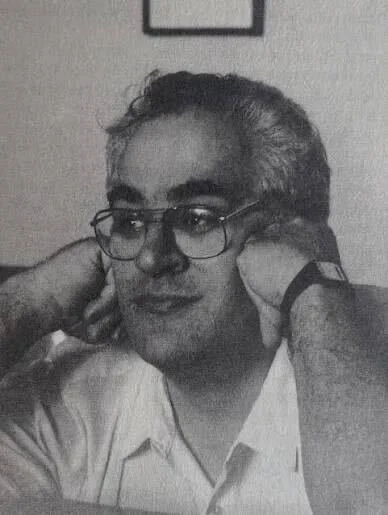
Fr. Luis Alberto Álvarez
“Preaching Christianity does not require speaking about it, but speaking from it.”
Nicolás Gómez Dávila
In his critical texts, Luis Alberto Álvarez (1945 - 1996) abandons the traditional manner in which the Catholic Church approached the cinema. This was a confessional, penitent and moralistic approach; it focused on discerning which directors or films were approved or disapproved, and which ones conformed to pre-established moral and aesthetic canons (what I would call a censorship regime).
In a world where the majority is Christian, it is reasonable to appeal to institutional prestige or the rule of authority, to assure certain statements are accepted as truths; however, in a world that is no longer Christian, in which there exist religious pluralism and anti-Christian positions, even among the majority, the most appropriate way to speak about the truth of Christ is to dispense with confessional or authoritative statements that only affect Christians. The best course then is to go to the things themselves, phenomenologically, and see what is true and what is not, regardless of whether it coincides with a pre-established message. This way of seeing things is also fundamental because it opens a bridge to non-Christian worldviews, to the ecumenical vision that LAA so often spoke of.
He was very clear that Christ’s message is not true because Christ says it, but rather, Christ says it because it is true. The truth, the authenticity and authority of the truth, is born from the things themselves, not from the person who speaks it. The problem of truth is therefore not based on a principle of institutional authority or on the eminence of an individual, nor on whether a Christian or the Bible declare it is true; on the contrary, it is because it is true that a Christian or the Bible declare it. The truth is true regardless of whether it is spoken by Agamemnon or his swineherd, Antonio Machado would say. [1] Truth, like grace, is similar to the wind: it blows where it pleases.
I wanted to ask myself what this truth is that LAA spoke of in his writings about cinema.
Simply put, I believe that this truth is the love of reality, especially love of the human person, and I believe that this love is redemptive. Ultimately, as the Song of Songs says, I believe that LAA’s message is that “love is strong as death.” [2]
I will briefly try to explain and demonstrate this: firstly, let’s ask ourselves, what is the idea of love that is implicit in LAA? I think his idea of love is the same as that of truth: love is the acceptance of things as they are. But an acceptance or recognition that is joyful, zealous, awed. Love is the fascination with being, for reality; it is to rejoice that all things are and exist. Love is the rejection of nothingness and nihilism.
Secondly, it has been said that LAA was first and foremost a humanist; this is correct, but I think a distinction needs to be made here. Love for humanity, for man in general, is a very poor love because humanity and man are abstract and imprecise concepts that have no basis in anything or anyone. While love of the person is above all emotional, a joyful and enthralled acceptance of someone’s being is concrete and determined. It is not the love of a concept but of a concrete, particular image, one that also moves in time and space; it is the love of a moving image.
So then, what are the parameters within which that love is given to a person? A person is an open totality. A being in motion that begins at infinity and returns to the same infinity, from before birth to after death. A person is also an integral whole; that is to say that he is not a spiritual or materialist whole, not the negation of matter and the body, nor the negation of spirit or its subordination to matter. A person understands all, its physical life as well as its metaphysical life. It comprehends all its actions, its behavior, can fall either way in its ethical conduct. It also understands all its physical and mental particularities, its racial character, age, ideology, nationality, social class, natural and intellectual integrity.
As such, any kind of dehumanization or attempt at depersonalization, any claim against the totality and integrity of the person in the aforementioned sense was rejected and reviled by LAA. Any desire or attempt to exalt one type of person to the detriment of another, any biased consideration of a person, any valorization of inhuman qualities, any exaltation of irrational, base, deathly forces, any spiritualization, purism or spiritual mystification of any sort that did not account for material or physical reality - he rejected them all.
Love of the person is also the overcoming of all egotism, love for the Other, the acceptance of difference. The more different the Other, the more obliged one is to love. That is, the more different and contrary the Other is, the more love imposes itself on us. Thus why Chesterton said that love of neighbor is exactly the same as love of enemies, because our true enemy is always our neighbor. [3]
Next to this (loving) consideration of the person, LAA saw in love a force, a redemptive power. He saw how it allowed the person who had descended to hell to rise, first to the earthly physical reality of the human, then into position to ascend to a metaphysical, transcendental, absolute plane. Hence, this ascension from evil, from faults, weaknesses, defects, discriminations and injustices had for him a redemptive, metaphysical nature, even beyond death. Like St. Paul, LAA firmly believed that, where sin abounds, grace abounds much more. [4]
He understood this redemptive nature of love in the Pauline sense of resurrection. [5] That is, a redemption both physical and metaphysical, material as well as spiritual. Physical in the sense that not only the spirit is redeemed, but also the matter, the body. Because the idea of redemption as resurrection begins with the consideration of the person as an integral substance of body and soul. A person is neither matter thrown into infinity without reason, nor pure spirit that can do without matter. To each individual and personal body corresponds an equally individual and personal soul, unique and irreproducible. That is why neither reincarnation nor cloning is allowed. My body only “fits” my soul, there can be no other body other than mine in which my soul can be “reincarnated.” We will be raised with the same physical body and the same individual soul, said St. Paul.
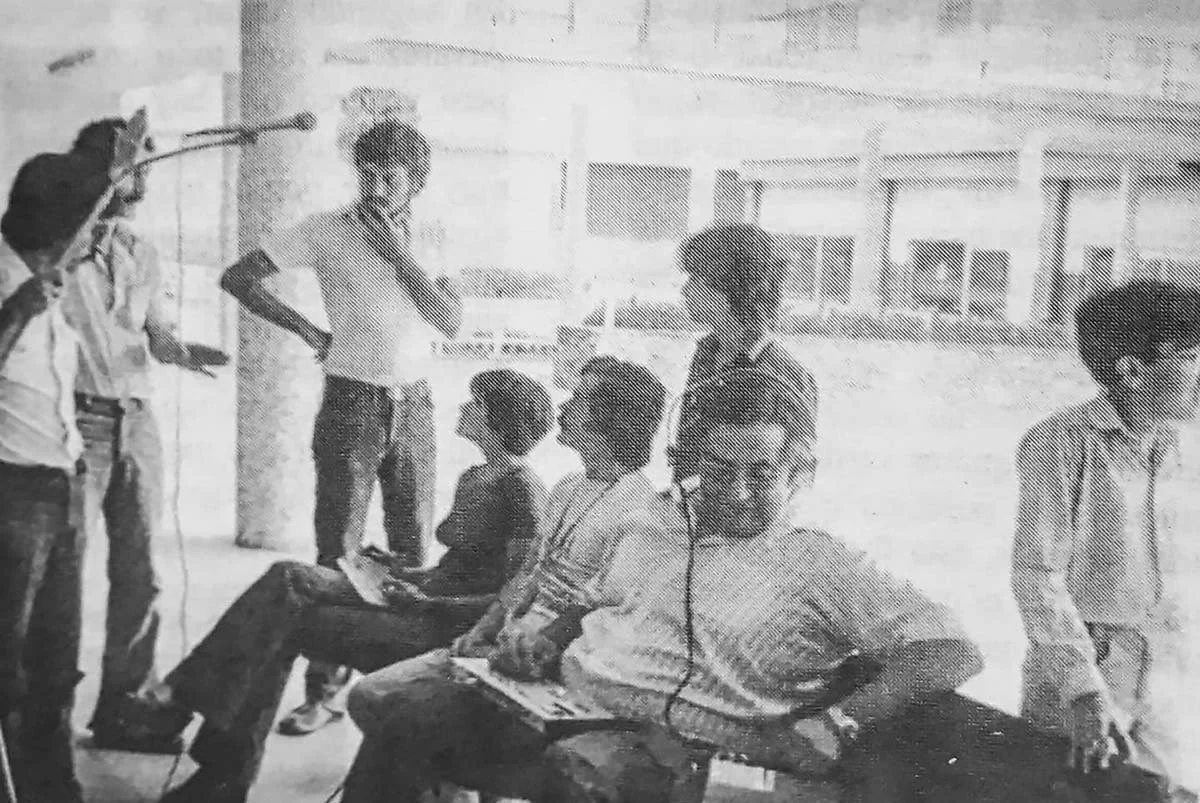
Fr. Luis Alberto Álvarez (with headphones) as sound recorder on Víctor Gaviria’s La lupa del fin del mundo (1980). Andrés Upegui Jiménez is in the background (third from the left) with Gaviria on his right.
Finally, we ask ourselves, how does all the above translate into cinematic terms?
Love for reality and the person is love not only for divine creation, the universe, the cosmos, but also love for human creation. Especially for that creation that is not utilitarian, but rather contemplative. I am referring not to artisanal or industrial creations, but to artistic creation. Art manifests and expresses being, reality as it is. Art is therefore the manifestation and expression of love, as I have considered it. Now, there is a special art form in which LAA was able to see, more so than in others, that loving manifestation. That art form was cinema.
I would say that LAA was a dogmatist of the so-called theory or politics of the auteur, a devotee of auteurist cinema. The auteur theory is the personalization of art, is seeing art from the fundamental and central reality of the person. Cinema expresses the reality of the human person through the creation of characters. LAA enjoyed seeing how, in films, auteurs expressed themselves through their characters, and how those characters, in turn, expressed the auteurs. But not in biographical terms, as in all things show business related, but rather how that person is reflected in the work, what he called the unique and loving perspective on reality. LAA would then always look for the personal and unique gaze of each auteur. An auteur was, for him, one who reflected their own particular gaze through that affection or love for the real.
He did not care for impersonal artists, those without their own perspectives, or those who had one but did not reveal any affection for the real. That is to say, he appreciated the method, the personal way in which reality was viewed; this is why he never tired of repeating that, for him, the how was always more important than the what.
Furthermore, this gaze should not only be compassionate and tolerant of human drama and tragedy, of all its adversities, but also redemptive. He advocated for a loving treatment of characters, one that understands all their facets, and what he called three-dimensional characters; he did not like the one-sided Manichaeism of the all-good heroes or all-bad villains, preferred tragic heroes, at once good and bad, heroes fallen and raised up again thanks to love.
Thus he rejected the gaze that was cynical, ironic, demeaning or decadent, that was nihilistic or would revel in human wickedness. That is why, even more than an impersonal cinema without little authorial character - which he called artisanal - what he rejected was an auteurist cinema that had a dehumanized and depersonalized view, in the sense that we’ve been discussing. He disliked auteurs who, as mentioned before, depicted the person as a victim of dark, inhuman, irrational, deathly forces, or alienated characters, subject to problems other than personal ones. On that contrary, what he valued and appreciated the most was how they escaped and redeemed themselves through love.
In conclusion, LAA liked films with a Dantesque structure. By this term, I don’t mean to refer to horror films, but to cinema with a Christian structure; films that show a journey that departs from the depths of hell, but, thanks to the flames of love, ascends to purgatory where all evil is purified, preparing one for the glorious ascent to heaven.
xx
1 | A reference to Antonio Machado’s 1936 work, Juan de Mairena (sentencias, donaires, apuntes y recuerdos de un profesor apócrifo).
2 | Paraphrases the Bible’s Song of Solomon 8:6 (also referred to as Song of Songs): ”for love is strong as death; jealousy is cruel as the grave; the coals thereof are coals of fire, which hath a most vehement flame.”
3 | G.K. Chesterton - “The Bible tells us to love our neighbors, and also to love our enemies; probably because generally they are the same people.”
4 | Romans 5:20: “But where sin increased, grace increased all the more.”
5 | Elsewhere in the book of Romans, St. Paul discusses the spiritual and physical question of resurrection.